JETem
  • Home
  • About
    • Aim and Scope
    • Our Team
    • Editorial Board
    • FAQ
  • Issues
    • Current Issue
    • Ahead of Print
    • Past Issues
  • Visual EM
    • Latest Visual EM
    • Search Visual EM
    • Thumbnail Library
  • For Authors
    • Instructions for Authors
    • Submit to JETem
    • Photo Consent
    • Policies
      • Peer Review Policy
      • Copyright Policy
      • Editorial Policy, Ethics and Responsibilities
      • Conflicts of Interest & Informed Consent
      • Open Access Policy
  • For Reviewers
    • Instructions for JETem Reviewers
    • Interested in Being a JETem Reviewer?
  • Topic
    • Abdominal/Gastroenterology
    • Administration
    • Board Review
    • Cardiology/Vascular
    • Certifying Exam Cases
      • Clinical Decision-Making
      • Prioritization
      • Communication
      • Procedure & Ultrasound
    • Clinical Informatics, Telehealth and Technology
    • Dermatology
    • EMS
    • Endocrine
    • ENT
    • Faculty Development
    • Genitourinary
    • Geriatrics
    • Hematology/Oncology
    • Infectious Disease
    • Miscellaneous (stats, etc)
    • Neurology
    • Ob/Gyn
    • Ophthalmology
    • Orthopedics
    • Pediatrics
    • Pharmacology
    • Procedures
    • Psychiatry
    • Renal/Electrolytes
    • Respiratory
    • Social Determinants of Health
    • Toxicology
    • Trauma
    • Ultrasound
    • Urology
    • Wellness
    • Wilderness
  • Modality
    • Certifying Exam Practice Cases
      • Clinical Care Cases
      • Communication & Procedural Cases
      • Old School Oral Board Cases
    • Curricula
    • Innovations
    • Lectures
    • Podcasts
    • Simulation
    • Small Group Learning
    • Team Based Learning (TBL)
    • Visual EM
  • Contact Us

Photograph

Creative Commons images

Dorsally-Displaced Metacarpal Dislocation-Fracture

Richard Barnett, DO* and Richard Brodsky, MD*

DOI: https://doi.org/10.21980/J8ZW54Issue 3:3[mrp_rating_result]
A two-view radiograph of the right hand was obtained which revealed a dorsal dislocation of the distal fourth and fifth metacarpals (see red and blue outline, respectively) with a concomitant fracture of the distal fifth metacarpal (see yellow line) and avulsion fracture of the lateral aspect of the hamate (see green line). After reduction the fourth and fifth metacarpal dislocations are resolved; however, the distal fifth metacarpal fracture (yellow line) and avulsion fracture of the lateral aspect of the hamate (green line) are still visible.
OrthopedicsVisual EM
Creative Commons images

Woman Swallows a “Handful of Pills”

Sarah E Mott, MD*, Michael Paddock, DO, MS*^ and Jessie Nelson, MD*^

DOI: https://doi.org/10.21980/J8V64XIssue 3:3[mrp_rating_result]
Soft tissue lateral X-ray of neck was performed. The lateral soft tissue X-ray of the neck showed a metallic foreign body at the level cricoid.
Abdominal/GastroenterologyVisual EM
Creative Commons images

Traumatic Hyphema

James Roy Waymack, MD* and Mark Baker, MD*

DOI: https://doi.org/10.21980/J8Z04SIssue 3:3[mrp_rating_result]
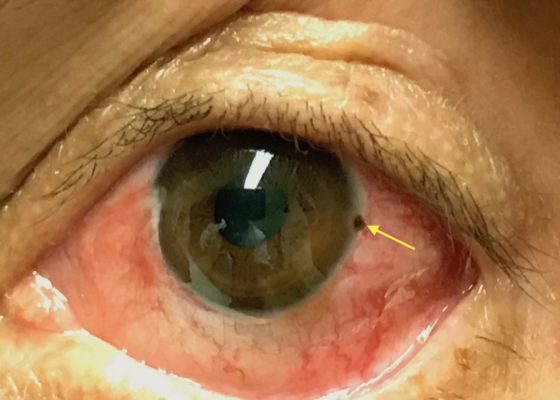
Upon initial evaluation, the patient had an obvious hyphema in the right eye with associated conjunctival injection. Initially, the bleeding in the anterior chamber was cloudy just above the level of the pupil (yellow arrow), appearing to possibly be a grade II hyphema. There were no other signs of trauma to the eye under Wood’s lamp examination with fluorescein staining. The globe was intact. Intraocular pressure in the affected eye was 19 mmHg and 15 mmHg in the unaffected eye. Extraocular movements were full and intact. The pupil was 4 mm round and reactive to direct and consensual light. Visual acuity was greater than 20/200 in the affected eye compared to 20/25 in the unaffected eye. After an observation period of two hours, with the patient remaining upright, the hyphema had settled down to a rim in the lower anterior chamber (green arrow), a grade I hyphema.
OphthalmologyVisual EM
Creative Commons images

An Unusual Case of Pharyngitis: Herpes Zoster of Cranial Nerves 9, 10, C2, C3 Mimicking a Tumor

Jason Cheng, DO*, Gregory Reinhold, DO* and Rahmon Zuckerman, DO*

DOI: https://doi.org/10.21980/J8B05K Issue 3:2[mrp_rating_result]
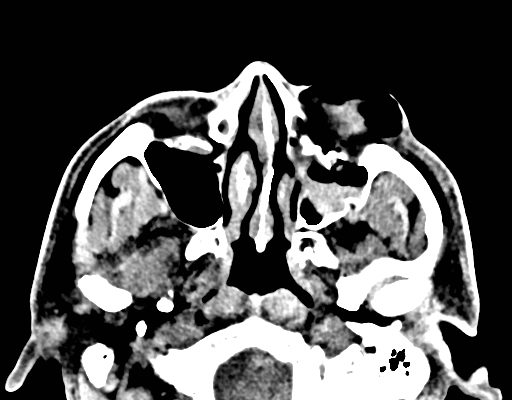
On exam, the patient was sitting upright while holding an emesis basin filled with saliva. His voice was noticeably hoarse. Examination of the head and neck revealed vesicular eruptions on the left scalp in the V1 dermatome and on the left mastoid process (Images 1 and 2). Physical exam also shows vesicular eruptions on the left posterior oropharynx that did not cross midline (Image 3).
ENTVisual EM
Creative Commons images

Ramsay Hunt Syndrome

John Costumbrado, MD, MPH* and Ryan Brenchley, MD*

DOI: https://doi.org/10.21980/J85S7QIssue 3:2[mrp_rating_result]
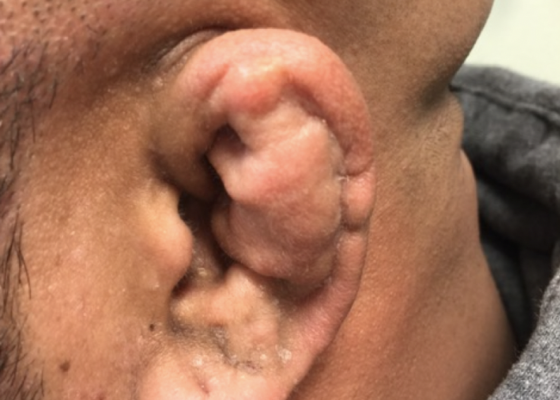
Left-sided cranial nerve VII palsy with flattened forehead creases, inability to keep the left eye open, and drooping of the corner of mouth. Vesicular lesions were found in and posterior to the left ear in a unilateral, dermatomal distribution.
ENTVisual EM
Creative Commons images

Herpes Zoster Ophthalmicus

Shayna Adams, BS* and Darren Knight, MD^

DOI: https://doi.org/10.21980/J88H07 Issue 3:2[mrp_rating_result]
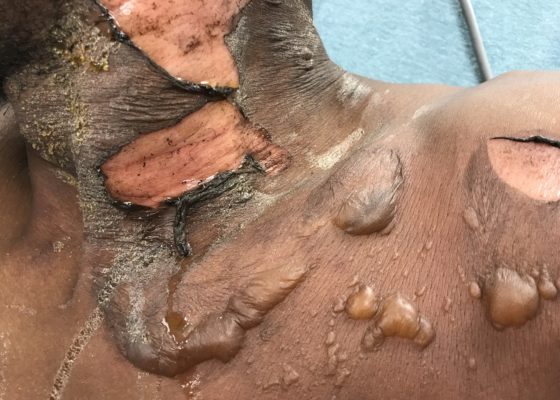
Physical exam was significant for an erythematous maculopapular rash in the right ophthalmic nerve (V1) region, a crusted vesicle at the right upper eyelid, and surrounding eyelid edema. Visual acuity remained at baseline and intraocular pressure was within normal limits. External slit lamp exam with fluorescein staining was remarkable for pseudodendrites in the inferior-temporal cornea approximately 1.5 mm from the limbus. Ophthalmology was consulted and completed an in-depth evaluation of the corneal lesions. They found no evidence of anterior chamber reaction and performed a complete dilated fundus examination which demonstrated no retinal involvement. The patient was then discharged on acyclovir and erythromycin ointment with close follow-up.
OphthalmologyVisual EM
Creative Commons images

Radial Nerve Palsy

Richard Barnett, DO* and Amy Church, MD*

DOI: https://doi.org/10.21980/J8KS7F Issue 3:2[mrp_rating_result]
On physical exam, the patient was unable to extend his right wrist, thumb, and fingers, and had no sensation of his 1stdorsal interosseous muscles up to the proximal dorsal radial aspect of his forearm. The patient also had slight weakness in thumb abduction. Triceps strength was preserved.
NeurologyVisual EM
Creative Commons images

Rare Rapidly Growing Thumb Lesion in a 12-Year-Old Male

Alana J Arnold, MD, MBA*

DOI: https://doi.org/10.21980/J8B92J Issue 3:2[mrp_rating_result]
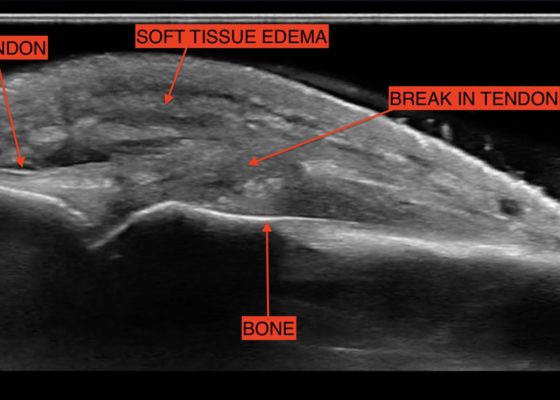
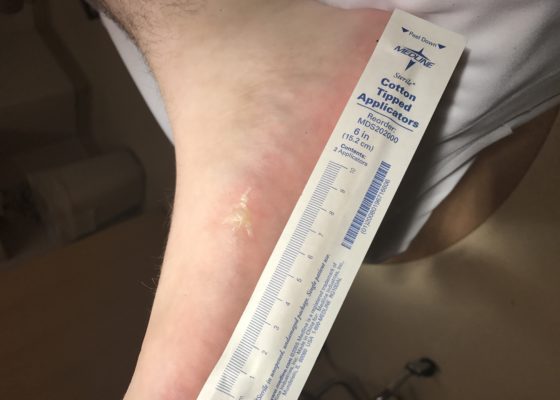
History of present illness: A 12-year-old male presented to the emergency department with right thumb pain and a mass for four months (see images). He denied fevers, chills, change in appetite, or fatigue. He noted that the lesion was growing and “bleeds easily if bumped.” He denied any trauma to the thumb, except “hitting it” months ago while in football
Hematology/OncologyOrthopedicsVisual EM
«‹8›»
Page 8 of 16

JETem is an online, open access, peer-reviewed, journal-repository for EM educators. We are PMC Indexed.

Most Viewed

  • Enhancing Emergency Medicine Resident Education: A Weekly Education Series to Augment Electrocardiogram Education
  • Development and Design of a Pediatric Case-Based Virtual Escape Room on Acute Iron Toxicity
  • Pre-Clinical Case Competition to Assess Confidence in Responding to Select Out-Of-Hospital Medical Emergencies
  • Pediatric Difficult Airway Simulation Day
  • Cards Against Pulmonology

Visit Our Collaborators


Creative Commons Licence
This work is licensed under a Creative Commons Attribution 4.0 International License.

About

Education

Learners should benefit from active learning. JETem accepts submissions of team-based learning, small group learning, simulation, podcasts, lectures, innovations, curricula, question sets, and visualEM.

Scholarship

We believe educators should advance through the scholarship of their educational work. JETem gives educators the opportunity to publish scholarly academic work so that it may be widely distributed, thereby increasing the significance of their results.

Links

  • Home
  • Aim and Scope
  • Current Issue
  • For Reviewers
  • Instructions for Authors
  • Contact Us

Newsletter

Sign up to receive updates from JETem regarding newly published issues and findings.

Copyright Creative Commons Attribution 4.0 International