
Photograph
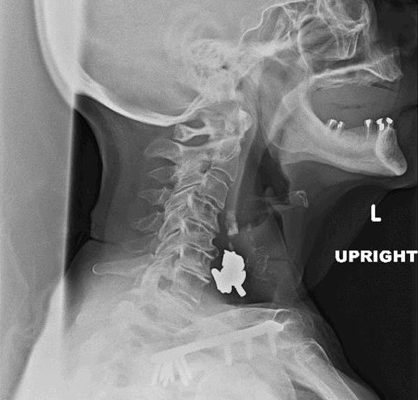

Woman Swallows a “Handful of Pills”
DOI: https://doi.org/10.21980/J8V64XSoft tissue lateral X-ray of neck was performed. The lateral soft tissue X-ray of the neck showed a metallic foreign body at the level cricoid.
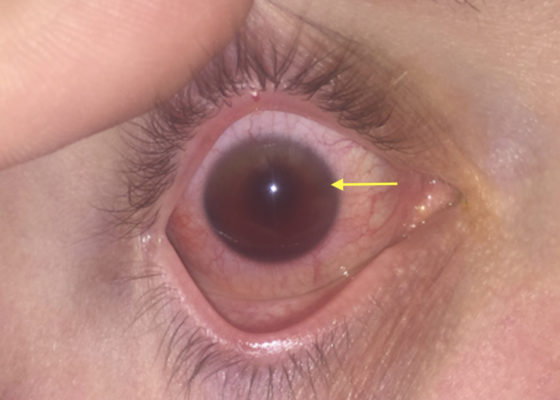
Traumatic Hyphema
DOI: https://doi.org/10.21980/J8Z04SUpon initial evaluation, the patient had an obvious hyphema in the right eye with associated conjunctival injection. Initially, the bleeding in the anterior chamber was cloudy just above the level of the pupil (yellow arrow), appearing to possibly be a grade II hyphema. There were no other signs of trauma to the eye under Wood’s lamp examination with fluorescein staining. The globe was intact. Intraocular pressure in the affected eye was 19 mmHg and 15 mmHg in the unaffected eye. Extraocular movements were full and intact. The pupil was 4 mm round and reactive to direct and consensual light. Visual acuity was greater than 20/200 in the affected eye compared to 20/25 in the unaffected eye. After an observation period of two hours, with the patient remaining upright, the hyphema had settled down to a rim in the lower anterior chamber (green arrow), a grade I hyphema.
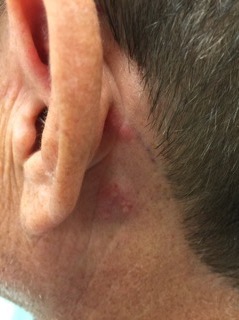
An Unusual Case of Pharyngitis: Herpes Zoster of Cranial Nerves 9, 10, C2, C3 Mimicking a Tumor
DOI: https://doi.org/10.21980/J8B05KOn exam, the patient was sitting upright while holding an emesis basin filled with saliva. His voice was noticeably hoarse. Examination of the head and neck revealed vesicular eruptions on the left scalp in the V1 dermatome and on the left mastoid process (Images 1 and 2). Physical exam also shows vesicular eruptions on the left posterior oropharynx that did not cross midline (Image 3).

Ramsay Hunt Syndrome
DOI: https://doi.org/10.21980/J85S7QLeft-sided cranial nerve VII palsy with flattened forehead creases, inability to keep the left eye open, and drooping of the corner of mouth. Vesicular lesions were found in and posterior to the left ear in a unilateral, dermatomal distribution.

Herpes Zoster Ophthalmicus
DOI: https://doi.org/10.21980/J88H07Physical exam was significant for an erythematous maculopapular rash in the right ophthalmic nerve (V1) region, a crusted vesicle at the right upper eyelid, and surrounding eyelid edema. Visual acuity remained at baseline and intraocular pressure was within normal limits. External slit lamp exam with fluorescein staining was remarkable for pseudodendrites in the inferior-temporal cornea approximately 1.5 mm from the limbus. Ophthalmology was consulted and completed an in-depth evaluation of the corneal lesions. They found no evidence of anterior chamber reaction and performed a complete dilated fundus examination which demonstrated no retinal involvement. The patient was then discharged on acyclovir and erythromycin ointment with close follow-up.
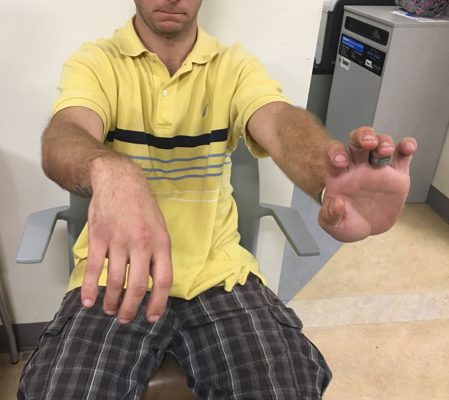
Radial Nerve Palsy
DOI: https://doi.org/10.21980/J8KS7FOn physical exam, the patient was unable to extend his right wrist, thumb, and fingers, and had no sensation of his 1stdorsal interosseous muscles up to the proximal dorsal radial aspect of his forearm. The patient also had slight weakness in thumb abduction. Triceps strength was preserved.
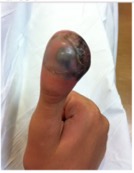
Rare Rapidly Growing Thumb Lesion in a 12-Year-Old Male
DOI: https://doi.org/10.21980/J8B92JHistory of present illness: A 12-year-old male presented to the emergency department with right thumb pain and a mass for four months (see images). He denied fevers, chills, change in appetite, or fatigue. He noted that the lesion was growing and “bleeds easily if bumped.” He denied any trauma to the thumb, except “hitting it” months ago while in football
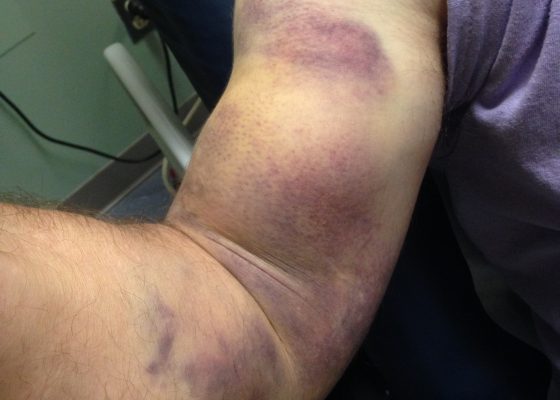
Biceps Tendon Rupture
DOI: https://doi.org/10.21980/J8RP8BPhysical exam was significant for ecchymosis and mild swelling of the right bicep. When the right arm was flexed at the elbow, a prominent mass was visible and palpable over the right bicep. Right upper extremity strength was 4/5 with flexion at the elbow.