
Orthopedics


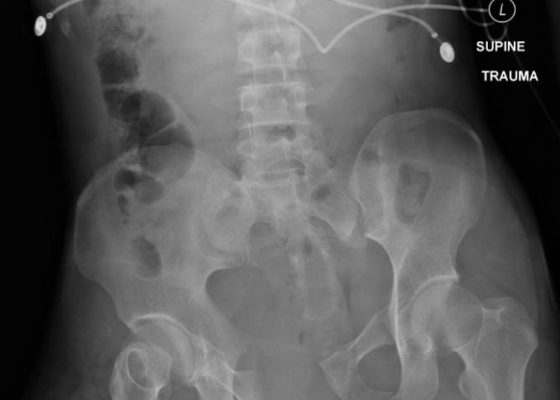
Bilateral Hip Dislocation in Unrestrained Driver
DOI: https://doi.org/10.21980/J8HD0CThe initial radiograph of the pelvis revealed bilateral hip dislocations. Small bony fragments were noted in the right hip joint, suggestive of an underlying fracture. The sacroiliac joints and the pelvic ring were intact. In the emergency department, bilateral hip reductions were performed using the Captain Morgan technique.1 The post-reduction film showed reduction of the bilateral hip dislocations with extensive comminuted and displaced fractures of the right and left acetabula.
Open Book Pelvic Fracture
DOI: https://doi.org/10.21980/J8CK7HThe initial radiograph of the pelvis shows an open-book pelvic fracture deformity with pubic symphyseal dislocation, left greater than right sacroiliac diastases, and fractures of the left superior and inferior pubic rami, right inferior pubic ramus, and left acetabular anterior column. The additional inlet and outlet radiographs of the pelvis after application of a pelvic binder also show an open book fracture with significant improvement of the widened pubic symphysis.
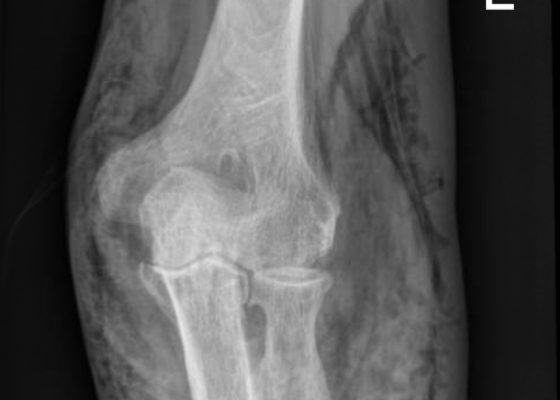
Subcutaneous Emphysema in Non-Necrotizing Soft Tissue Injury
DOI: https://doi.org/10.21980/J8432MX-Rays of the elbow revealed diffuse striated lucencies throughout the soft tissue, consistent with extensive subcutaneous air throughout the superficial and deep tissues. There was no evidence of a fracture.
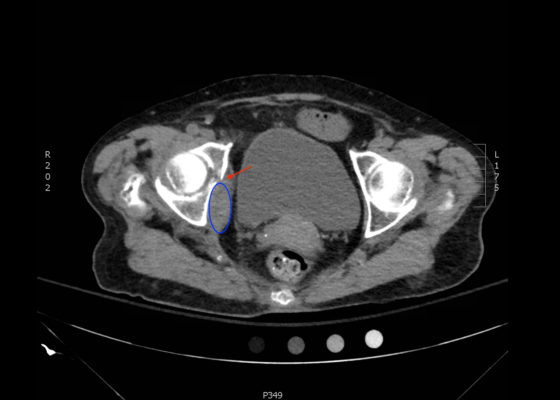
Acetabular Fracture
DOI: https://doi.org/10.21980/J8BK8KThe non-contrast CT images show a minimally displaced comminuted fracture of the right acetabulum involving the acetabular roof, medial and anterior walls (red arrows), with associated obturator muscle hematoma (blue oval).
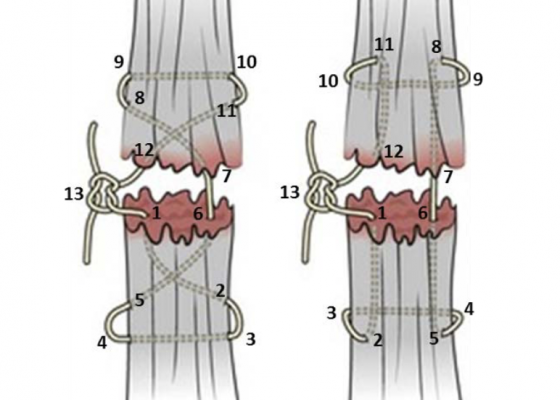

A Simulation Model for Extensor Tendon Repair
DOI: https://doi.org/10.21980/J8VS7XBy the end of this educational session, the learner will be able to: 1) List the indications for extensor tendon repair in the emergency department, 2) recognize the indications for referral to orthopedic or hand surgery, 3) list the risks and benefits of emergency department extensor tendon repair, 4) perform an appropriate physical examination for a patient with a potential extensor tendon laceration, 5) list the maximum time limit of tourniquet application for this procedure, 6) list the materials needed for extensor tendon repair in the emergency department, 7) successfully repair a completely severed extensor tendon using four different techniques: horizontal mattress, figure of eight, modified Kessler and modified Bunnell, and 8) describe the appropriate splinting of a repaired extensor tendon.

Introducing point-of-care ultrasound through competency-based simulation education using a fractured chicken bone model
DOI: https://doi.org/10.21980/J8GG95To introduce medical students to PoCUS with an inexpensive, reproducible, and educationally effective model using fractured chicken bones set in gelatin, and to assess medical students’ abilities to identify simulated long-bone fractures using PoCUS.

Supracondylar Fracture
DOI: https://doi.org/10.21980/J8492PHistory of present illness: A 15-year-old male presented to the emergency department with right elbow pain after falling off a skateboard. The patient denied a decrease in strength or sensation but did endorse paresthesias to his hand. On exam, the patient had an obvious deformity of his right elbow with tenderness to palpation and decreased range of motion at the

Galeazzi Fracture
DOI: https://doi.org/10.21980/J8HS39The X-ray showed an acute comminuted fracture of the distal diaphysis of the radius with disruption of the distal radioulnar joint, consistent with a Galeazzi fracture. The patient was then splinted and taken for operative reduction and internal fixation the following day.