
Wilderness

Brown Recluse Spider Bite
DOI: https://doi.org/10.21980/J8TK99Examination of the skin revealed erythema and induration on the right lateral leg 12 cm in diameter with a 6 cm area of central necrosis and surrounding petechiae without fluctuance or crepitus. The patient was neurovascularly intact distal to the lesion. Laboratory values were within normal limits, except for an elevated C-reactive protein (5.31 mg/dL, normal range <0.70 mg/dL). The patient was diagnosed with ulceration secondary to envenomation from a brown recluse spider.

Emergency Medicine Curriculum Utilizing the Flipped Classroom Method: Environmental Emergencies
DOI: https://doi.org/10.21980/J8TP8ZThrough a flipped classroom design, we aim to teach the presentation and management of environmental emergencies, specifically cold related illness, heat related illness, undersea medicine, high altitude medicine, submersion, electrocution, radiation injury, and envenomation. This unique, innovative curriculum utilizes resources chosen by education faculty and resident learners, study questions, real-life experiences, and small group discussions in place of traditional lectures. In doing so, a goal of the curriculum is to encourage self-directed learning, improve understanding and knowledge retention, and improve the educational experience of our residents.
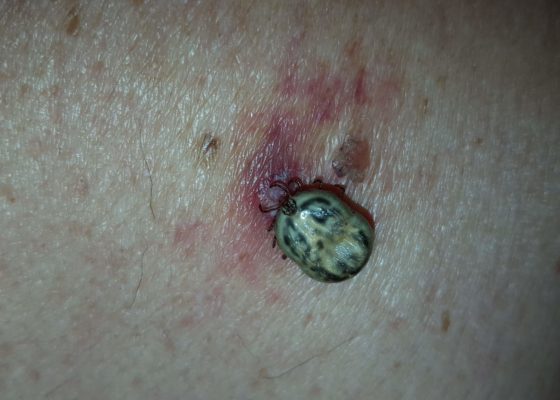

Tick Removal
DOI: https://doi.org/10.21980/J8HK9HOn physical exam, an engorged tick was found attached to the patient’s left upper back. The underlying skin was nontender but mildly erythematous, without central clearing. The tick was gently removed with blunt angle forceps and sent for further analysis, which later revealed the specimen to be an American dog tick (Dermacentor variabilis).
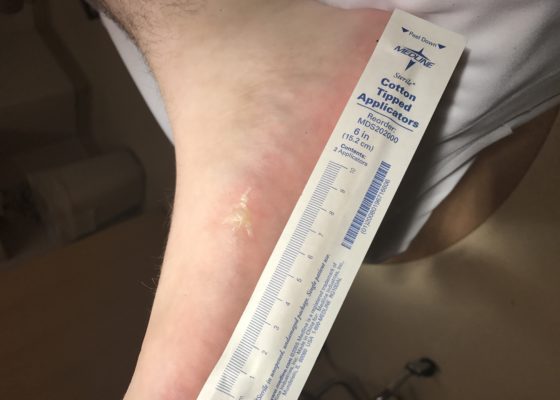
Lightning Ground Current Injury: A Subtle Shocker
DOI: https://doi.org/10.21980/J8KD1CThe first photograph demonstrates a dendritic blister (Lichtenburg figure) on the medial aspect of his right foot where the ground current injury entered the patient's foot. Although no data exists regarding the sensitivity or specificity of Lichtenberg figures as skin findings, they are considered pathognomonic for lightning injuries and are not produced by alternating current or industrial electrical injuries. The second photograph demonstrates a 4 x 3 cm area of petechiae where the ground current injury exited the patient.

Evaluation of Snake Bites with Bedside Ultrasonography
DOI: https://doi.org/10.21980/J84S7DHistory of present illness: While watering his lawn, a 36-year-old man felt two sharp bites to his bilateral ankles. He reports that he then saw a light brown, 2-foot snake slither away from him. He came to the emergency department because of pain and swelling in his ankles and inability to bear weight. Physical examination revealed bilateral ankle swelling and
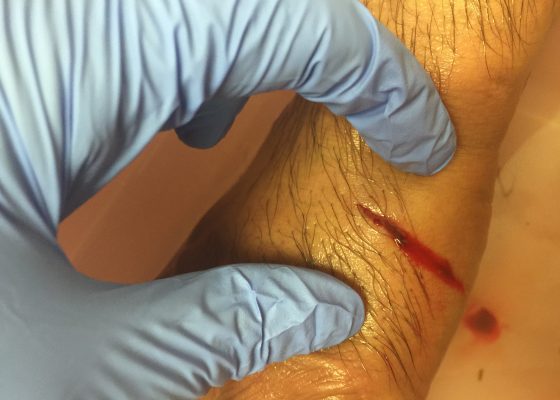
Stingray Envenomation
DOI: http://doi.org/10.21980/J86C7WPhysical exam revealed a 3cm laceration to the ulnar side of the dorsum of the left hand with minimal hand swelling. There was no exposed tendon or bone, the hand was neurovascularly intact and had full strength. A small barb was visualized and removed from the injury site. Radiograph of the left hand confirmed that there was no remaining barb (see normal x-ray).
‹2
Page 2 of 2