
JETem
  • Home
  • About
    • Aim and Scope
    • Our Team
    • Editorial Board
    • FAQ
  • Issues
    • Current Issue
    • Ahead of Print
    • Past Issues
  • Visual EM
    • Latest Visual EM
    • Search Visual EM
    • Thumbnail Library
  • For Authors
    • Instructions for Authors
    • Submit to JETem
    • Photo Consent
    • Policies
      • Peer Review Policy
      • Copyright Policy
      • Editorial Policy, Ethics and Responsibilities
      • Conflicts of Interest & Informed Consent
      • Open Access Policy
      • Acceptance Fee
  • For Reviewers
    • Instructions for JETem Reviewers
    • Interested in Being a JETem Reviewer?
  • Topic
    • Abdominal/Gastroenterology
    • Administration
    • Board Review
    • Cardiology/Vascular
    • Certifying Exam Cases
      • Clinical Decision-Making
      • Prioritization
      • Communication
      • Procedure & Ultrasound
    • Clinical Informatics, Telehealth and Technology
    • Dermatology
    • EMS
    • Endocrine
    • ENT
    • Faculty Development
    • Genitourinary
    • Geriatrics
    • Hematology/Oncology
    • Infectious Disease
    • Miscellaneous (stats, etc)
    • Neurology
    • Ob/Gyn
    • Ophthalmology
    • Orthopedics
    • Pediatrics
    • Pharmacology
    • Procedures
    • Psychiatry
    • Renal/Electrolytes/Nutrition
    • Respiratory
    • Social Determinants of Health
    • Toxicology
    • Trauma
    • Ultrasound
    • Urology
    • Wellness
    • Wilderness
  • Modality
    • Certifying Exam Practice Cases
      • Clinical Care Cases
      • Communication & Procedural Cases
      • Old School Oral Board Cases
    • Curricula
    • Innovations
    • Lectures
    • Podcasts
    • Simulation
    • Small Group Learning
    • Team Based Learning (TBL)
    • Visual EM
  • Contact Us

Trauma

Implementing the Stop the Bleed Campaign in a University Community

Robert A Katzer, MD, MBA*, David A Beshai, BS^, Ajeet Pal Bayo Bhatia, BA^ and Andre Serop Ksajikian, BA^

DOI: https://doi.org/10.21980/J84D0ZIssue 4:1[mrp_rating_result]
The main objective is to implement a system to use available resources of the Stop the Bleed campaign to widely educate members of the university community in the utilization of multiple compression techniques including direct pressure, tourniquet application, and wound packing.  Additional course objectives include using the Stop the Bleedsm campaign to teach participants how to fit into the emergency response team as the immediate responder and the identification of life-threatening bleeding.
EMSSmall Group LearningTrauma
Creative Commons images

Bilateral Shoulder Dislocation after Ski Injury

Alaina Rajagopal, PhD, MD*, Brian Knight, BS* and Lance Orr, MD^

DOI: https://doi.org/10.21980/J86929Issue 4:1[mrp_rating_result]
An anteroposterior chest X-ray demonstrates bilateral shoulder dislocations. Both the right and left humeral heads (blue lines) are displaced medially, anteriorly, and inferiorly from their normal positions in the glenoid fossae (red lines), thus signifying bilateral anterior dislocations. There is also a fracture of the left humeral head at the greater tubercle (green arrow).
OrthopedicsTraumaVisual EM
Creative Commons images

Facial Fracture Induced Periorbital Emphysema

Hamid Ehsani-Nia, DO* and Robert Eisenstein, MD*

DOI: https://doi.org/10.21980/J8F05HIssue 3:4[mrp_rating_result]
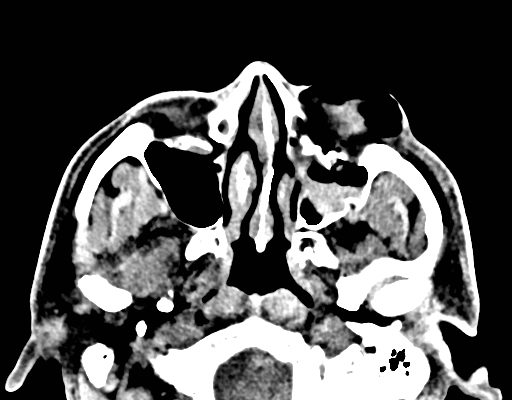
Physical exam showed marked left palpebral subcutaneous crepitus, as well as bulbar and palpebral conjunctival bulging. Visual acuity was normal with intact extraocular movements, and normal pupillary exam. Computed tomography (CT) imaging of the face was obtained and revealed multiple displaced fractures involving the left orbital floor and zygomatic arch associated with moderate periorbital and postseptal extraconal gas, resulting in orbital proptosis.
TraumaENTVisual EM
Creative Commons images

Subcutaneous Emphysema After Chest Trauma

Ronald Goubert, BS* and Alisa Wray, MD, MAEd*

DOI: https://doi.org/10.21980/J8864NIssue 3:4[mrp_rating_result]
Plain film anteroposterior (AP) radiography of the chest shows left-sided subcutaneous emphysema (red arrow) with overlapping muscle striations of the pectoralis major (green arrow). After chest tube placement (blue arrow), AP chest radiography shows persistent left-sided subcutaneous emphysema (red arrow). CT of the chest shows pneumomediastinum (blue arrow), left apical pneumothorax (pink arrow), and subcutaneous emphysema (red arrow) at the level of T2. At the level of T6, rib fractures can be visualized on the CT (yellow arrow). At the level of T8, left sided pneumothorax is also seen (pink arrow) as the absence of lung tissue on CT.
TraumaRespiratoryVisual EM
Creative Commons images

Various Degrees of Thermal Burns

Hamid Ehsani-Nia, DO*, Mohammad I Ehsani-Nia, BS* and John Collins, MD*

DOI: https://doi.org/10.21980/J8R91WIssue 3:4[mrp_rating_result]
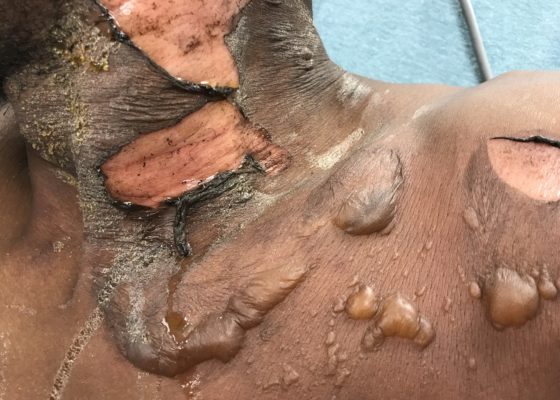
On exam,there is a large swath of skin with evidence of thermal injury involving the neck, shoulder, chest, and face, including damage to the ear, external nostril, and lips. Burns exhibit varying degrees of severity and total approximately 4.5% of the body surface area. Several areas are charred and insensate to pinprick. The left earlobe is partially burned off. Patient's airway is patent with no evidence of thermal injury or obstruction to the oropharynx or nasal vestibule.
TraumaVisual EM
Creative Commons images

A Low Cost Escharotomy Simulation Model for Residency Education

Christopher Sampson, MD*, Catherine D Parker, MD*, Edward Burns, MD^, Marty Ruyan, BSN, RN†, Dena Higbee, EdS† and Timothy Koboldt, MD*

DOI: https://doi.org/10.21980/J8D34V Issue 3:3[mrp_rating_result]
By the end of this educational session, the learner will be able to: 1) Understand the indications for an escharotomy. 2) List equipment needed to perform an escharotomy. 3) Demonstrate how to perform an escharotomy. 4) Perform an escharotomy and experience the sensation of cutting through simulated burned tissue. 5) Understand post-escharotomy management and referral to specialist.
ProceduresInnovationsTrauma
Creative Commons images

Fight Bite with Tendon Laceration

Michelle Chang, MD*, Grant Wei, MD*, Christopher J Bryczkowski, MD*, Sha Yan, DO* and Chirag N Shah, MD*

DOI: https://doi.org/10.21980/J8MP7QIssue 3:3[mrp_rating_result]
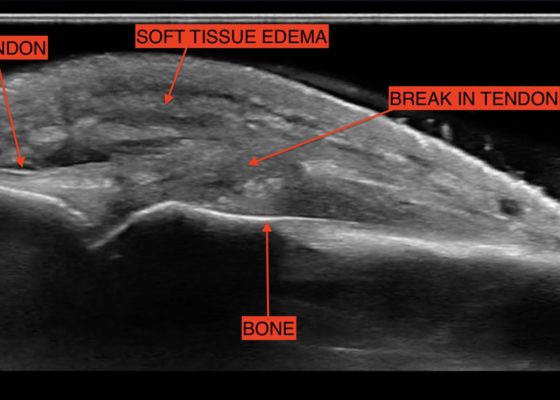
The video shows a water bath ultrasound of the right 4th digit, demonstrating soft tissue swelling with a hypoechoic region along the tendon consistent with edema and tendon disruption (see video and annotated still image).
OrthopedicsTraumaVisual EM
Creative Commons images

Glass Foreign Body Hand Radiograph

Hamid Ehsani-Nia, DO* and Joshua Bucher, MD*

DOI: https://doi.org/10.21980/J8W92HIssue 3:2[mrp_rating_result]
History of present illness: A 27-year-old female sustained an injury to her left hand after she tripped and fell on a vase. She presented to the emergency department (ED) complaining of pain over the laceration. Upon examination, patient presented with multiple small abrasions of the medial aspect of the left 5thdigit that are minimally tender. Additionally, she has one 0.5cm
TraumaUltrasoundVisual EM
«‹4›»
Page 4 of 6

JETem is an online, open access, peer-reviewed, journal-repository for EM educators. We are PMC Indexed.

Most Viewed

  • Simple Auricular Hematoma (“Cauliflower Ear”) Task Trainer
  • The Three Breath Method: Teaching Coping Mechanisms for Processing Patient Death
  • Clinical Decision Making: Acute Ischemic Stroke with Large Vessel Occlusion
  • PRIMER: Premedical Introduction to Mentored Emergency Research: Connecting Undergraduate Assistants and Emergency Medicine Residents in a Community Hospital Setting
  • Dangerous Dysrhythmias in the ED: An Interactive EKG Workshop for Emergency Medicine Clerkship Learners

Visit Our Collaborators


Creative Commons Licence
This work is licensed under a Creative Commons Attribution 4.0 International License.

About

Education

Learners should benefit from active learning. JETem accepts submissions of team-based learning, small group learning, simulation, podcasts, lectures, innovations, curricula, question sets, and visualEM.

Scholarship

We believe educators should advance through the scholarship of their educational work. JETem gives educators the opportunity to publish scholarly academic work so that it may be widely distributed, thereby increasing the significance of their results.

Links

  • Home
  • Aim and Scope
  • Current Issue
  • For Reviewers
  • Instructions for Authors
  • Contact Us

Newsletter

Sign up to receive updates from JETem regarding newly published issues and findings.

Copyright Creative Commons Attribution 4.0 International