
JETem
  • Home
  • About
    • Aim and Scope
    • Our Team
    • Editorial Board
    • FAQ
  • Issues
    • Current Issue
    • Ahead of Print
    • Past Issues
  • Visual EM
    • Latest Visual EM
    • Search Visual EM
    • Thumbnail Library
  • For Authors
    • Instructions for Authors
    • Submit to JETem
    • Photo Consent
    • Policies
      • Peer Review Policy
      • Copyright Policy
      • Editorial Policy, Ethics and Responsibilities
      • Conflicts of Interest & Informed Consent
      • Open Access Policy
  • For Reviewers
    • Instructions for JETem Reviewers
    • Interested in Being a JETem Reviewer?
  • Topic
    • Abdominal/Gastroenterology
    • Administration
    • Board Review
    • Cardiology/Vascular
    • Certifying Exam Cases
      • Clinical Decision-Making
      • Prioritization
      • Communication
      • Procedure & Ultrasound
    • Clinical Informatics, Telehealth and Technology
    • Dermatology
    • EMS
    • Endocrine
    • ENT
    • Faculty Development
    • Genitourinary
    • Geriatrics
    • Hematology/Oncology
    • Infectious Disease
    • Miscellaneous (stats, etc)
    • Neurology
    • Ob/Gyn
    • Ophthalmology
    • Orthopedics
    • Pediatrics
    • Pharmacology
    • Procedures
    • Psychiatry
    • Renal/Electrolytes
    • Respiratory
    • Social Determinants of Health
    • Toxicology
    • Trauma
    • Ultrasound
    • Urology
    • Wellness
    • Wilderness
  • Modality
    • Certifying Exam Practice Cases
      • Clinical Care Cases
      • Communication & Procedural Cases
      • Old School Oral Board Cases
    • Curricula
    • Innovations
    • Lectures
    • Podcasts
    • Simulation
    • Small Group Learning
    • Team Based Learning (TBL)
    • Visual EM
  • Contact Us

Cardiology/Vascular

Chest Pain with Acute Coronary Syndrome

Alisa Wray, MD*

DOI: https://doi.org/10.21980/J8K04C Issue 3:2[mrp_rating_result]
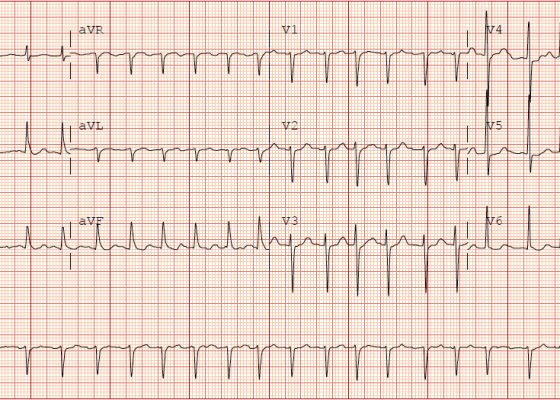
At the end of this case learners should be able to prepare a differential for patients with chest pain, provide appropriate medications for a patient with chest pain, recognize an ST segment elevation MI, and appropriately disposition a patient with acute myocardial infarction (AMI).
Cardiology/VascularSimulation
Creative Commons images

Osborn Waves in a Severely Hypothermic Patient

Jon Van Heukelom, MD*

DOI: https://doi.org/10.21980/J8H34SIssue 3:2[mrp_rating_result]
The initial EKG shows marked elevation of the J-point (point where the QRS segment joins the ST segment), otherwise known as an “Osborn Wave” (see black arrows).  A subsequent EKG obtained after active rewarming, showed resolution of the Osborn waves.
Cardiology/VascularVisual EM
Creative Commons images

Torsades de Pointes

Richard J Chen, MD*, Grant Wei, MD* and Chirag Shah, MD*

DOI: https://doi.org/10.21980/J87K91 Issue 3:2[mrp_rating_result]
The patient was found to be in a polymorphic ventricular tachycardia; he was alert, awake and asymptomatic. A rhythm strip showed a wide complex tachycardia with the QRS complex varying in amplitude around the isoelectric line consistent with Torsades de Pointes.
Cardiology/VascularVisual EM
Creative Commons images

Type 1 Brugada Syndrome

Sha Yan, DO*, Grant Wei, MD* and Chirag Shah, MD*

DOI: https://doi.org/10.21980/J8V91T Issue 3:2[mrp_rating_result]
ECG shows an incomplete right bundle branch block (blue arrow) with coved ST segment elevation and an inverted T wave in V1 (red arrow) and ST segment elevation in V2 (black arrow).
Cardiology/VascularVisual EM
Creative Commons images

Osborn Waves

James Elliot Karz, DO*, Grant Wei, MD* and Chirag Shah, MD*

DOI: https://doi.org/10.21980/J8G34G Issue 3:2[mrp_rating_result]
The initial ECG shows a junctional rhythm with Osborn waves (or J point elevations/J waves) in the lateral precordial leads, as well as the limb leads (Image 1). The second ECG, 49 minutes later, shows an improving ventricular rate and Osborn wave height decrease of approximately 50% (Image 2). 
Cardiology/VascularVisual EM
Creative Commons images

Elderly female with acute abdominal pain presenting with Superior Mesenteric Artery Thrombus

Sassan Ghassemzadeh, MD*

DOI: https://doi.org/10.21980/J82W52 Issue 3:2[mrp_rating_result]
Computed tomography (CT) angiogram of the abdomen and pelvis revealed a superior mesenteric artery (SMA) thrombosis 5 cm from the origin off of the abdominal aorta. As seen in the sagittal view, there does not appear to be any contrast 5 cm past the origin of the SMA. On the axial views, you can trace the SMA until the point that there is no longer any contrast visible which indicates the start of the thrombus.  The SMA does not appear to be reconstituted. There was normal flow to the celiac artery. (See annotated images).
Abdominal/GastroenterologyCardiology/VascularVisual EM
Creative Commons images

Tricuspid Annular Plane Systolic Excursion (TAPSE) in a Patient with Pulmonary Emboli

Nicole Zawada, BS*, Ethan Kunstadt, MD* and Maili Alvarado, MD^

DOI: https://doi.org/10.21980/J8M052 Issue 3:1[mrp_rating_result]
Video 1 and Image 1 show a thrombus in the patient’s IVC. Video 2 and Images 2-3 demonstrate a positive TAPSE of less than 17mm (blue arrow length) with a significantly dilated RV, indicating abnormal excursion of the tricuspid annulus and right ventricular dysfunction.  
RespiratoryCardiology/VascularVisual EM
Creative Commons images

Management of Wolff-Parkinson-White Tachyarrhythmia Presenting as Syncope with Seizure-like Activity

Samuel Kaplan, BS* and Lindsey Spiegelman, MD*

DOI: https://doi.org/10.21980/J8534P Issue 2:4[mrp_rating_result]
At the end of this simulation session the learner will: 1) Recognize clinical history suggestive of cardiogenic syncope, 2) recognize clinical evidence of Wolff-Parkinson-White syndrome, 3) promptly and appropriately treat unstable WPW tachyarrhythmia.
Cardiology/VascularSimulation
«‹11›»
Page 11 of 14

JETem is an online, open access, peer-reviewed, journal-repository for EM educators. We are PMC Indexed.

Most Viewed

  • Enhancing Emergency Medicine Resident Education: A Weekly Education Series to Augment Electrocardiogram Education
  • Development and Design of a Pediatric Case-Based Virtual Escape Room on Acute Iron Toxicity
  • Pre-Clinical Case Competition to Assess Confidence in Responding to Select Out-Of-Hospital Medical Emergencies
  • Pediatric Difficult Airway Simulation Day
  • Cards Against Pulmonology

Visit Our Collaborators


Creative Commons Licence
This work is licensed under a Creative Commons Attribution 4.0 International License.

About

Education

Learners should benefit from active learning. JETem accepts submissions of team-based learning, small group learning, simulation, podcasts, lectures, innovations, curricula, question sets, and visualEM.

Scholarship

We believe educators should advance through the scholarship of their educational work. JETem gives educators the opportunity to publish scholarly academic work so that it may be widely distributed, thereby increasing the significance of their results.

Links

  • Home
  • Aim and Scope
  • Current Issue
  • For Reviewers
  • Instructions for Authors
  • Contact Us

Newsletter

Sign up to receive updates from JETem regarding newly published issues and findings.

Copyright Creative Commons Attribution 4.0 International