
JETem
  • Home
  • About
    • Aim and Scope
    • Our Team
    • Editorial Board
    • FAQ
  • Issues
    • Current Issue
    • Ahead of Print
    • Past Issues
  • Visual EM
    • Latest Visual EM
    • Search Visual EM
    • Thumbnail Library
  • For Authors
    • Instructions for Authors
    • Submit to JETem
    • Photo Consent
    • Policies
      • Peer Review Policy
      • Copyright Policy
      • Editorial Policy, Ethics and Responsibilities
      • Conflicts of Interest & Informed Consent
      • Open Access Policy
  • For Reviewers
    • Instructions for JETem Reviewers
    • Interested in Being a JETem Reviewer?
  • Topic
    • Abdominal / Gastroenterology
    • Administration
    • Board Review
    • Cardiology / Vascular
    • Certifying Exam Cases
      • Clinical Decision-Making
      • Prioritization
      • Communication
      • Procedure & Ultrasound
    • Clinical Informatics, Telehealth and Technology
    • Dermatology
    • EMS
    • Endocrine
    • ENT
    • Faculty Development
    • Genitourinary
    • Geriatrics
    • Hematology / Oncology
    • Infectious Disease
    • Miscellaneous
    • Neurology
    • Ob / Gyn
    • Ophthalmology
    • Orthopedics
    • Pediatrics
    • Pharmacology
    • Procedures
    • Psychiatry
    • Renal / Electrolytes
    • Respiratory
    • Social Determinants of Health
    • Toxicology
    • Trauma
    • Ultrasound
    • Urology
    • Wellness
    • Wilderness
  • Modality
    • Certifying Exam Practice Cases
      • Clinical Care Cases
      • Communication & Procedural Cases
      • Old School Oral Board Cases
    • Curricula
    • Innovations
    • Lectures
    • Podcasts
    • Simulation
    • Small Group Learning
    • Team Based Learning
    • Visual EM
  • Contact Us

Ultrasound

Creative Commons images

Bedside Ultrasound for the Diagnosis of Small Bowel Obstruction

Alexander Anshus, BS* and Maili Alvarado, MD^

DOI: https://doi.org/10.21980/J86W6PIssue 2:4[mrp_rating_result]
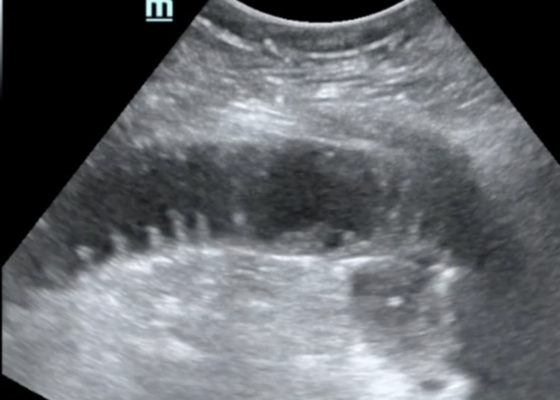
The POCUS utilizing the low frequency curvilinear probe demonstrates fluid-filled, dilated bowel loops greater than 2.5cm with to-and-fro peristalsis, and thickened bowel walls greater than 3mm, concerning for SBO. 
Abdominal/GastroenterologyVisual EM
Creative Commons images

Using Bedside Ultrasound to Rapidly Differentiate Shock

Mohamad Moussa, MD*, Jacob Willen, BS* and Sudipa Biswas, BS, MS*

DOI: https://doi.org/10.21980/J8S047 Issue 2:3[mrp_rating_result]
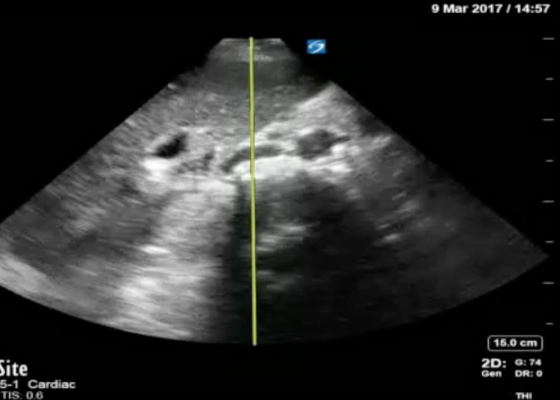
A RUSH exam demonstrated hyperdynamic cardiac contractility and collapse of the inferior vena cava (IVC) with probe compression more than 50% suggesting hypovolemia likely secondary to sepsis. Incidentally, Morrison’s pouch revealed a large right renal cyst but no signs of free fluid. A computed tomography of abdomen/pelvis showed a 10.8 x 9.5 cm right renal cyst and left lower lobe pneumonia.
UltrasoundInfectious DiseaseVisual EM
Creative Commons images

Pneumonia Diagnosed by Point-of-Care Ultrasound

Akash Patel, BA*, Steven Bunch, MD^, Maili Alvarado, MD^, Shadi Lahham, MD^ and J. Christian Fox, MD^

DOI: https://doi.org/10.21980/J8XP64 Issue 2:3[mrp_rating_result]
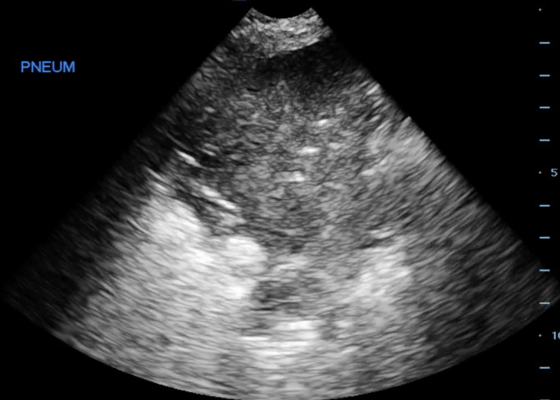
Point-of-care ultrasound of the left lower lobe demonstrates lung hepatization, a classic finding for pneumonia. In addition, a shred sign is present with both air bronchograms and focal B-lines—all suggestive of poorly aerated, consolidated lung. The patient was started on antibiotics and admitted to the hospital with a diagnosis of community-acquired pneumonia.
UltrasoundRespiratoryVisual EM
Creative Commons images

Perforated Gastric Ulcer with Intra-abdominal Abscess

Leslie Palmerlee, MD, MPH*, Scott Mackey, DO* and Michael Petrauskis, MD, MEd*

DOI: https://doi.org/10.21980/J82H0C Issue 2:3[mrp_rating_result]
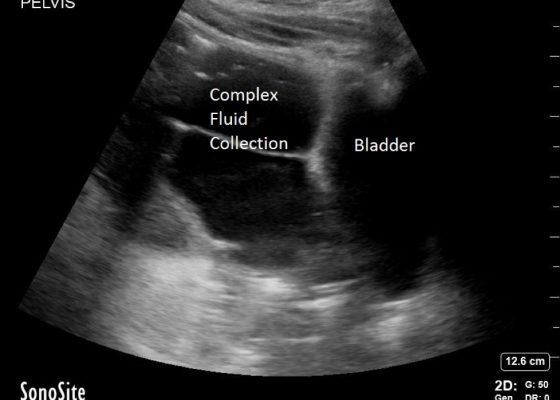
Bedside ultrasound revealed a large volume of free fluid in the right upper quadrant and in the pelvis. The fluid appeared complex with multiple septations. Its appearance was not consistent with ascites or acute intra-abdominal free fluid due to striations and pockets.
Abdominal/GastroenterologyVisual EM
Creative Commons images

Use of Bedside Compression Ultrasonography for Diagnosis of Deep Venous Thrombosis

Mohamad Moussa, MD* and Maher Abdo, BS*

DOI: https://doi.org/10.21980/J81G94 Issue 2:3[mrp_rating_result]
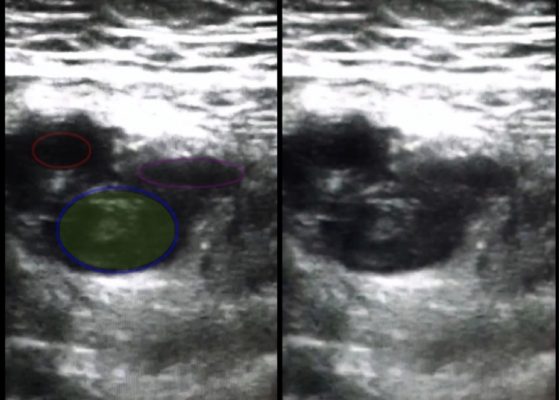
As shown in the still image of the performed ultrasound, a transverse view of the proximal-thigh revealed a visible thrombus (green shading) occluding the lumen of the left common femoral vein (blue ring), which was non-compressible when direct pressure was applied to the probe. Also visible is a patent and compressible branch of the common femoral vein (purple ring) and the femoral artery (red ring), highlighted by its thick vessel wall and pulsatile motion.
UltrasoundCardiology/VascularVisual EM
Creative Commons images

Bedside Echocardiography for Rapid Diagnosis of Malignant Cardiac Tamponade

Alaina Brinley, MD, PhD*, Maili Alvarado, MD* and J Christian Fox, MD*

DOI: https://doi.org/10.21980/J82S38Issue 2:1[mrp_rating_result]
The video shows a subxiphoid view of the heart with evidence of a large pericardial effusion with tamponade – note the anechoic stripe in the pericardial sac (see red arrow). This video demonstrates paradoxical right ventricular collapse during diastole and right atrial collapse during systole which is indicative of tamponade.1,2 Figure 1 is from the same patient and shows sonographic pulsus paradoxus. This is an apical 4 chamber view of the heart with the sampling gate of the pulsed wave doppler placed over the mitral valve. The Vpeak max and Vpeak min are indicated. If there is more than a 25% difference with inspiration between these 2 values, this is highly suggestive of tamponade.1 In this case, there is a 32.4% difference between the Vpeak max 69.55 cm/s and Vpeak min 46.99 cm/s.
Cardiology/VascularHematology/OncologyUltrasoundVisual EM
Creative Commons images

Takotsubo (Stress) Cardiomyopathy

Justin J Hourmozdi, MD*, Julian P Suszanski, MD* and Jacqueline M Pflaum, MD*^

DOI: https://doi.org/10.21980/J8Z309Issue 2:1[mrp_rating_result]
Bedside echocardiography showed the findings consistent with Takotsubo cardiomyopathy. Echocardiographic images are shown in subxiphoid (A) and apical four chamber (B) views. Note the apical ballooning appearance (asterisk) of the left ventricle (LV).
Cardiology/VascularVisual EM
Creative Commons images

Intraocular Foreign Body: Ultrasound and CT Findings

Maja Feldman, MPP*, Kristi Shigyo, MD^ and Amy Kaji, MD^

DOI: https://doi.org/10.21980/J8JS3MIssue 2:1[mrp_rating_result]
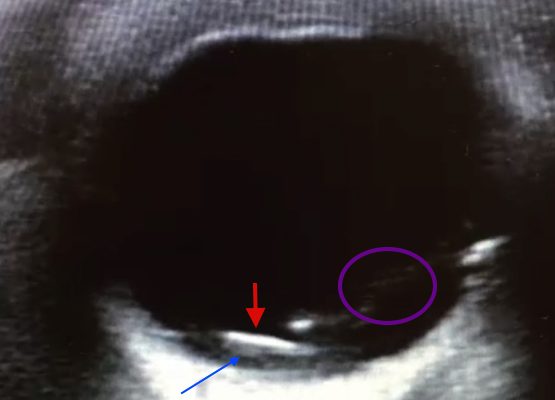
Point of care ultrasound revealed a mobile, radiolucent hyperechoic structure (see red arrow) with reverberation within the posterior chamber (see blue arrow), likely a metallic foreign body. Linear areas of mobile hyperechoic material revealed possible vitreous hemorrhage (see purple circular area). Orbital non-contrast CT confirmed a 3 mm metallic focus within the dependent portion of the left globe, lodged in the posterior sclera, with some vitreous hemorrhage but no evidence of globe rupture. Ophthalmology was consulted and the patient was taken to surgery later that night.
OphthalmologyVisual EM
«‹9›
Page 9 of 10

JETem is an online, open access, peer-reviewed, journal-repository for EM educators. We are PMC Indexed.

Most Viewed

  • Simulation-Based Preparation for the American Board of Emergency Medicine Certifying Exam: A Comprehensive Curriculum for Residents
  • Difficult Conversation Case: Missed Testicular Cancer
  • Difficult Conversation Case: Death Notification
  • Managing Conflict Case: Admission of a Patient with Decompensated Schizophrenia, Hypertension, and Diabetes
  • Managing Conflict Case: The Difficult Consultant

Visit Our Collaborators


Creative Commons Licence
This work is licensed under a Creative Commons Attribution 4.0 International License.

About

Education

Learners should benefit from active learning. JETem accepts submissions of team-based learning, small group learning, simulation, podcasts, lectures, innovations, curricula, question sets, and visualEM.

Scholarship

We believe educators should advance through the scholarship of their educational work. JETem gives educators the opportunity to publish scholarly academic work so that it may be widely distributed, thereby increasing the significance of their results.

Links

  • Home
  • Aim and Scope
  • Current Issue
  • For Reviewers
  • Instructions for Authors
  • Contact Us

Newsletter

Sign up to receive updates from JETem regarding newly published issues and findings.

Copyright Creative Commons Attribution 4.0 International