
JETem
  • Home
  • About
    • Aim and Scope
    • Our Team
    • Editorial Board
    • FAQ
  • Issues
    • Current Issue
    • Ahead of Print
    • Past Issues
  • Visual EM
    • Latest Visual EM
    • Search Visual EM
    • Thumbnail Library
  • For Authors
    • Instructions for Authors
    • Submit to JETem
    • Photo Consent
    • Policies
      • Peer Review Policy
      • Copyright Policy
      • Editorial Policy, Ethics and Responsibilities
      • Conflicts of Interest & Informed Consent
      • Open Access Policy
  • For Reviewers
    • Instructions for JETem Reviewers
    • Interested in Being a JETem Reviewer?
  • Topic
    • Abdominal/Gastroenterology
    • Administration
    • Board Review
    • Cardiology/Vascular
    • Certifying Exam Cases
      • Clinical Decision-Making
      • Prioritization
      • Communication
      • Procedure & Ultrasound
    • Clinical Informatics, Telehealth and Technology
    • Dermatology
    • EMS
    • Endocrine
    • ENT
    • Faculty Development
    • Genitourinary
    • Geriatrics
    • Hematology/Oncology
    • Infectious Disease
    • Miscellaneous (stats, etc)
    • Neurology
    • Ob/Gyn
    • Ophthalmology
    • Orthopedics
    • Pediatrics
    • Pharmacology
    • Procedures
    • Psychiatry
    • Renal/Electrolytes
    • Respiratory
    • Social Determinants of Health
    • Toxicology
    • Trauma
    • Ultrasound
    • Urology
    • Wellness
    • Wilderness
  • Modality
    • Certifying Exam Practice Cases
      • Clinical Care Cases
      • Communication & Procedural Cases
      • Old School Oral Board Cases
    • Curricula
    • Innovations
    • Lectures
    • Podcasts
    • Simulation
    • Small Group Learning
    • Team Based Learning (TBL)
    • Visual EM
  • Contact Us
  • Question Bank

ECG

Creative Commons images

Torsades de Pointes

Richard J Chen, MD*, Grant Wei, MD* and Chirag Shah, MD*

DOI: https://doi.org/10.21980/J87K91 Issue 3:2[mrp_rating_result]
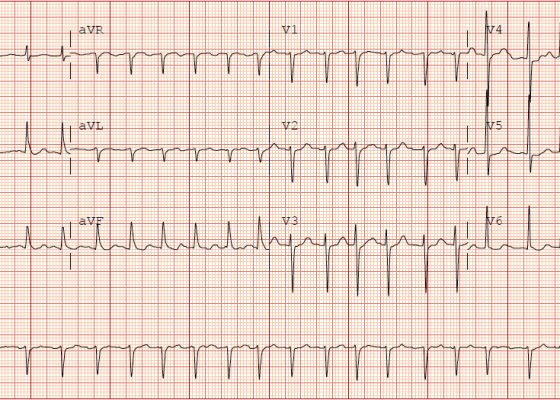
The patient was found to be in a polymorphic ventricular tachycardia; he was alert, awake and asymptomatic. A rhythm strip showed a wide complex tachycardia with the QRS complex varying in amplitude around the isoelectric line consistent with Torsades de Pointes.
Cardiology/VascularVisual EM
Creative Commons images

Type 1 Brugada Syndrome

Sha Yan, DO*, Grant Wei, MD* and Chirag Shah, MD*

DOI: https://doi.org/10.21980/J8V91T Issue 3:2[mrp_rating_result]
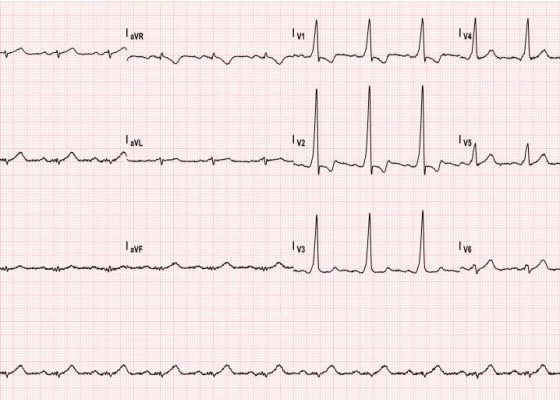
ECG shows an incomplete right bundle branch block (blue arrow) with coved ST segment elevation and an inverted T wave in V1 (red arrow) and ST segment elevation in V2 (black arrow).
Cardiology/VascularVisual EM
Creative Commons images

Osborn Waves

James Elliot Karz, DO*, Grant Wei, MD* and Chirag Shah, MD*

DOI: https://doi.org/10.21980/J8G34G Issue 3:2[mrp_rating_result]
The initial ECG shows a junctional rhythm with Osborn waves (or J point elevations/J waves) in the lateral precordial leads, as well as the limb leads (Image 1). The second ECG, 49 minutes later, shows an improving ventricular rate and Osborn wave height decrease of approximately 50% (Image 2). 
Cardiology/VascularVisual EM
Creative Commons images

Asymptomatic Wolff-Parkinson-White Syndrome: Incidental EKG

Samer Assaf, MD* and Christopher Libby, MD, MPH^

DOI: https://doi.org/10.21980/J8T05X Issue 2:3[mrp_rating_result]
The ECG shows slurred up-stroking of the QRS complexes characteristic of a delta wave. The PR interval is normal; however, the QT interval is greater than 110ms.
Cardiology/VascularVisual EM
Hyperkalemia ECG JETem 2016

Hyperkalemia on ECG

Bryson Hicks, MD*

DOI: https://doi.org/10.21980/J8K017Issue 1:2[mrp_rating_result]
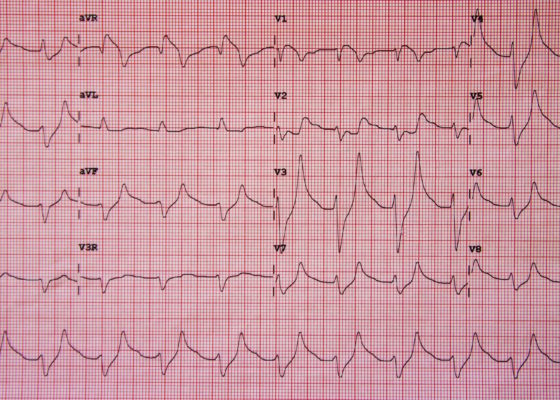
Initial ECG shows tall, peaked T waves, most prominently in V3 and V4, as well as QRS widening. These findings are consistent with hyperkalemia, which was promptly treated. Follow-up ECG post-treatment shows narrowing of the QRS complexes and normalization of peaked T waves.
Cardiology/VascularVisual EM
WPW EKG 1, initial EKG. JETem 2016

Wolff-Parkinson-White Syndrome: Electrocardiogram

Brianna Miner*, Jonathan Patane, MD*, and Carrie Chandwani, MD*

DOI: https://doi.org/10.21980/J8201KIssue 1:2[mrp_rating_result]
The initial EKG showed wide complex, irregular tachycardia > 200 bpm (EKG 1). Given the possibility of Wolff-Parkinson-White (WPW), procainamide was given to the patient. The patient’s heart rate responded and decreased to 120-140 bpm with narrowing of the QRS complex. A repeat EKG showed narrow complex tachycardia without P waves approximately 120 bpm (EKG 2). Once the procainamide infusion was complete, the patient had converted to sinus rhythm with a delta wave now apparent, consistent with WPW (EKG 3).
Cardiology/VascularVisual EM
Creative Commons images

Acute Pericarditis: Electrocardiogram

Jason Mefford, MD* and Shannon L Toohey, MD*

DOI: https://doi.org/10.21980/J8059QIssue 1:1[mrp_rating_result]
The ECG shows diffuse ST- elevation. The patient also has mild PR-depression, most notably in the inferior and lateral leads. The patient also has minimal PR elevation in lead aVR. The patient was diagnosed with acute pericarditis (ECG stage 1).
Cardiology/VascularVisual EM
«‹3
Page 3 of 3

JETem is an online, open access, peer-reviewed, journal-repository for EM educators. We are PMC Indexed.

Most Viewed

  • Simulation-Based Preparation for the American Board of Emergency Medicine Certifying Exam: A Comprehensive Curriculum for Residents
  • Difficult Conversation Case: Missed Testicular Cancer
  • Difficult Conversation Case: Death Notification
  • Managing Conflict Case: Admission of a Patient with Decompensated Schizophrenia, Hypertension, and Diabetes
  • Managing Conflict Case: The Difficult Consultant

Visit Our Collaborators


Creative Commons Licence
This work is licensed under a Creative Commons Attribution 4.0 International License.

About

Education

Learners should benefit from active learning. JETem accepts submissions of team-based learning, small group learning, simulation, podcasts, lectures, innovations, curricula, question sets, and visualEM.

Scholarship

We believe educators should advance through the scholarship of their educational work. JETem gives educators the opportunity to publish scholarly academic work so that it may be widely distributed, thereby increasing the significance of their results.

Links

  • Home
  • Aim and Scope
  • Current Issue
  • For Reviewers
  • Instructions for Authors
  • Contact Us

Newsletter

Sign up to receive updates from JETem regarding newly published issues and findings.

Copyright Creative Commons Attribution 4.0 International