
JETem
  • Home
  • About
    • Aim and Scope
    • Our Team
    • Editorial Board
    • FAQ
  • Issues
    • Current Issue
    • Ahead of Print
    • Past Issues
  • Visual EM
    • Latest Visual EM
    • Search Visual EM
    • Thumbnail Library
  • For Authors
    • Instructions for Authors
    • Submit to JETem
    • Photo Consent
    • Policies
      • Peer Review Policy
      • Copyright Policy
      • Editorial Policy, Ethics and Responsibilities
      • Conflicts of Interest & Informed Consent
      • Open Access Policy
  • For Reviewers
    • Instructions for JETem Reviewers
    • Interested in Being a JETem Reviewer?
  • Topic
    • Abdominal/Gastroenterology
    • Administration
    • Board Review
    • Cardiology/Vascular
    • Certifying Exam Cases
      • Clinical Decision-Making
      • Prioritization
      • Communication
      • Procedure & Ultrasound
    • Clinical Informatics, Telehealth and Technology
    • Dermatology
    • EMS
    • Endocrine
    • ENT
    • Faculty Development
    • Genitourinary
    • Geriatrics
    • Hematology/Oncology
    • Infectious Disease
    • Miscellaneous (stats, etc)
    • Neurology
    • Ob/Gyn
    • Ophthalmology
    • Orthopedics
    • Pediatrics
    • Pharmacology
    • Procedures
    • Psychiatry
    • Renal/Electrolytes
    • Respiratory
    • Social Determinants of Health
    • Toxicology
    • Trauma
    • Ultrasound
    • Urology
    • Wellness
    • Wilderness
  • Modality
    • Certifying Exam Practice Cases
      • Clinical Care Cases
      • Communication & Procedural Cases
      • Old School Oral Board Cases
    • Curricula
    • Innovations
    • Lectures
    • Podcasts
    • Simulation
    • Small Group Learning
    • Team Based Learning (TBL)
    • Visual EM
  • Contact Us

Latest Articles

Creative Commons images
visualem icon

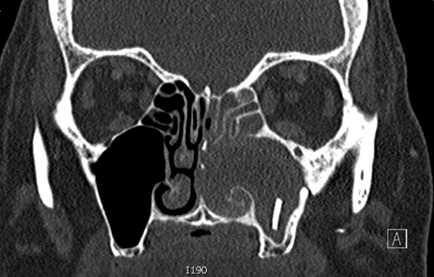
Foreign Body in Maxillary Sinus: A Rare Case of Chronic Rhinosinusitis

Richard Barnett, DO* and Meigra Chin, MD*

DOI: https://doi.org/10.21980/J85H09Issue 3:4[mrp_rating_result]
Computed tomography (CT) sinus with contrast demonstrated complete opacification of left paranasal sinuses and nasal cavity, and a linear radiopacity within the left maxillary sinus consistent with a foreign body.  There were additional left facial subcutaneous radiopaque opacities.
ENTVisual EM
Creative Commons images
visualem icon

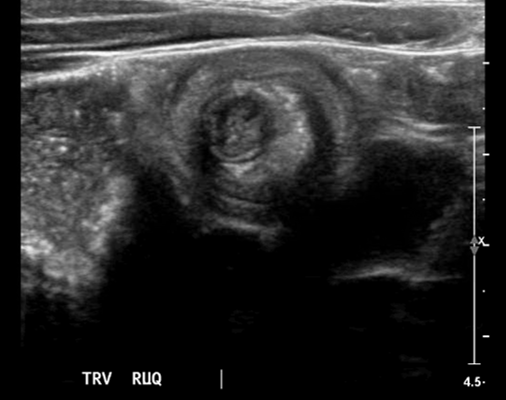
Brief Review of Intussusception Diagnosis and Management

Claire Thomas, MD*, Wirachin Hoonpongsimanont, MD*, Sara Paradise, MD* and Mohammad Helmy, MD^

DOI: https://doi.org/10.21980/J81P7FIssue 3:4[mrp_rating_result]
The patient’s abdominal ultrasound revealed intussusception in the right upper abdominal quadrant. The transverse ultrasound view showed a “doughnut sign” (dashed yellow line), telescoping bowel (yellow arrow), and invaginated hyperechoic mesenteric fat with crescent configuration (dashed orange line).  The sagittal ultrasound view demonstrated the intussusception formed by the outer recipient bowel loop (yellow arrows), invaginated hyperechoic mesenteric fat (orange asterisks), and telescoping bowel centrally (red arrow).
Abdominal/GastroenterologyPediatricsVisual EM
Creative Commons images
visualem icon

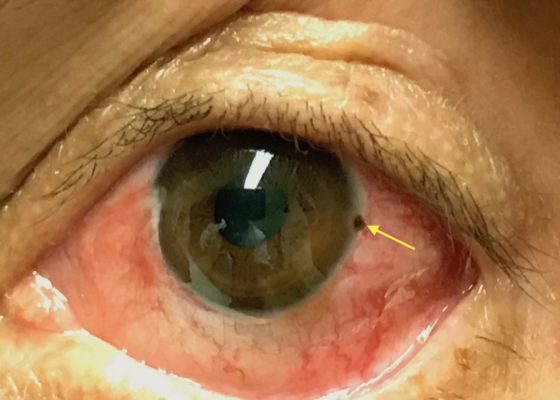
Corneal Rust Ring

Joseph Zakaria, BS* and Jonathan Peña, MD*

DOI: https://doi.org/10.21980/J8X067Issue 3:4[mrp_rating_result]
The photograph reveals a limbic metallic foreign body with a surrounding corneal rust ring (arrow) in the three o’clock position of the left cornea. 
OphthalmologyVisual EM
Creative Commons images
visualem icon

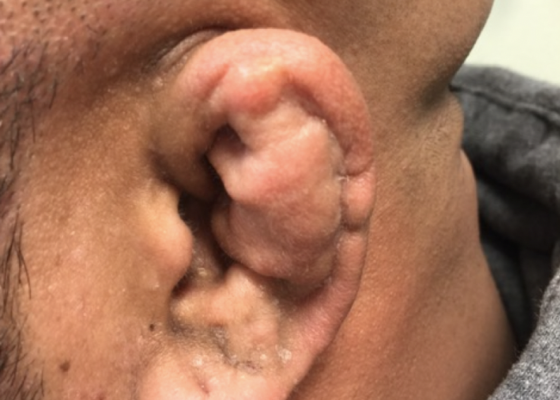
Cauliflower Ear Secondary to a Chronic Auricular Hematoma

Nichole Niknafs, DO*

DOI: https://doi.org/10.21980/J8S63XIssue 3:4[mrp_rating_result]
On exam, the patient has a gross deformity to the left pinna that was not painful to touch or fluctuant. Findings and history are consistent with cauliflower ear, secondary to a chronic auricular hematoma.
ENTVisual EM
Creative Commons images
visualem icon

Sialadenitis

Lauren Sylwanowicz, MD* and Andrew Wong, MD, MBA^

DOI: https://doi.org/10.21980/J8NH0NIssue 3:4[mrp_rating_result]
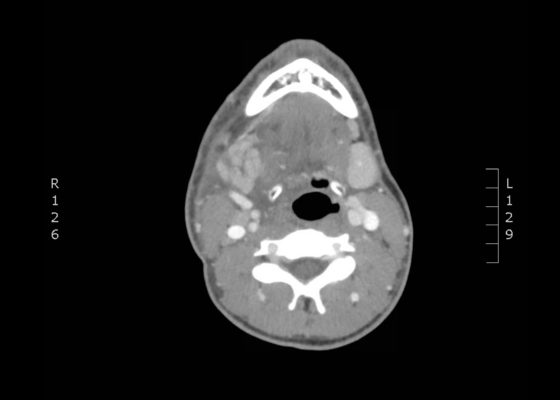
The computed tomography (CT) scan demonstrates prominent enlargement and heterogeneous enhancement of the right submandibular gland (single large arrow) compatible with sialadenitis. There is no evidence of a sialolith or obstruction on the CT. There is associated edema (two small arrows) of the right submandibular space, parapharyngeal space and anterior right neck with partial effacement of the right vallecula and right pyriform sinus.
ENTVisual EM
Creative Commons images
visualem icon

Clinical Evaluation and Management of Pediatric Pericarditis

Sharona Hariri, BA*, Alisa Wray, MD, MAEd^ and Lauren Sylwanowicz, MD^

DOI: https://doi.org/10.21980/J8HP85Issue 3:4[mrp_rating_result]
An electrocardiogram (ECG) was concerning for ST segment elevation in leads II, III, aVF, and V4, with subtle ST elevations in V5 and V6 (see black arrows).  There is also ST segment depression in aVL (see blue arrows).
Cardiology/VascularVisual EM
Creative Commons images
visualem icon

Point-of-care Ultrasound for the Diagnosis of Ovarian and Fallopian Tube Torsion

Tushank Chadha, BS*, Maili Alexandria Drachman, MD^, Michelle Bui, BS* and Amal Shafi, BS*

DOI: https://doi.org/10.21980/J8D06KIssue 3:4[mrp_rating_result]
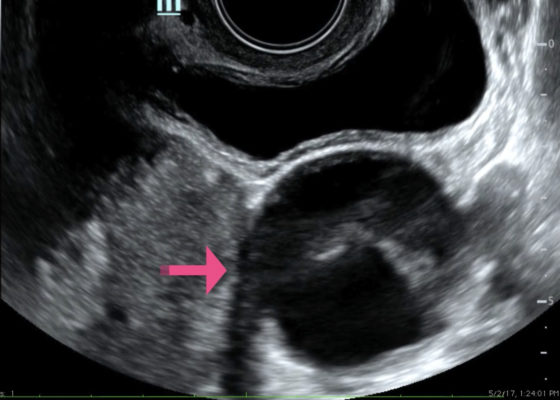
The ultrasound video clip demonstrates a transverse view of the pelvis using the endocavitary probe. The bladder can be seen on the anterior portion of the scan (yellow arrow), while the uterus with an intrauterine pregnancy is visible posteriorly (blue arrow). The thickened appearance of the uterine wall is also indicative of pregnancy. A large, anechoic cystic structure measuring approximately 5 cm is seen in the vicinity of the patient’s left adnexa (pink arrow), which raises concerns for ovarian torsion.
Ob/GynVisual EM
Creative Commons images
visualem icon

Subcutaneous Emphysema After Chest Trauma

Ronald Goubert, BS* and Alisa Wray, MD, MAEd*

DOI: https://doi.org/10.21980/J8864NIssue 3:4[mrp_rating_result]
Plain film anteroposterior (AP) radiography of the chest shows left-sided subcutaneous emphysema (red arrow) with overlapping muscle striations of the pectoralis major (green arrow). After chest tube placement (blue arrow), AP chest radiography shows persistent left-sided subcutaneous emphysema (red arrow). CT of the chest shows pneumomediastinum (blue arrow), left apical pneumothorax (pink arrow), and subcutaneous emphysema (red arrow) at the level of T2. At the level of T6, rib fractures can be visualized on the CT (yellow arrow). At the level of T8, left sided pneumothorax is also seen (pink arrow) as the absence of lung tissue on CT.
TraumaRespiratoryVisual EM
Creative Commons images
visualem icon

An Unusual Case of Hematemesis

Amanda Amen, BA*, Jane Xiao, MD^, Julie Parks-Bortel, MD† and Shanna Jones, MD†

DOI: https://doi.org/10.21980/J84H00Issue 3:4[mrp_rating_result]
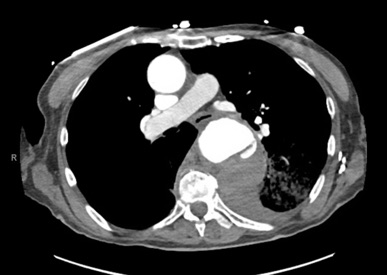
The patient’schest X-ray revealed a prominent mediastinum and opacification in the left middle and lower lung fields. The CT showed an aortic aneurysm extending from the thorax to the abdomen with rupture near T7 (blue arrow). It also showed periaortic hemorrhage with active extravasation (green arrow) likely secondary to a penetrating ulcer and bilateral pulmonary opacities concerning for hemothorax (pink arrow).
Cardiology/VascularVisual EM
Creative Commons images
visualem icon

Extensive Aortic Dissection with Normal Vital Signs

Meryl Abrams, MD*, Nicole Pagliuso, EMT* and Xiao Chi Zhang, MD, MS*

DOI: https://doi.org/10.21980/J80S6SIssue 3:4[mrp_rating_result]
The patient was found to have a Stanford type A dissection (see yellow arrow) with visible false lumen starting at aortic arch (see green circle). The dissection extended into the descending aorta (see blue circle) as shown by the false lumen (red highlighted area) visible on CT. The radiologist performed a reconstruction of the aorta, which showed that the left kidney was not being perfused, making the kidney not visible on the reconstruction.
Cardiology/VascularVisual EM
Show More

JETem is an online, open access, peer-reviewed, journal-repository for EM educators. We are PMC Indexed.

Most Viewed

  • Enhancing Emergency Medicine Resident Education: A Weekly Education Series to Augment Electrocardiogram Education
  • Development and Design of a Pediatric Case-Based Virtual Escape Room on Acute Iron Toxicity
  • Pre-Clinical Case Competition to Assess Confidence in Responding to Select Out-Of-Hospital Medical Emergencies
  • Pediatric Difficult Airway Simulation Day
  • Cards Against Pulmonology

Visit Our Collaborators


Creative Commons Licence
This work is licensed under a Creative Commons Attribution 4.0 International License.

About

Education

Learners should benefit from active learning. JETem accepts submissions of team-based learning, small group learning, simulation, podcasts, lectures, innovations, curricula, question sets, and visualEM.

Scholarship

We believe educators should advance through the scholarship of their educational work. JETem gives educators the opportunity to publish scholarly academic work so that it may be widely distributed, thereby increasing the significance of their results.

Links

  • Home
  • Aim and Scope
  • Current Issue
  • For Reviewers
  • Instructions for Authors
  • Contact Us

Newsletter

Sign up to receive updates from JETem regarding newly published issues and findings.

Copyright Creative Commons Attribution 4.0 International