
Latest Articles


Classic Slipped Capital Femoral Epiphysis: A Case Report
DOI: https://doi.org/10.21980/J8BD16The pelvis X-ray demonstrates a widened right capital femoral epiphysis (more than 2 mm) that is typical of a slipped capital femoral epiphysis (SCFE).1 The yellow highlight outlines this area of widening.
The classic Klein’s line (orange lines) is often inaccurate and even difficult to draw with certainty.1 Nevertheless, in this X-ray, one has a sense that the right capital femoral epiphysis does not align with the femoral neck in the same way as it does on the left side, suggesting slippage.
FAST Exam to Diagnose Subcapsular Renal Hematoma
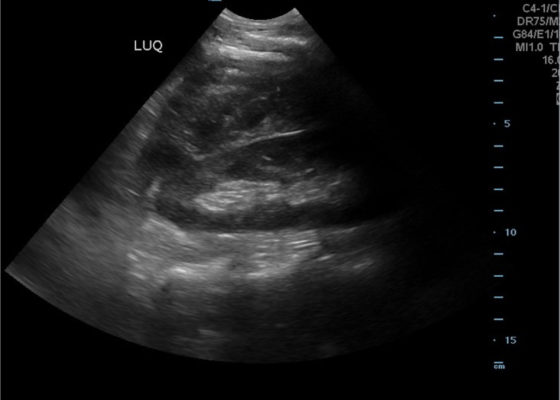
DOI: https://doi.org/10.21980/J8NP8DA bedside point of care ultrasound FAST exam was performed revealing a left subcapsular renal hematoma. The hematoma was a non-compressing hematoma, evidenced by preserved renal contour with the hematoma labeled with a red H and the normal renal contour labeled with a green K. Additionally, cortical necrosis and ischemia can be characterized by a dark, hypoechogenic renal cortex on ultrasonography with a decrease in flow to the cortex on color doppler which was not seen on this patient, providing further evidence that the hematoma was non-compressing. The hematoma was concluded to be an acute process due to its hypoechoic appearance with some mixed ultrasonographic echoes caused by the early deposit of fibrin.
Right Upper Quadrant Pain in a World Explorer
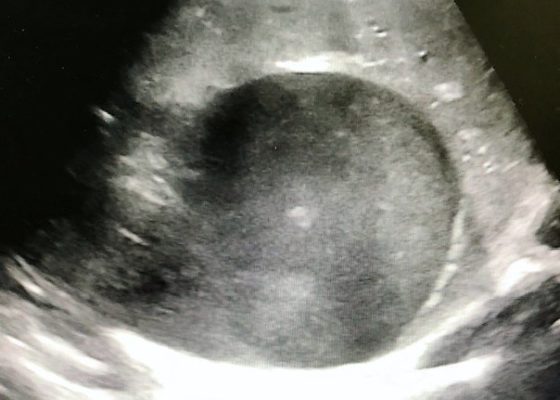
DOI: https://doi.org/10.21980/J8QP9DThe ultrasound images show the abscess, which is a large, circular, hypoechoic mass outlined in blue in the center of the image. The abscess is surrounded by the hyperechoic and heterogeneous liver tissue.
For better delineation of the abscess, a CT was ordered. The axial CT scan image shows the liver abscess, which appears as a hypodense, ovoid, intrahepatic fluid collection within the liver parenchyma. The size of the abscess has been annotated with a dotted line measuring 194.9 mm x 166.2 mm.

Thyroid Storm
DOI: https://doi.org/10.21980/J8XD03By the end of this simulation session, the learner will be able to: 1) understand the essential physical exam components necessary to evaluate for etiologies of acute encephalopathy, 2) review laboratory and imaging studies to obtain for evaluation of acute encephalopathy and/or suspected thyroid storm, as well as the rationale behind ordering each study, 3) identify underlying etiologies or pathologies for developing thyroid storm, 4) discuss treatment for thyroid storm.
A Simulated Scenario to Improve Communication Skills of Residents Providing Online Medical Command of Emergency Medical Service Providers
DOI: https://doi.org/10.21980/J8SK8MBy the end of this simulation, learners will be able to: 1) discuss appropriate medical command instructions for pediatric cardiac arrest; 2) describe alternative methods to obtain weight-based dosing of pediatric critical care medications, if Broselow tape is unavailable; 3) identify need for a definitive airway in a pulseless patient without interruption of chest compressions.
Identify need for rapid intraosseous access in a pulseless pediatric patient; 4) describe the indications for helicopter transfer in a critically ill child.
Post-Termination Hemorrhage
DOI: https://doi.org/10.21980/J8NW6QBy the end of this simulation, participants will be able to: 1) recognize post-termination hemorrhage and hemorrhagic shock; 2) demonstrate appropriate acute resuscitation for a patient with hemorrhagic shock; 3) review the differential diagnosis for a patient with post-termination hemorrhage; 4) identify the indications for massive transfusion protocol.
Thyroid Storm in the Emergency Department
DOI: https://doi.org/10.21980/J8234RBy the end of this simulation-based session, the learner will be able to: 1) Recognize the signs and symptoms of thyroid storm and appropriately diagnose a patient with thyroid storm. 2) Choose appropriate medications for the treatment of thyroid storm. 3) Determine the appropriate disposition for a patient presenting in thyroid storm. 4) Discuss the rationale behind each drug used to treat thyroid storm. 5) List at least three precipitants of thyroid storm.

A Story About Mesenteric Ischemia
DOI: https://doi.org/10.21980/J8J33QWe aim to teach the presentation and management of cardiovascular emergencies through the creation of a flipped classroom design. This unique, innovative curriculum utilizes resources chosen by education faculty and resident learners, study questions, real-life experiences, and small group discussions in place of traditional lectures. In doing so, a goal of the curriculum is to encourage self-directed learning, improve understanding and knowledge retention, and improve the educational experience of our residents.

Emergency Medicine Curriculum Utilizing the Flipped Classroom Method: Infectious Disease and Immunology
DOI: https://doi.org/10.21980/J8DD1TWe aim to teach the presentation and management of infectious disease and immunological emergencies through the creation of a flipped classroom design. The topics include sepsis, sexually transmitted infections (STIs), tropical diseases, angioedema and anaphylaxis, transplant-related emergencies, and collagen vascular diseases. This unique, innovative curriculum utilizes resources chosen by education faculty and resident learners, study questions, real-life experiences, and small group discussions in place of traditional lectures. The goal of our curriculum is to encourage self-directed learning, improve understanding and knowledge retention, and improve the educational experience of our residents.