
JETem
  • Home
  • About
    • Aim and Scope
    • Our Team
    • Editorial Board
    • FAQ
  • Issues
    • Current Issue
    • Ahead of Print
    • Past Issues
  • Visual EM
    • Latest Visual EM
    • Search Visual EM
    • Thumbnail Library
  • For Authors
    • Instructions for Authors
    • Submit to JETem
    • Photo Consent
    • Policies
      • Peer Review Policy
      • Copyright Policy
      • Editorial Policy, Ethics and Responsibilities
      • Conflicts of Interest & Informed Consent
      • Open Access Policy
  • For Reviewers
    • Instructions for JETem Reviewers
    • Interested in Being a JETem Reviewer?
  • Topic
    • Abdominal/Gastroenterology
    • Administration
    • Board Review
    • Cardiology/Vascular
    • Certifying Exam Cases
      • Clinical Decision-Making
      • Prioritization
      • Communication
      • Procedure & Ultrasound
    • Clinical Informatics, Telehealth and Technology
    • Dermatology
    • EMS
    • Endocrine
    • ENT
    • Faculty Development
    • Genitourinary
    • Geriatrics
    • Hematology/Oncology
    • Infectious Disease
    • Miscellaneous (stats, etc)
    • Neurology
    • Ob/Gyn
    • Ophthalmology
    • Orthopedics
    • Pediatrics
    • Pharmacology
    • Procedures
    • Psychiatry
    • Renal/Electrolytes
    • Respiratory
    • Social Determinants of Health
    • Toxicology
    • Trauma
    • Ultrasound
    • Urology
    • Wellness
    • Wilderness
  • Modality
    • Certifying Exam Practice Cases
      • Clinical Care Cases
      • Communication & Procedural Cases
      • Old School Oral Board Cases
    • Curricula
    • Innovations
    • Lectures
    • Podcasts
    • Simulation
    • Small Group Learning
    • Team Based Learning (TBL)
    • Visual EM
  • Contact Us

Visual EM

Creative Commons images

Pericardial Clot on Point-of-Care Ultrasound

Rame Bashir, BS*, Esther Kim, BS*, Shadi Lahham, MD, MS* and John C Fox, MD*

DOI: https://doi.org/10.21980/J8ZH1TIssue 4:2[mrp_rating_result]
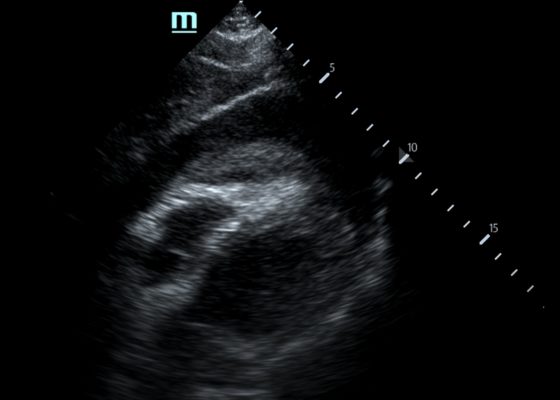
Focused assessment with sonography in trauma (FAST) scan was positive for a clinically significant pericardial effusion as evidenced by the hypoechoic fluid around the myocardium, indicated by the blue arrow in image 2. Findings are also consistent with tamponade process as evidenced by restricted expansion and collapse of the right ventricle during diastole. The hyperechoic floating structure between the pericardium and myocardium, adjacent to the right ventricle, represents a pericardial clot, indicated by the white arrow.The density of the pericardial clot differs from that of the myocardium, thus serving as an additional variable to avoid confusing this as part of the myocardial structure.
Cardiology/VascularUltrasoundVisual EM
Creative Commons images

Wellens’ Syndrome

Brittany Perry Hoffstatter, DO* and Brian Walsh, MD*

DOI: https://doi.org/10.21980/J8FS8KIssue 4:1[mrp_rating_result]
Initial electrocardiogram (ECG) revealed the classic biphasic T waves in V2 and V3 of Wellen’s syndrome (see red outlines). A second EKG demonstrated an evolving deeply inverted T wave (see blue outlines).
Visual EMCardiology/Vascular
Creative Commons images

Arteriovenous Graft Pseudoaneurysm

Erik Madsen, MD*, Lauren Sylwanowicz, MD^ and Alisa Wray, MD, MAEd^

DOI: https://doi.org/10.21980/J8B06ZIssue 4:1[mrp_rating_result]
A bedside ultrasound of the mass demonstrated a large compressible hypoechoic structure (see purple outline) above the arteriovenous graft (see red outline). The contents demonstrated movement of fluid within the structure. This was confirmed with Doppler mode, which allowed for visualization of flow communicating between the structure and the underlying vessel, which is diagnostic for a pseudoaneurysm.
Visual EMCardiology/Vascular
Creative Commons images

Bilateral Shoulder Dislocation after Ski Injury

Alaina Rajagopal, PhD, MD*, Brian Knight, BS* and Lance Orr, MD^

DOI: https://doi.org/10.21980/J86929Issue 4:1[mrp_rating_result]
An anteroposterior chest X-ray demonstrates bilateral shoulder dislocations. Both the right and left humeral heads (blue lines) are displaced medially, anteriorly, and inferiorly from their normal positions in the glenoid fossae (red lines), thus signifying bilateral anterior dislocations. There is also a fracture of the left humeral head at the greater tubercle (green arrow).
OrthopedicsTraumaVisual EM
Creative Commons images

Abdominal Pain with Black Tongue

David A Adler, MD* and Isabel M Algaze Gonzalez, MD^

DOI: https://doi.org/10.21980/J8XS7JIssue 4:1[mrp_rating_result]
Patient’s tongue had a black discoloration, without elongated filiform papillae. We could not appreciate lymphadenopathy. His abdomen was tender to palpation.
ENTVisual EM
Creative Commons images

Beware the Devastating Outcome of a Common Procedure

Ellsworth J Wright IV, MBS*, James F Martin MD^ and Kevin Sirchio, DO^

DOI: https://doi.org/10.21980/J8T336Issue 4:1[mrp_rating_result]
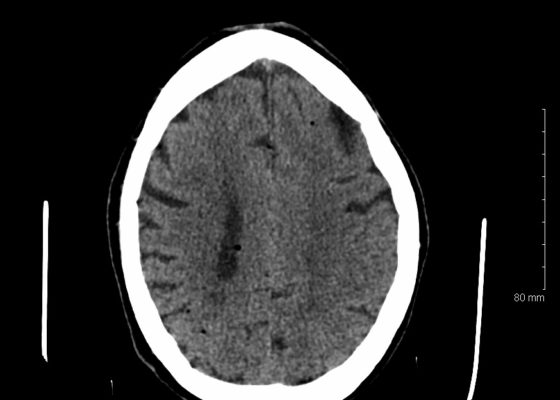
Non-contrast head computed tomography (CT) demonstrates multifocal bilateral hypodense lesions (white arrows) representing air emboli. Note the lesions are located in the intra-axial distribution which indicates an underlying vascular origin.
NeurologyProceduresVisual EM
Creative Commons images

Suspicious Skin Lesion in an 11-Year-Old Male

Rachel E Bonczek, MSN*, Kimberley M Farr, MD^ and Corrie E Chumpitazi, MD, MS‡

DOI: https://doi.org/10.21980/J8JK9TIssue 4:1[mrp_rating_result]
The patient had a 5 cm ulcerative lesion with raised borders and a yellow, “fatty” center. There was no active drainage, site tenderness, or lymphadenopathy.
Visual EMDermatologyInfectious Disease
Creative Commons images

Guilty as Charged: Jailed Coronary Vessel Presenting as Wellens’ Syndrome Type B

Aderonke Susan Akapo, DO*, Ryan Fashempour*, Mohamad Moussa, MD* and Patrick Bruss, MD^

DOI: https://doi.org/10.21980/J8DS6H Issue 4:1[mrp_rating_result]
Evolving changes to electrocardiograph (ECG) were noted during serial ECG monitoring involving leads V2 and V3, along with some T-wave inversion in V4 and V5 that were concerning for a Wellens’ syndrome type B on second ECG. She was admitted and subsequently taken to cardiac catheterization suite where it was revealed that the previously placed stent in the left anterior descending (LAD) artery was patent. Unfortunately, the stent blocked off an adjacent side branch vessel off the LAD in proximal two-third region of the stent (as seen in the cartoon).
Visual EMCardiology/Vascular
«‹22›»
Page 22 of 43

JETem is an online, open access, peer-reviewed, journal-repository for EM educators. We are PMC Indexed.

Most Viewed

  • Enhancing Emergency Medicine Resident Education: A Weekly Education Series to Augment Electrocardiogram Education
  • Development and Design of a Pediatric Case-Based Virtual Escape Room on Acute Iron Toxicity
  • Pre-Clinical Case Competition to Assess Confidence in Responding to Select Out-Of-Hospital Medical Emergencies
  • Pediatric Difficult Airway Simulation Day
  • Cards Against Pulmonology

Visit Our Collaborators


Creative Commons Licence
This work is licensed under a Creative Commons Attribution 4.0 International License.

About

Education

Learners should benefit from active learning. JETem accepts submissions of team-based learning, small group learning, simulation, podcasts, lectures, innovations, curricula, question sets, and visualEM.

Scholarship

We believe educators should advance through the scholarship of their educational work. JETem gives educators the opportunity to publish scholarly academic work so that it may be widely distributed, thereby increasing the significance of their results.

Links

  • Home
  • Aim and Scope
  • Current Issue
  • For Reviewers
  • Instructions for Authors
  • Contact Us

Newsletter

Sign up to receive updates from JETem regarding newly published issues and findings.

Copyright Creative Commons Attribution 4.0 International