
Orthopedics


Open Fracture of the Patella
DOI: https://doi.org/10.21980/J8BK9ZX-ray of the right knee showed evidence of an acute comminuted fracture of the patella (red arrows) with a suprapatellar joint effusion with gas (blue arrow). There was no evidence of joint dislocation or other osseous lesions.

Diagnosis and Treatment of an Anterior Shoulder Dislocation with Bedside Ultrasound
DOI: https://doi.org/10.21980/J8Z924Bedside ultrasound with the transducer placed on the posterior right shoulder revealed an anterior dislocation of the right humerus. This is evident by displacement of the humeral head further away from the posteriorly placed ultrasound transducer, and appears deep to the glenoid cavity. In a posterior shoulder dislocation, the humeral head would appear closer to the transducer (and the near field of the ultrasound image) than the glenoid. Note that a hypoechoic, heterogeneous fluid collection is within the joint space, compatible with a hematoma. A right shoulder X-ray confirmed the anterior dislocation with no evidence of fracture. Under direct ultrasound guidance the glenohumeral joint space was injected with 10 mL of 2% lidocaine as an intraarticular anesthetic block. The right shoulder was reduced using continual traction. Post-reduction ultrasound demonstrated a successful shoulder reduction, depicted by the humeral head being relocated to its anatomical location, adjacent to the glenoid cavity, as noted on the ultrasound image. A hematoma remains present within the joint space. Successful shoulder reduction was further confirmed by X-ray. The patient’s arm was placed in a sling and she was discharged home with orthopedics follow-up.

Pectoralis Muscle Tendon Rupture
DOI: https://doi.org/10.21980/J81D01There is a noticeable difference in appearance and location of maximal prominence of the right pectoral muscle with arms outstretched (image 1). This is accentuated by having the patient perform an isometric arm press. (image 2).There is absence of the anterior axillary fold with adduction against resistance. The stump of the pectoralis muscle was palpated along his armpit. He otherwise has full range of motion in the shoulder with minimal pain.

Pediatric Sedation for Forearm Fracture
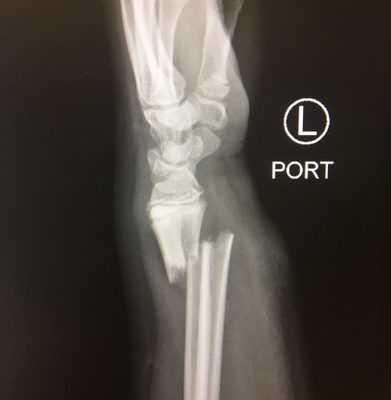
DOI: https://doi.org/10.21980/J8CS7KAt the end of this simulation, participants will: 1) review options for pain control in pediatric patients, 2) perform a pre-sedation history and physical exam, 3) review the indications and contraindications for pediatric moderate sedation, 4) understand components of consent, and get consent from the patient’s parent, 5) list medication options for moderate sedation in a pediatric patient and review their appropriate doses, indications, contraindications, and side effects, 6) discuss management of moderate sedation complications, and 7) review criteria for discharging a patient after sedation.

Bilateral Shoulder Dislocation after Ski Injury
DOI: https://doi.org/10.21980/J86929An anteroposterior chest X-ray demonstrates bilateral shoulder dislocations. Both the right and left humeral heads (blue lines) are displaced medially, anteriorly, and inferiorly from their normal positions in the glenoid fossae (red lines), thus signifying bilateral anterior dislocations. There is also a fracture of the left humeral head at the greater tubercle (green arrow).
Talonavicular Dislocation
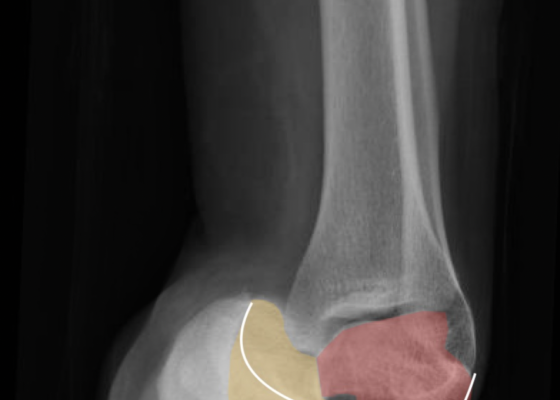
DOI: https://doi.org/10.21980/J8PG91The X-rays were significant for a subtalar dislocation. The calcaneus (red) is laterally displaced with respect to the talar head (orange), and the white lines indicate the normal articular surface. Additionally, there was a talonavicular dislocation, as seen in the fourth image: the talus (green) and navicular bone (purple) overlapping suggests a dislocation. In a normally aligned foot, the boundaries of the two bones create a point of articulation.
Fight Bite with Tendon Laceration
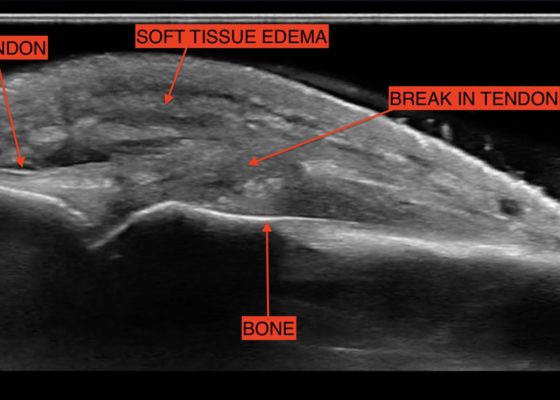
DOI: https://doi.org/10.21980/J8MP7QThe video shows a water bath ultrasound of the right 4th digit, demonstrating soft tissue swelling with a hypoechoic region along the tendon consistent with edema and tendon disruption (see video and annotated still image).
Bilateral Tibia/Fibula Fractures in Automobile versus Pedestrian Accident
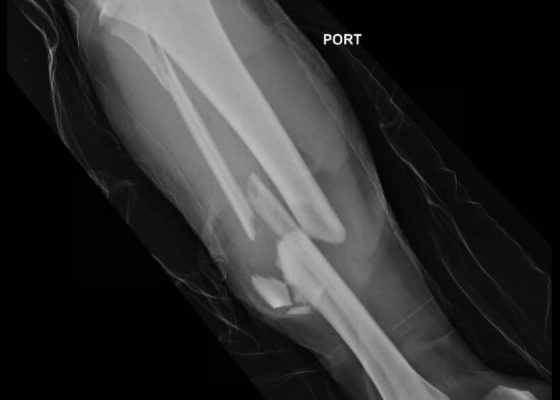
DOI: https://doi.org/10.21980/J8C636Plain film shows severely comminuted and displaced mid tibia/fibula fractures of bilateral lower extremities (red arrows) and comminuted right fibular head (blue arrow) and proximal shaft fracture (yellow arrow).