
JETem
  • Home
  • About
    • Aim and Scope
    • Our Team
    • Editorial Board
    • FAQ
  • Issues
    • Current Issue
    • Ahead of Print
    • Past Issues
  • Visual EM
    • Latest Visual EM
    • Search Visual EM
    • Thumbnail Library
  • For Authors
    • Instructions for Authors
    • Submit to JETem
    • Photo Consent
    • Policies
      • Peer Review Policy
      • Copyright Policy
      • Editorial Policy, Ethics and Responsibilities
      • Conflicts of Interest & Informed Consent
      • Open Access Policy
  • For Reviewers
    • Instructions for JETem Reviewers
    • Interested in Being a JETem Reviewer?
  • Topic
    • Abdominal/Gastroenterology
    • Administration
    • Board Review
    • Cardiology/Vascular
    • Certifying Exam Cases
      • Clinical Decision-Making
      • Prioritization
      • Communication
      • Procedure & Ultrasound
    • Clinical Informatics, Telehealth and Technology
    • Dermatology
    • EMS
    • Endocrine
    • ENT
    • Faculty Development
    • Genitourinary
    • Geriatrics
    • Hematology/Oncology
    • Infectious Disease
    • Miscellaneous (stats, etc)
    • Neurology
    • Ob/Gyn
    • Ophthalmology
    • Orthopedics
    • Pediatrics
    • Pharmacology
    • Procedures
    • Psychiatry
    • Renal/Electrolytes
    • Respiratory
    • Social Determinants of Health
    • Toxicology
    • Trauma
    • Ultrasound
    • Urology
    • Wellness
    • Wilderness
  • Modality
    • Certifying Exam Practice Cases
      • Clinical Care Cases
      • Communication & Procedural Cases
      • Old School Oral Board Cases
    • Curricula
    • Innovations
    • Lectures
    • Podcasts
    • Simulation
    • Small Group Learning
    • Team Based Learning (TBL)
    • Visual EM
  • Contact Us

Cardiology/Vascular

Creative Commons images

Asymptomatic Wolff-Parkinson-White Syndrome: Incidental EKG

Samer Assaf, MD* and Christopher Libby, MD, MPH^

DOI: https://doi.org/10.21980/J8T05X Issue 2:3[mrp_rating_result]
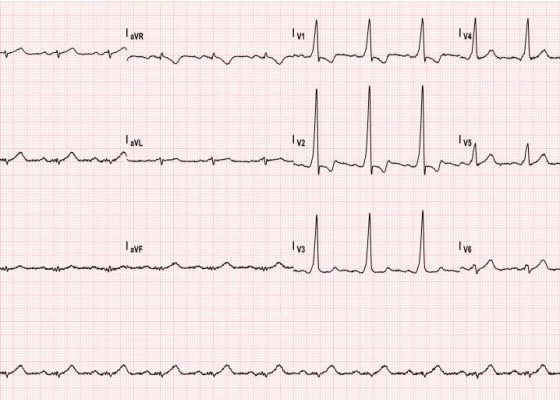
The ECG shows slurred up-stroking of the QRS complexes characteristic of a delta wave. The PR interval is normal; however, the QT interval is greater than 110ms.
Cardiology/VascularVisual EM
Creative Commons images

Renal Infarction from Type B Aortic Dissection

Marit Tweet, MD* and James Roy Waymack, MD*

DOI: https://doi.org/10.21980/J8HG9G Issue 2:3[mrp_rating_result]
Initial abdominal images demonstrated a dissection flap; therefore, a CTA of the chest was also obtained. These images revealed a Stanford type B aortic dissection beginning just distal to the left subclavian artery and extending to the origin of the inferior mesenteric artery. The right renal artery arose from the true lumen of the dissection while the left renal artery arose from the false lumen. This case is interesting as imaging shows the lack of perfusion to the left kidney, residing in the retroperitoneum, which correlates with her non-descript abdominal and left flank pain.
Cardiology/VascularRenal/ElectrolytesVisual EM
Creative Commons images

Ruptured Abdominal Aortic Aneurysm

Jessica Andrusaitis, BS, MS* and Jonathan Peña, MD*

DOI: https://doi.org/10.21980/J8FP6SIssue 2:3[mrp_rating_result]
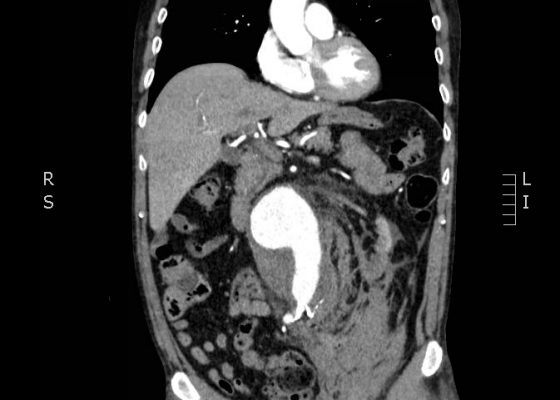
CTA demonstrated a ruptured 7.4 cm infrarenal abdominal aortic aneurysm with a large left retroperitoneal hematoma.
Cardiology/VascularVisual EM
Creative Commons images

Use of Bedside Compression Ultrasonography for Diagnosis of Deep Venous Thrombosis

Mohamad Moussa, MD* and Maher Abdo, BS*

DOI: https://doi.org/10.21980/J81G94 Issue 2:3[mrp_rating_result]
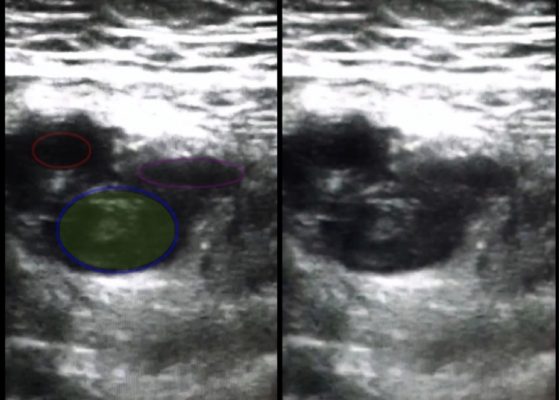
As shown in the still image of the performed ultrasound, a transverse view of the proximal-thigh revealed a visible thrombus (green shading) occluding the lumen of the left common femoral vein (blue ring), which was non-compressible when direct pressure was applied to the probe. Also visible is a patent and compressible branch of the common femoral vein (purple ring) and the femoral artery (red ring), highlighted by its thick vessel wall and pulsatile motion.
UltrasoundCardiology/VascularVisual EM

Emed-Opoly: Echocardiography

Andrew W Phillips, MD, MEd*, Michelle Hunter-Behrend, MD* and Sara Nikravan, MD^

DOI: https://doi.org/10.21980/J8PC77 Issue 2:2[mrp_rating_result]
By the end of this session, the learner will be able to: 1) Recognize normal and abnormal left heart global function 2) Recognize normal and abnormal right heart global function 3) Recognize pericardial effusions and pericardial tamponade
Cardiology/VascularSmall Group LearningUltrasound

Left Ventricular Assist Devices

Khuansiri Narajeenron, MD, MSc*^, Wirachin Ying Hoonpongsimanot, MD, MS^ and Megan Boysen Osborn, MD, MHPE^

DOI: https://doi.org/10.21980/J8JP4Z Issue 2:2[mrp_rating_result]
Upon completion of this cTBL module, the learner will be able to: 1) Properly assess LVAD patients’ circulatory status; 2) appropriately resuscitate LVAD patients; 3) identify common LVAD complications; 4) evaluate and appropriately manage patients with LVAD malfunctions.
Cardiology/VascularTeam Based Learning (TBL)
Creative Commons images

Acute Aortic Dissection Presenting Exclusively as Lower Extremity Paresthesias

Ryan Gibney, BS*, Jonathan Patane, MD* and Steven Bunch, MD*

DOI: https://doi.org/10.21980/J8NK57 Issue 2:2[mrp_rating_result]
Chest x-ray and CT angiogram was performed to evaluate his thoracic and abdominal vasculature. Chest x-ray did not show any significant widening of the mediastinum. The CT angiogram demonstrated an intimal tear along the aortic arch separating a true and false aortic lumen, consistent with an acute aortic dissection. The true lumen (highlighted in blue in images 1-5) can be identified by continuity with an undissected part of the aorta. While the false lumen (highlighted in red in images 1-5) can be identified by its crescent shape and larger cross-sectional area.
Cardiology/VascularVisual EM
Creative Commons images

Acute, massive pulmonary embolism with right heart strain and hypoxia requiring emergent tissue plasminogen activator (TPA) infusion

Jonathan Patane, MD* and Wirachin Hoonpongsimanont, MD*

DOI: https://doi.org/10.21980/J84K5K Issue 2:2[mrp_rating_result]
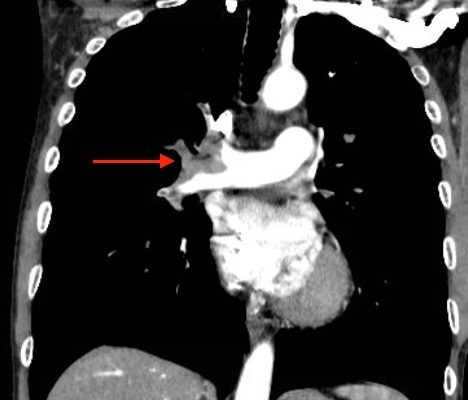
CT angiogram showed multiple large acute pulmonary emboli, most significantly in the distal right main pulmonary artery (image 1 and 2). Additional pulmonary emboli were noted in the bilateral lobar, segmental, and subsegmental levels of all lobes. There was a peripheral, wedge-shaped consolidation surrounded by groundglass changes in the posterolateral basal right lower lobe that was consistent with a small lung infarction (image 3).
Cardiology/VascularRespiratoryVisual EM
«‹12›»
Page 12 of 14

JETem is an online, open access, peer-reviewed, journal-repository for EM educators. We are PMC Indexed.

Most Viewed

  • Enhancing Emergency Medicine Resident Education: A Weekly Education Series to Augment Electrocardiogram Education
  • Development and Design of a Pediatric Case-Based Virtual Escape Room on Acute Iron Toxicity
  • Pre-Clinical Case Competition to Assess Confidence in Responding to Select Out-Of-Hospital Medical Emergencies
  • Pediatric Difficult Airway Simulation Day
  • Cards Against Pulmonology

Visit Our Collaborators


Creative Commons Licence
This work is licensed under a Creative Commons Attribution 4.0 International License.

About

Education

Learners should benefit from active learning. JETem accepts submissions of team-based learning, small group learning, simulation, podcasts, lectures, innovations, curricula, question sets, and visualEM.

Scholarship

We believe educators should advance through the scholarship of their educational work. JETem gives educators the opportunity to publish scholarly academic work so that it may be widely distributed, thereby increasing the significance of their results.

Links

  • Home
  • Aim and Scope
  • Current Issue
  • For Reviewers
  • Instructions for Authors
  • Contact Us

Newsletter

Sign up to receive updates from JETem regarding newly published issues and findings.

Copyright Creative Commons Attribution 4.0 International