
Posts by JETem

Brown Recluse Spider Bite
DOI: https://doi.org/10.21980/J8TK99Examination of the skin revealed erythema and induration on the right lateral leg 12 cm in diameter with a 6 cm area of central necrosis and surrounding petechiae without fluctuance or crepitus. The patient was neurovascularly intact distal to the lesion. Laboratory values were within normal limits, except for an elevated C-reactive protein (5.31 mg/dL, normal range <0.70 mg/dL). The patient was diagnosed with ulceration secondary to envenomation from a brown recluse spider.


Wandering Spleen
DOI: https://doi.org/10.21980/J8PS7CHistory of present illness: A 7-month-old boy presented for evaluation of an abdominal mass. Two weeks prior, the patient had a fever followed by 24 hours of vomiting and abdominal pain, which self-resolved. His pediatrician noted the mass on exam and referred child to the emergency department (ED). His abdominal exam was significant for a hard mass palpated to the

Levamisole Induced, Cocaine Associated Vasculitis
DOI: https://doi.org/10.21980/J8K35SAn asymmetric pattern of palpable purpura with bullae was noted on bilateral lower extremities with smaller patches on bilateral upper extremities. There was no tenderness or crepitus.
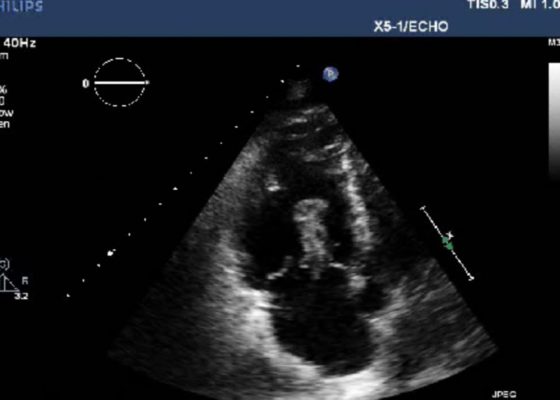
Right Atrial Thrombus
DOI: https://doi.org/10.21980/J8F93V History of present illness: A 77-year-old male presented to the emergency department with shortness of breath. Symptoms progressively worsened over the last 4-5 days, and on arrival was associated with chest tightness. He denied any medical conditions, smoking, or pertinent family history. He has not seen a primary care physician in “many years.” Upon arrival he was in mild

Posterior Vitreous Detachment
DOI: https://doi.org/10.21980/J89K9NOcular ultrasound was performed and demonstrated a thin, slightly echogenic strand (blue arrow) extending from the posterior eye into the vitreous humor (yellow arrow) which was hyperkinetic with extraocular motion. These findings are consistent with a posterior vitreous detachment (PVD).

Acute Ischemic Stroke
DOI: https://doi.org/10.21980/J8R04XBy the end of this simulation session, learners will be able to: 1) recognize a CVA using the National Institutes of Health Stroke Scale (NIHSS), 2) understand and properly utilize the NIHSS, 3) list appropriate imaging and laboratory orders for a CVA work-up, 4) determine appropriate subspecialty consultation, 5) discuss common stroke syndromes and associated cerebral locations, 6) review indications and contraindications for tissue plasminogen activator (tPA), 7) review hospital specific stroke protocol.
Ethylene Glycol Ingestion
DOI: https://doi.org/10.21980/J8M620By the conclusion of the simulation session, learners will be able to: 1) obtain a thorough toxicologic history, including intent, timing, volume/amount, and assessment for co-ingestions, 2) distinguish the variable clinical signs and symptoms associated with toxic alcohol ingestions, 3) identify metabolic derangements associated with toxic alcohol ingestions, 4) discuss the management of toxic alcohol ingestion, 5) appropriately disposition the patient for admission to intensive care unit (ICU).

Approach to Geriatric Emergency Medicine: A Flipped Classroom Group Learning Exercise for Undergraduate Medical Trainees
DOI: https://doi.org/10.21980/J8GH03At the end of the module, learners should be able to: 1) recognize that many benign-seeming presentations, including restricting fatigue and cognitive decline, can have serious and life-threatening causes, 2) describe the importance of screening for delirium in older ED patients, 3) identify situations in which vital signs can be misleading in older adults and know strategies to further investigate such data, and 4) recognize that older adults can rapidly develop delirium in the ED and be able to apply strategies to reduce risk of delirium.