
Issue 11:4

The Challenge of Critical Feedback: A Simulation-based Advanced Residents as Teachers Module
DOI: https://doi.org/10.5070/M5.52392The purpose of this module was to provide a safe learning environment for residents to practice giving critical feedback to medical students. By the end of the session, residents will be able to 1) identify gaps in student proficiency through analysis of a simulated student’s clinical performance as demonstrated by a simulated case presentation, 2) formulate specific feedback for student learners to target identified gaps, and 3) apply a newly learned strategy for providing feedback to a “student” during two simulation-based communication cases.

Awaiting Stress: An Interprofessional In-situ Simulation to Optimize Team Management of Cardiac Arrest in an Emergency Department Observation Unit
DOI: https://doi.org/10.5070/M5.52393By the end of this simulation session, learners will be able to: 1) prioritize and coordinate team-based tasks within the CDU environment upon recognizing patient decompensation and cardiac arrest, 2) optimize clinical decision unit (CDU) team member roles and interprofessional communication, 3) adapt resuscitation principles in the resource-variable setting of a CDU to manage a critically ill patient.
Meeting the Milestones through Simulation: Disclosing a Medical Error
DOI: https://doi.org/10.5070/M5.53010By the end of this simulation activity, learners will be able to: 1) disclose a medical error to a patient and/or their family, 2) understand the different types of patient safety events that should be reported, 3) locate the form for disclosing a patient safety event at their institution, and 4) appropriately complete a patient safety report at their institution.
Simulation-Based Interprofessional Didactic for Emergency Management of Snakebites
DOI: https://doi.org/10.5070/M5.61957By the end of the simulation, participants will be able to recognize and appropriately manage neurotoxic snakebite envenomation, including initiating first-line management and toxicology consultation, coordinating antivenom administration, recognizing and treating antivenom-associated anaphylaxis, assessing and managing progressive respiratory failure, demonstrating effective interprofessional communication using TeamSTEPPS principles,4 and coordinating timely consultation, handoff, and disposition with toxicology, pharmacy, and the critical care team.

How to Place a Central Line: Preparing Your Kit & Performing the Procedure
DOI: https://doi.org/10.5070/M5.54074By the end of these videos, learners will be able to:
1. Identify and gather all necessary materials for internal jugular (IJ) CVC placement.
2. Describe the appropriate positioning of the patient, ultrasound machine, and proceduralist for CVC placement.
3. List common complications of IJ CVC placement.
4. Demonstrate sterile field preparation, including donning personal protective equipment (PPE), placing a sterile drape, and placement of a sterile ultrasound probe cover.
5. Perform a proper pre-procedural time-out including at least two patient identifiers and site verification.
6. Prepare and organize CVC kit components for efficient procedural flow.
7. Identify key anatomical landmarks and optimal patient positioning for right IJ CVC placement using ultrasound guidance.
8. Demonstrate stepwise needle insertion with real-time ultrasound visualization to safely cannulate the
internal jugular vein.
9. Verify proper guidewire placement using both short- and long-axis ultrasound views before vessel dilation.
10. Perform safe dilation and catheter advancement using standard procedural technique.
11. Exhibit best-practice behaviors, including port flushing, line securement, and sterile dressing application.
12. Document the procedure and identify post-placement safety steps such as confirmatory chest imaging.

Transforming Emergency Medicine Mentorship: A Skill-Building Curriculum to Optimize Mentee Growth and Development
DOI: https://doi.org/10.5070/M5.52383The aim of this curriculum is to train mentors to approach mentoring with a curious and non-judgmental mindset. The curriculum offers specific, practical exercises to increase mentors’ ability to foster a mentee-driven relationship that meets the needs of all mentees, which in turn enhances career development and faculty retention at the department level.

Ruptured Hemorrhagic Ovarian Cyst Mimicking Ruptured Ectopic Pregnancy in a Post-Transplant Patient: A Case Report
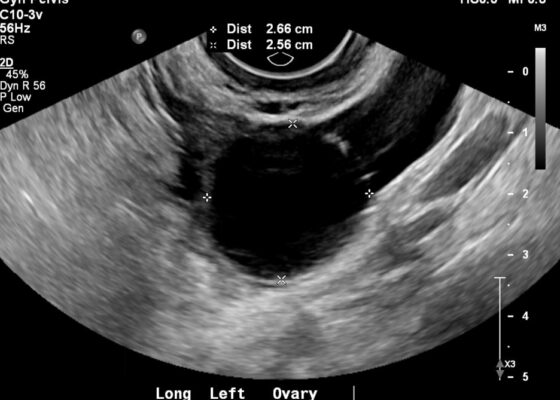
DOI: https://doi.org/10.5070/M5.52390A formal transvaginal ultrasound was ordered in the setting of the positive beta-hCG levels, which demonstrated a moderate volume of debris-containing free pelvic fluid layering in the posterior cul-de-sac (yellow highlighting), without sonographic evidence of an intrauterine gestational sac or yolk sac. Additionally, the left ovary contained a 2.8 cm cystic structure consistent with a hemorrhagic ovarian cyst (blue highlighting).
Intentional Pencil Ingestion – A Case Report of a Sharp Ingested Foreign Body
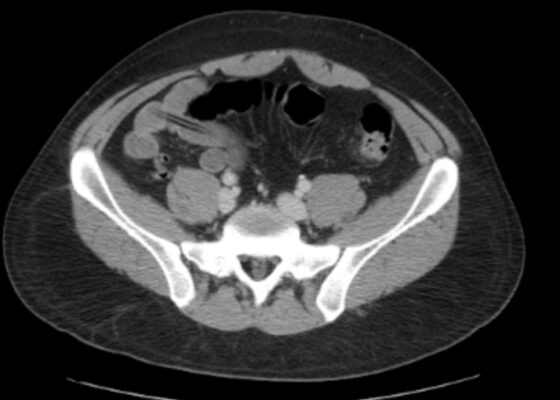
DOI: https://doi.org/10.5070/M5.53005Computerized tomography (CT) of the abdomen and pelvis two days after the ingestion of the pencil revealed a hypodense foreign object measuring 7.9 cm (blue arrows) in the lumen of the distal ileum. The images obtained demonstrate that the object progressed past physiological strictures within the gastrointestinal tract such as the esophagus and stomach; however, it had yet to progress through the ileocecal junction. Ingested foreign bodies carry a high risk of obstruction and perforation at these physiological stricture points. A repeat CT scan six days later showed that the pencil (yellow arrow) had progressed to the distal transverse colon.