
JETem
  • Home
  • About
    • Aim and Scope
    • Our Team
    • Editorial Board
    • FAQ
  • Issues
    • Current Issue
    • Ahead of Print
    • Past Issues
  • Visual EM
    • Latest Visual EM
    • Search Visual EM
    • Thumbnail Library
  • For Authors
    • Instructions for Authors
    • Submit to JETem
    • Photo Consent
    • Policies
      • Peer Review Policy
      • Copyright Policy
      • Editorial Policy, Ethics and Responsibilities
      • Conflicts of Interest & Informed Consent
      • Open Access Policy
      • Acceptance Fee
  • For Reviewers
    • Instructions for JETem Reviewers
    • Interested in Being a JETem Reviewer?
  • Topic
    • Abdominal/Gastroenterology
    • Administration
    • Board Review
    • Cardiology/Vascular
    • Certifying Exam Cases
      • Clinical Decision-Making
      • Prioritization
      • Communication
      • Procedure & Ultrasound
    • Clinical Informatics, Telehealth and Technology
    • Dermatology
    • EMS
    • Endocrine
    • ENT
    • Faculty Development
    • Genitourinary
    • Geriatrics
    • Hematology/Oncology
    • Infectious Disease
    • Miscellaneous (stats, etc)
    • Neurology
    • Ob/Gyn
    • Ophthalmology
    • Orthopedics
    • Pediatrics
    • Pharmacology
    • Procedures
    • Psychiatry
    • Renal/Electrolytes/Nutrition
    • Respiratory
    • Social Determinants of Health
    • Toxicology
    • Trauma
    • Ultrasound
    • Urology
    • Wellness
    • Wilderness
  • Modality
    • Certifying Exam Practice Cases
      • Clinical Care Cases
      • Communication & Procedural Cases
      • Old School Oral Board Cases
    • Curricula
    • Innovations
    • Lectures
    • Podcasts
    • Simulation
    • Small Group Learning
    • Team Based Learning (TBL)
    • Visual EM
  • Contact Us

Issue 11:4

Clinical Decision Making: Sickle Cell Crisis with Acute Chest Syndrome

Ryan Adkins, DO*

DOI: https://doi.org/10.5070/M5.53173 Issue 11:4[mrp_rating_result]
By the end of this clinical decision-making case, learners will be able to: 1) demonstrate familiarity with a case, 2) identify focused historical and physical exam findings in ACS, 3) develop a differential diagnosis for chest pain in a sickle cell patient, 4) select and interpret appropriate diagnostic studies, 5) initiate ED management including oxygen, antibiotics, and pain control, 6) recognize when to consult hematology and consider transfusion, 7) appropriately disposition the patient and communicate a transition of care, and 8) explain the pathophysiology of ACS.
Current IssueCertifying Exam CasesClinical Decision-Making

Physical Wellbeing Scavenger Hunt

Walker Plash, MD* and Grace Lagasse, MD*

DOI: https://doi.org/10.5070/M5.53258 Issue 11:4[mrp_rating_result]
By the end of this session, the learner will be able to: 1) implement basic ways to improve sleep quality, 2) avoid common pitfalls in diet and nutrition, 3) incorporate more physical activity into their lives.
Current IssueSmall Group LearningWellness

Physical Frailty and End-of-Life Care Small Groups

Candace Leigh, MD* and Kevin Watkins, MD*

DOI: https://doi.org/10.5070/M5.53060 Issue 11:4[mrp_rating_result]
At the end of this module, learners should be able to: 1) recognize and classify end-of-life trajectories, 2) define physical frailty, including risk factors, prevalence and prognosis in ED patients, 3) develop a differential diagnosis and diagnostic and treatment plan for a patient with metastatic cancer presenting with fatigue, constipation, labile mood, and diffuse osseous pain, 4) review Medicare Hospice Benefit eligibility, 5) understand the differential diagnosis and medical management of chemotherapy-related nausea, 6) discuss the assessment and management of dyspnea in end-of-life patients, and 7) review how to estimate and communicate prognosis using practical timeframes.
Current IssueSmall Group LearningSocial Determinants of Health
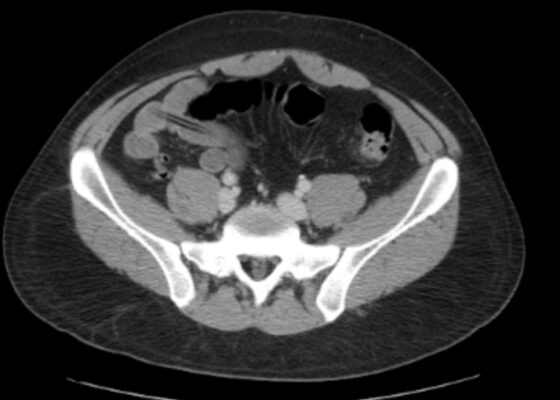
Intentional Pencil Ingestion. CT axial. JETem 2026

Intentional Pencil Ingestion – A Case Report of a Sharp Ingested Foreign Body

Francis Gan, MD*, Nathan Mercado, MD*, Abhijnya Gowder^, Daniel Ng, MD*^ , Sassan Ghassemzadeh, MD* and John Costumbrado, MD, MPH*^

DOI: https://doi.org/10.5070/M5.53005Issue 11:4[mrp_rating_result]
Computerized tomography (CT) of the abdomen and pelvis two days after the ingestion of the pencil revealed a hypodense foreign object measuring 7.9 cm (blue arrows) in the lumen of the distal ileum. The images obtained demonstrate that the object progressed past physiological strictures within the gastrointestinal tract such as the esophagus and stomach; however, it had yet to progress through the ileocecal junction. Ingested foreign bodies carry a high risk of obstruction and perforation at these physiological stricture points. A repeat CT scan six days later showed that the pencil (yellow arrow) had progressed to the distal transverse colon.
Current IssueAbdominal/GastroenterologyVisual EM

JETem is an online, open access, peer-reviewed, journal-repository for EM educators. We are PMC Indexed.

Most Viewed

  • Clinical Decision Making: Sickle Cell Crisis with Acute Chest Syndrome
  • Simple Auricular Hematoma (“Cauliflower Ear”) Task Trainer
  • The Three Breath Method: Teaching Coping Mechanisms for Processing Patient Death
  • Clinical Decision Making: Acute Ischemic Stroke with Large Vessel Occlusion
  • PRIMER: Premedical Introduction to Mentored Emergency Research: Connecting Undergraduate Assistants and Emergency Medicine Residents in a Community Hospital Setting

Visit Our Collaborators


Creative Commons Licence
This work is licensed under a Creative Commons Attribution 4.0 International License.

About

Education

Learners should benefit from active learning. JETem accepts submissions of team-based learning, small group learning, simulation, podcasts, lectures, innovations, curricula, question sets, and visualEM.

Scholarship

We believe educators should advance through the scholarship of their educational work. JETem gives educators the opportunity to publish scholarly academic work so that it may be widely distributed, thereby increasing the significance of their results.

Links

  • Home
  • Aim and Scope
  • Current Issue
  • For Reviewers
  • Instructions for Authors
  • Contact Us

Newsletter

Sign up to receive updates from JETem regarding newly published issues and findings.

Copyright Creative Commons Attribution 4.0 International