JETem
  • Home
  • About
    • Aim and Scope
    • Our Team
    • Editorial Board
    • FAQ
  • Issues
    • Current Issue
    • Ahead of Print
    • Past Issues
  • Visual EM
    • Latest Visual EM
    • Search Visual EM
    • Thumbnail Library
  • For Authors
    • Instructions for Authors
    • Submit to JETem
    • Photo Consent
    • Policies
      • Peer Review Policy
      • Copyright Policy
      • Editorial Policy, Ethics and Responsibilities
      • Conflicts of Interest & Informed Consent
      • Open Access Policy
      • Acceptance Fee
  • For Reviewers
    • Instructions for JETem Reviewers
    • Interested in Being a JETem Reviewer?
  • Topic
    • Abdominal/Gastroenterology
    • Administration
    • Board Review
    • Cardiology/Vascular
    • Certifying Exam Cases
      • Clinical Decision-Making
      • Prioritization
      • Communication
      • Procedure & Ultrasound
    • Clinical Informatics, Telehealth and Technology
    • Dermatology
    • EMS
    • Endocrine
    • ENT
    • Faculty Development
    • Genitourinary
    • Geriatrics
    • Hematology/Oncology
    • Infectious Disease
    • Miscellaneous (stats, etc)
    • Neurology
    • Ob/Gyn
    • Ophthalmology
    • Orthopedics
    • Pediatrics
    • Pharmacology
    • Procedures
    • Psychiatry
    • Renal/Electrolytes/Nutrition
    • Respiratory
    • Social Determinants of Health
    • Toxicology
    • Trauma
    • Ultrasound
    • Urology
    • Wellness
    • Wilderness
  • Modality
    • Certifying Exam Practice Cases
      • Clinical Care Cases
      • Communication & Procedural Cases
      • Old School Oral Board Cases
    • Curricula
    • Innovations
    • Lectures
    • Podcasts
    • Simulation
    • Small Group Learning
    • Team Based Learning (TBL)
    • Visual EM
  • Contact Us

Latest Articles

Creative Commons images
visualem icon

Presentation of Significant Subarachnoid Hemorrhage without Loss of Consciousness

Nicholas Taylor, BA* and Shannon Toohey, MD, MAEd*

DOI: https://doi.org/10.21980/J80W29 Issue 2:2[mrp_rating_result]
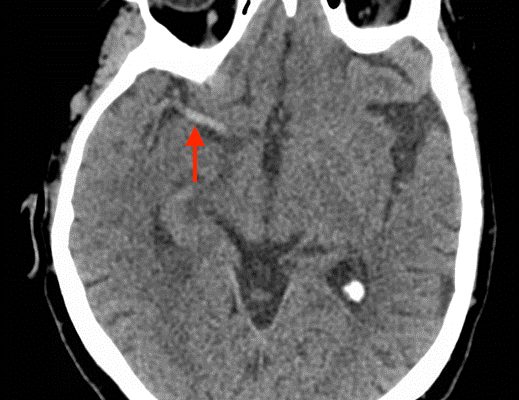
A non-contrast head CT demonstrated extensive subarachnoid hemorrhage occupying both cerebral convexities, the anterior interhemispheric fissure, the sylvian fissures, and the basal cisterns. Later CTA would show an 8 mm by 7 mm by 8mm MCA aneurysm near the M1/M2 junction and two pericallosal artery aneurysms, 7 by 6 mm and 8 by 5 mm respectively.
NeurologyVisual EM
Creative Commons images
visualem icon

Acute Subdural Hematoma

Ellen Lester, BS*, Jonathan Peña, MD* and Warren Wiechmann, MD, MBA*

DOI: https://doi.org/10.21980/J87C76 Issue 2:2[mrp_rating_result]
Non-contrast Computed Tomography (CT) of the Head showed a dense extra-axial collection along the left frontal and parietal regions, extending superior to the vertex with mild mass effect, but no midline shift.
NeurologyVisual EM
Creative Commons images
visualem icon

Wellens’ Sign (Wellens’ Syndrome)

Jonathan Patane, MD* and Kim Sokol, MD*

DOI: https://doi.org/10.21980/J8W30P Issue 2:2[mrp_rating_result]
This EKG shows deep, inverted T waves that are most pronounced in V2-V4, and are associated with continued T wave inversions in V5 and V6 and ST segment changes in V1-V3.
Cardiology/VascularVisual EM
Creative Commons images
visualem icon

Herpes Zoster

Hamid Ehsani-Nia, BS, MS* and Robert Rowe, MD^

DOI: https://doi.org/10.21980/J8C301 Issue 2:2[mrp_rating_result]
The patient was in mild distress, afebrile, with stable vital signs. His physical exam revealed an erythematous, grouped vesicular rash in various stages of progression including erythematous papules, clear vesicles, and pustular vesicles. Few lesions were scabbed over. No signs of crusting or scarring were appreciated. The distribution encompassed the entire left T4 dermatome both posteriorly and anteriorly. No other rashes were appreciated elsewhere on the body.
Infectious DiseaseDermatologyVisual EM
Creative Commons images
visualem icon

Stingray Envenomation

Tanya Dall, MD*

DOI: http://doi.org/10.21980/J86C7W Issue 2:2[mrp_rating_result]
Physical exam revealed a 3cm laceration to the ulnar side of the dorsum of the left hand with minimal hand swelling. There was no exposed tendon or bone, the hand was neurovascularly intact and had full strength. A small barb was visualized and removed from the injury site. Radiograph of the left hand confirmed that there was no remaining barb (see normal x-ray).
WildernessVisual EM
Creative Commons images
visualem icon

The Lost Guidewire

Ankit Shah, MD*, Adam Sigal, MD* and Kristen Sandel, MD*

DOI: https://doi.org/10.21980/J82P4M Issue 2:2[mrp_rating_result]
Initial chest radiograph shows a guidewire in the inferior vena cava (IVC), superior vena cava (SVC), and right IJ veins.
ProceduresAdministrationVisual EM
Creative Commons images
visualem icon

A Toddler with Abdominal Pain and Emesis

Saema Said, BS* and Kevin Koenig, MD*

DOI: https://doi.org/10.21980/J8XW2P Issue 2:2[mrp_rating_result]
In the long axis video, the appendix appears as an enlarged, non-compressible, blind-ending tubular structure (white arrow) with distinct appendiceal wall layers and lack of peristalsis. In the short axis video, the appendix appears as a target sign (yellow arrow) between the abdominal and psoas muscles. The maximal outer diameter (MOD) measures 11.8mm and the appendix wall measures 0.17mm. There is trace adjacent free fluid and echogenic periappendiceal fat. Transverse axis video and image (red arrow) demonstrate that the appendix is not compressible. These findings are consistent with acute appendicitis.
Abdominal/GastroenterologyInfectious DiseasePediatricsUltrasoundVisual EM
curriculum icon

Advanced Ultrasound Workshops for Emergency Medicine Residents

Michelle Lall, MD, MHS*, Sierra Beck, MD* and Jehangir Meer, MD, FACEP, RDMS, RDCS*

DOI: https://doi.org/10.21980/J8W88F Issue 2:1[mrp_rating_result]
This curriculum seeks to renew interest in ultrasound by presenting two advanced workshops on nontraditional content. Sessions covered ways ultrasound could augment or replace aspects of the physical exam, and covered ultrasound guided nerve blocks
UltrasoundCurricula
curriculum icon

A Formalized Three-Year Emergency Medicine Residency Musculoskeletal Emergencies Curriculum

Andrew King, MD, FACEP*, Jeffrey Yu^, Mark J Conroy, MD*, Robert Cooper, MD*, Jennifer Mitzman, MD*, Colin Kaide, MD, FACEP* Sarah Greenberger, MD*, Sorabh Khandelwal, MD* and Michael Barrie, MD*

DOI: https://doi.org/10.21980/J8RG6HIssue 2:1[mrp_rating_result]
Resident learners will master the diagnosis and management of emergent musculoskeletal conditions including fractures/dislocations, soft tissue injuries, compartment syndrome, joint complaints, infections, and complex injuries.
OrthopedicsCurricula
curriculum icon

Novel Emergency Medicine Curriculum Utilizing Self-Directed Learning and the Flipped Classroom Method: Gastrointestinal Emergencies Small Group Module

Andrew King, MD, FACEP*, Elizabeth Matheson^, BS, Christopher San Miguel, MD*, Sarah Greenberger, MD*, Michael Barrie, MD*, Jillian McGrath, MD*, Howard Werman, MD*, Ashish Panchal, MD*, Daniel Martin, MD*, David P Bahner, MD*, Sorabh Khandelwal, MD* and Jennifer Mitzman, MD*

DOI: https://doi.org/10.21980/J8MS37 Issue 2:1[mrp_rating_result]
We aim to teach the presentation and management of GI emergencies through the creation of a flipped classroom design. This unique, innovative curriculum utilizes resources chosen by education faculty and resident learners, study questions, real-life experiences, and small group discussions in place of traditional lectures. In doing so, a goal of the curriculum is to encourage self-directed learning, improve understanding and knowledge retention, and improve the educational experience of our residents.
Abdominal/GastroenterologyCurriculaSmall Group Learning
Show More

JETem is an online, open access, peer-reviewed, journal-repository for EM educators. We are PMC Indexed.

Most Viewed

  • Escape Intern Orientation! — A Capstone and Team Building Activity for New EM Interns
  • Enhancing Relationship-Centered Communication and Feedback in Emergency Medicine Through Applied Improvisation (EM-PROV)
  • Postpartum Complications Modified TBL
  • Midline Catheters: A Novel Curriculum for Emergency Medicine Residents
  • Stopping Fistula Hemorrhage without Bleeding Time and Money – A Low Cost, Low Resource Hemodialysis Fistula Model for Emergency Medicine Residents

Visit Our Collaborators


Creative Commons Licence
This work is licensed under a Creative Commons Attribution 4.0 International License.

About

Education

Learners should benefit from active learning. JETem accepts submissions of team-based learning, small group learning, simulation, podcasts, lectures, innovations, curricula, question sets, and visualEM.

Scholarship

We believe educators should advance through the scholarship of their educational work. JETem gives educators the opportunity to publish scholarly academic work so that it may be widely distributed, thereby increasing the significance of their results.

Links

  • Home
  • Aim and Scope
  • Current Issue
  • For Reviewers
  • Instructions for Authors
  • Contact Us

Newsletter

Sign up to receive updates from JETem regarding newly published issues and findings.

Copyright Creative Commons Attribution 4.0 International