
Visual EM


Posterior Elbow Dislocation
DOI: https://doi.org/10.21980/J8X593Elbow dislocations are classified by the position of the radio-ulnar joint relative to the humerus.1 Images 1, 2, and 3 show a left posterior elbow dislocation; the radius and ulna (red lines) are displaced posteriorly with respect to the distal humerus (blue line). The lateral view of the elbow most clearly shows this: trochlear notch of the ulna (red line) is empty and displaced posteriorly relative to the trochlea (blue line). There is no associated fracture. Images 4 and 5 show the elbow status-post reduction, demonstrating proper alignment of the distal humerus (blue line) with the radius and ulna (red lines).
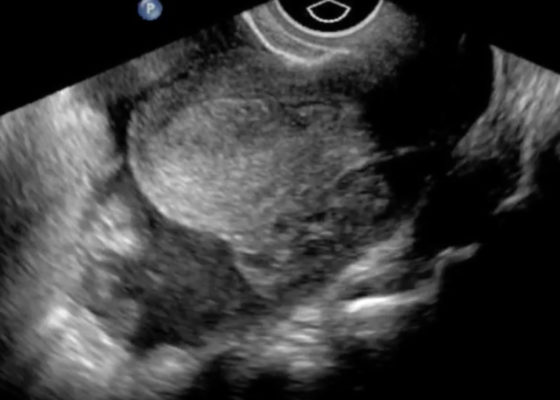
Ruptured Ectopic Pregnancy
DOI: https://doi.org/10.21980/J8SG6TThe patient’s serum beta-hCG was 5,637 mIU/mL. The transvaginal ultrasound showed an empty uterus with free fluid posteriorly in the pelvis and Pouch of Douglas (00:00). A 4.5 cm heterogeneous mass was visible in the left adnexa concerning for an ectopic pregnancy (00:10).
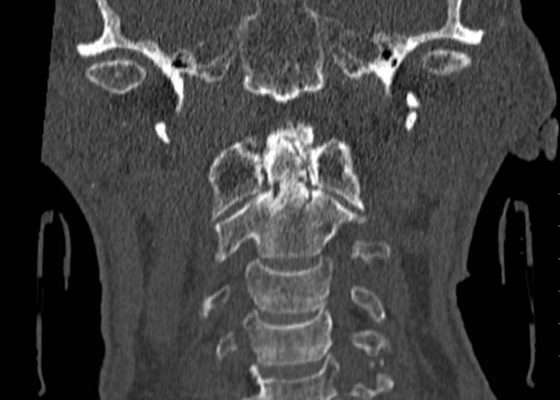
Odontoid Fracture: Computed Tomography
DOI: https://doi.org/10.21980/J8NP4WComputed Tomography (CT) of the cervical spine showed a stable, acute, non-displaced fracture of the odontoid process extending into the body of C2, consistent with a Type III Odontoid Fracture. He was evaluated by orthopedic spine service who recommended conservative, non-operative management.

Open Dislocation of Fifth Digit
DOI: https://doi.org/10.21980/J8J01XPhysical exam revealed an open dislocation of the proximal interphalangeal joint (PIP) of the right fifth digit. X-ray confirmed dislocation and revealed no fractures. The patient received a tetanus booster, Cefazolin, and the dislocation was then washed out and reduced. Multiple reduction attempts were made and were only successful once the metacarpophalangeal joints were held in 90 degree flexion, which relaxed the lateral bands and enabled the finger to be reduced.

Large Right Pleural Effusion
DOI: https://doi.org/10.21980/J8D59FChest x-ray and bedside ultrasound revealed a large right pleural effusion, estimated to be greater than two and a half liters in size.

Morel-Lavallée Lesion
DOI: https://doi.org/10.21980/J88G65On physical examination, the patient was noted to have a nearly “watermelon-sized” fluctuant mass to his right lateral superior quadriceps with multiple overlying abrasions (Image 1). Computed tomography (CT) scans of the area showed a large heterogeneous collection measuring roughly 37x9.5x16 centimeters in the subcutaneous adipose layer of the lateral right thigh (Image 2), while ultrasonography revealed a complex fluid collection containing some nodular solid components and debris (Image 3). Additionally, radiographs confirmed multiple fractures including most significantly a pelvic ring fracture. Surgical debridement, evacuation, and sclerodhesis were performed nine weeks post injury to allow overlying abrasions to heal prior to intervention.

Atrial Myxoma
DOI: https://doi.org/10.21980/J87P45Bedside ultrasound revealed the presence of a left atrial mass that appeared to be tethered to the mitral valve. The mass was best viewed on ultrasound in the apical four-chamber window with the phased array probe placed over the patients’ point of maximal impact (PMI), with the patient in left lateral decubitus position.
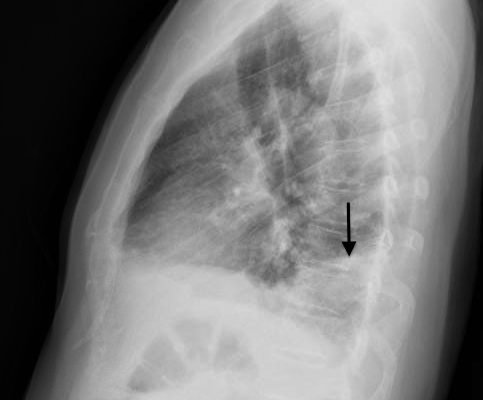
Hampton’s Hump in Pulmonary Embolism
DOI: https://doi.org/10.21980/J83W27In the lateral view chest x-ray, there is a Hampton’s Hump, a pleural based, wedge-shaped opacity at the base of the right lung, representing lung infarction (black arrow). These findings correlate with the sagittal view on CT angiography of the chest. The CT chest also shows a filling defect in the distal posterior basal segmental pulmonary artery (white arrow), as demonstrated by the absence of contrast enhancement in the distal portion of the vessel. This is associated with an opacification of the lung parenchyma distal to the occlusion (red arrow), representing lung infarction.