JETem
  • Home
  • About
    • Aim and Scope
    • Our Team
    • Editorial Board
    • FAQ
  • Issues
    • Current Issue
    • Ahead of Print
    • Past Issues
  • Visual EM
    • Latest Visual EM
    • Search Visual EM
    • Thumbnail Library
  • For Authors
    • Instructions for Authors
    • Submit to JETem
    • Photo Consent
    • Policies
      • Peer Review Policy
      • Copyright Policy
      • Editorial Policy, Ethics and Responsibilities
      • Conflicts of Interest & Informed Consent
      • Open Access Policy
  • For Reviewers
    • Instructions for JETem Reviewers
    • Interested in Being a JETem Reviewer?
  • Topic
    • Abdominal / Gastroenterology
    • Administration
    • Board Review
    • Cardiology / Vascular
    • Certifying Exam Cases
      • Clinical Decision-Making
      • Prioritization
      • Communication
      • Procedure & Ultrasound
    • Clinical Informatics, Telehealth and Technology
    • Dermatology
    • EMS
    • Endocrine
    • ENT
    • Faculty Development
    • Genitourinary
    • Geriatrics
    • Hematology / Oncology
    • Infectious Disease
    • Miscellaneous
    • Neurology
    • Ob / Gyn
    • Ophthalmology
    • Orthopedics
    • Pediatrics
    • Pharmacology
    • Procedures
    • Psychiatry
    • Renal / Electrolytes
    • Respiratory
    • Social Determinants of Health
    • Toxicology
    • Trauma
    • Ultrasound
    • Urology
    • Wellness
    • Wilderness
  • Modality
    • Certifying Exam Practice Cases
      • Clinical Care Cases
      • Communication & Procedural Cases
      • Old School Oral Board Cases
    • Curricula
    • Innovations
    • Lectures
    • Podcasts
    • Simulation
    • Small Group Learning
    • Team Based Learning
    • Visual EM
  • Contact Us

Respiratory

Ventilator TBL

Alisa Wray, MD* and Shannon Toohey, MD, MAEd*

DOI: https://doi.org/10.21980/J8H01MIssue 2:1[mrp_rating_result]
At completion of this TBL the learner should be able to: 1. Choose appropriate ventilator settings and adjustments for a patient with lung injury or obstructive lung pattern 2. Troubleshoot an alarming ventilator 3. Set up the most common ventilator in their ED 4. Set up the equipment needed for transtracheal jet ventilation.
RespiratoryTeam Based Learning (TBL)
Creative Commons images

An Elderly Female with Dyspnea and Abdominal Pain

Jon Van Heukelom, MD*

DOI: https://doi.org/10.21980/J83S3KIssue 2:1[mrp_rating_result]
Radiography shows a dilated, gas-filled structure that fills nearly the entire left hemi-thorax. Lung markings are visible in the uppermost portion of the left hemi-thorax. There is mediastinal shift to the right. In the visualized portion of the abdomen, dilated loops of bowel are also visualized. This constellation of findings is consistent with a tension gastrothorax.
RespiratoryVisual EM
Creative Commons images

Pulmonary Embolism: Diagnosis by Computerized Tomography without Intravenous Contrast

James Roy Waymack, MD*

DOI: https://doi.org/10.21980/J8001ZIssue 2:1[mrp_rating_result]
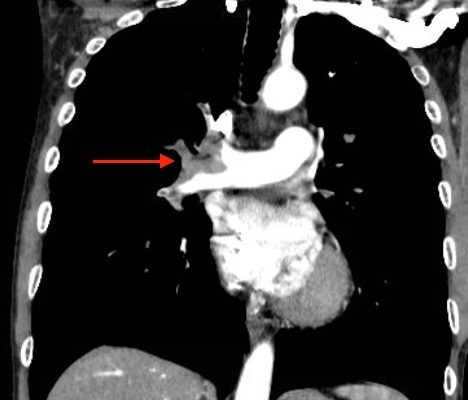
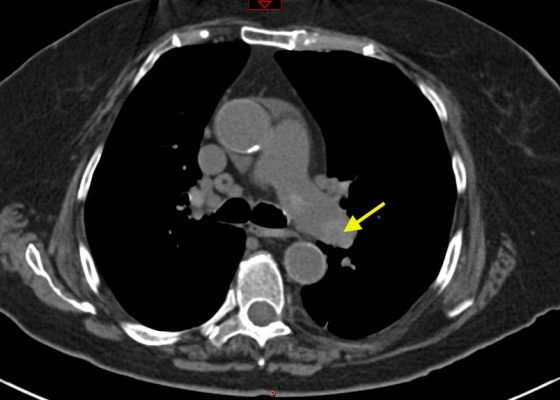
Non-contrast CT of the chest demonstrates hyper-densities within both central and sub-segmental pulmonary arteries bilaterally (see yellow arrows). The right ventricle is dilated.
RespiratoryVisual EM
Pleural Effusion, AP Chest Xray JETem 2016

Large Right Pleural Effusion

Robert Rowe, MD* and Alisa Wray, MD*

DOI: https://doi.org/10.21980/J8D59FIssue 1:2[mrp_rating_result]
Chest x-ray and bedside ultrasound revealed a large right pleural effusion, estimated to be greater than two and a half liters in size.
RespiratoryVisual EM
Creative Commons images

Hampton’s Hump in Pulmonary Embolism

Jonathan Patane, MD* and Megan Boysen Osborn*

DOI: https://doi.org/10.21980/J83W27Issue 1:1[mrp_rating_result]
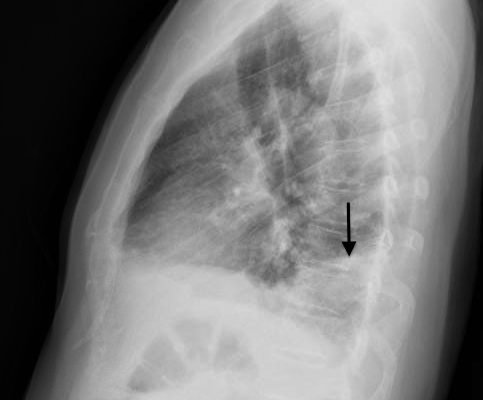
In the lateral view chest x-ray, there is a Hampton’s Hump, a pleural based, wedge-shaped opacity at the base of the right lung, representing lung infarction (black arrow). These findings correlate with the sagittal view on CT angiography of the chest. The CT chest also shows a filling defect in the distal posterior basal segmental pulmonary artery (white arrow), as demonstrated by the absence of contrast enhancement in the distal portion of the vessel. This is associated with an opacification of the lung parenchyma distal to the occlusion (red arrow), representing lung infarction.
RespiratoryVisual EM
Creative Commons images

Pediatric Retractions

[mrp_rating_result]
Keywords: pediatrics, retractions, respiratory, pulmonary
RespiratoryVisual EM
Creative Commons images

Normal CXR: AP and Lateral

[mrp_rating_result]
  Keywords: radiology, normal, chest, CXR, pulm, respiratory, cardiovascular, CV, AP, lateral
Respiratory
post intubation chest x-ray

Normal CXR and Post-Intubation CXR

[mrp_rating_result]
  Keywords: radiology, normal, intubation, CXR, chest, respiratory, respiratory failure, AP, ETT, post-intubation
RespiratoryProcedures
«‹7
Page 7 of 7

JETem is an online, open access, peer-reviewed, journal-repository for EM educators. We are PMC Indexed.

Most Viewed

  • Simulation-Based Preparation for the American Board of Emergency Medicine Certifying Exam: A Comprehensive Curriculum for Residents
  • Difficult Conversation Case: Missed Testicular Cancer
  • Difficult Conversation Case: Death Notification
  • Managing Conflict Case: Admission of a Patient with Decompensated Schizophrenia, Hypertension, and Diabetes
  • Managing Conflict Case: The Difficult Consultant

Visit Our Collaborators


Creative Commons Licence
This work is licensed under a Creative Commons Attribution 4.0 International License.

About

Education

Learners should benefit from active learning. JETem accepts submissions of team-based learning, small group learning, simulation, podcasts, lectures, innovations, curricula, question sets, and visualEM.

Scholarship

We believe educators should advance through the scholarship of their educational work. JETem gives educators the opportunity to publish scholarly academic work so that it may be widely distributed, thereby increasing the significance of their results.

Links

  • Home
  • Aim and Scope
  • Current Issue
  • For Reviewers
  • Instructions for Authors
  • Contact Us

Newsletter

Sign up to receive updates from JETem regarding newly published issues and findings.

Copyright Creative Commons Attribution 4.0 International