JETem
  • Home
  • About
    • Aim and Scope
    • Our Team
    • Editorial Board
    • FAQ
  • Issues
    • Current Issue
    • Ahead of Print
    • Past Issues
  • Visual EM
    • Latest Visual EM
    • Search Visual EM
    • Thumbnail Library
  • For Authors
    • Instructions for Authors
    • Submit to JETem
    • Photo Consent
    • Policies
      • Peer Review Policy
      • Copyright Policy
      • Editorial Policy, Ethics and Responsibilities
      • Conflicts of Interest & Informed Consent
      • Open Access Policy
      • Acceptance Fee
  • For Reviewers
    • Instructions for JETem Reviewers
    • Interested in Being a JETem Reviewer?
  • Topic
    • Abdominal/Gastroenterology
    • Administration
    • Board Review
    • Cardiology/Vascular
    • Certifying Exam Cases
      • Clinical Decision-Making
      • Prioritization
      • Communication
      • Procedure & Ultrasound
    • Clinical Informatics, Telehealth and Technology
    • Dermatology
    • EMS
    • Endocrine
    • ENT
    • Faculty Development
    • Genitourinary
    • Geriatrics
    • Hematology/Oncology
    • Infectious Disease
    • Miscellaneous (stats, etc)
    • Neurology
    • Ob/Gyn
    • Ophthalmology
    • Orthopedics
    • Pediatrics
    • Pharmacology
    • Procedures
    • Psychiatry
    • Renal/Electrolytes/Nutrition
    • Respiratory
    • Social Determinants of Health
    • Toxicology
    • Trauma
    • Ultrasound
    • Urology
    • Wellness
    • Wilderness
  • Modality
    • Certifying Exam Practice Cases
      • Clinical Care Cases
      • Communication & Procedural Cases
      • Old School Oral Board Cases
    • Curricula
    • Innovations
    • Lectures
    • Podcasts
    • Simulation
    • Small Group Learning
    • Team Based Learning (TBL)
    • Visual EM
  • Contact Us

Orthopedics

Creative Commons images

Lunate Dislocation

Jonathan Peña, MD*

DOI: https://doi.org/10.21980/J86K56Issue 2:1[mrp_rating_result]
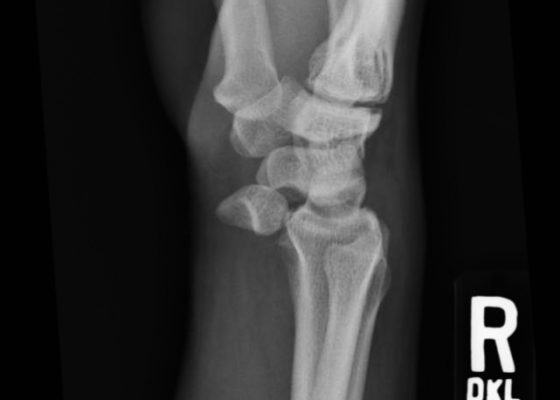
Plain film of the right wrist showed the classic “spilled teacup” consistent with a lunate dislocation. There is a loss of the normal articulation between the distal radius and lunate.
OrthopedicsTraumaVisual EM
Creative Commons images

Pediatric Supracondylar Fracture

Jonathan Peña, MD* and John R. Marshall, MD*

DOI: https://doi.org/10.21980/J8T88TIssue 2:1[mrp_rating_result]
Plain film radiography showed a displaced supracondylar fracture with disrupted anterior and posterior periostea, consistent with a type 3 supracondylar fracture.
OrthopedicsVisual EM
Creative Commons images

Calcaneal Fractures and Böhler’s Angle

Lindsey Spiegelman, MD* and Mohammed Helmy, MD^

Issue 2:1[mrp_rating_result]
The right ankle lateral radiograph shows a comminuted, non-displaced fracture of the posterior calcaneus (red arrow) in addition to fracture fragments along the heel pad margin (blue arrow). The left ankle lateral radiograph shows a displaced, comminuted fracture of the mid to posterior calcaneus with extension into the subtalar joint posteriorly (purple arrow). There is subcutaneous air seen anteriorly to the tibiotalar joint space (green arrow) in addition to a joint effusion. Of note, the Böhler’s angle in the left x-ray is 16 degrees which is consistent with a fracture (see red annotation showing Böhler’s angle).
OrthopedicsVisual EM
Creative Commons images

Monteggia Fracture in an Assault Patient

John Jiao, MHS* and Shannon Toohey, MD, MAEd*

DOI: https://doi.org/10.21980/J81S3ZIssue 2:1[mrp_rating_result]
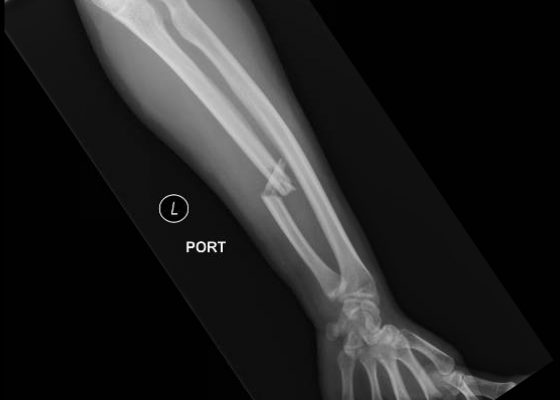
On the axial elbow x-ray, the radial head (red arrow) is dislocated anteriorly from the humerus; the humeroulnar articulation is intact. On the AP forearm x-ray, there is a closed, displaced, comminuted fracture of the ulna (blue arrow).
OrthopedicsVisual EM
Creative Commons images

Hill-Sachs Deformity

Jessa Baker* and Shannon Toohey, MD*

DOI: https://doi.org/10.21980/J8Z59DIssue 1:2[mrp_rating_result]
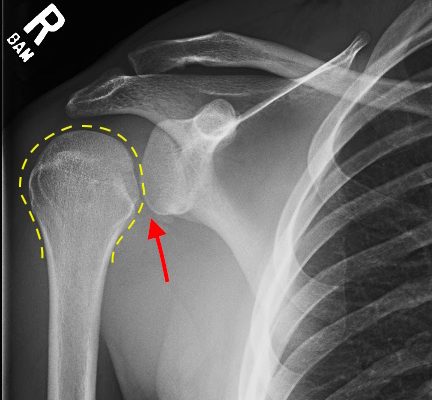
In the post-reduction film, there is a lateral depression in the humeral head (arrow, a Hill-Sachs deformity). A Hill-Sachs deformity is a cortical depression (fracture) in the humeral head that forms as the humeral head hits the glenoid rim during the dislocation.
OrthopedicsVisual EM
Creative Commons images

Trimalleolar Fracture

Christopher Gilani* and Shannon Toohey, MD, MA*

DOI: https://doi.org/10.21980/J8PP46 Issue 1:2[mrp_rating_result]
Anteroposterior (AP), lateral, and oblique x-ray views were obtained. The AP view revealed a displaced spiral fracture of the lateral malleolus (red) and a vertical fracture of the medial malleolus (blue). The lateral view revealed a displaced fracture of the posterior malleolus, tibial plafond (yellow), and the oblique view showed widening of the distal tibiofibular syndesmosis (green). CT scans confirmed trimalleolar fracture, annotated with the same colored lines (red, lateral malleolus; blue, medial malleolus; yellow, posterior malleolus).
OrthopedicsVisual EM
Perilunate Dislocation, XRay. JETem 2016

Perilunate Dislocation

John Jiao, MHS* and Shannon Toohey, MD, MA*

DOI: https://doi.org/10.21980/J8F59RIssue 1:2[mrp_rating_result]
In the left lateral wrist x-ray, the lunate is dislocated from the rest of the wrist bones but still articulates with the radius. The capitate does not sit within the distal articulation of the lunate and is displaced dorsally. Additionally, a line drawn through the radius and lunate fails to intersect with the capitate. This is consistent with a perilunate dislocation. This is compared to a lunate dislocation, where the lunate itself is displaced and turned ventrally (spilled teacup) and the proximal aspect does not articulate with the radius.
OrthopedicsVisual EM
Femoral Neck Fracture, AP Xray. JETem 2016

Femoral Neck Fracture

Jonathan Lee* and Shannon Toohey, MD, MA*

DOI: https://doi.org/10.21980/J89G6GIssue 1:2[mrp_rating_result]
In the anteroposterior view bilateral hip x-ray, there is an evident loss of Shenton’s line on the left when compared to the normal right, indicative of a fracture in the left femoral neck. This correlates with findings seen on pelvic CT, which reveals both a subcapital fracture and transcervical fracture. The neck of the femur is displaced superiorly relative to the head of the femur while the head of the femur remains in its anatomical position within the acetabulum.
OrthopedicsVisual EM
«‹8›»
Page 8 of 10

JETem is an online, open access, peer-reviewed, journal-repository for EM educators. We are PMC Indexed.

Most Viewed

  • Escape Intern Orientation! — A Capstone and Team Building Activity for New EM Interns
  • Enhancing Relationship-Centered Communication and Feedback in Emergency Medicine Through Applied Improvisation (EM-PROV)
  • Postpartum Complications Modified TBL
  • Midline Catheters: A Novel Curriculum for Emergency Medicine Residents
  • Stopping Fistula Hemorrhage without Bleeding Time and Money – A Low Cost, Low Resource Hemodialysis Fistula Model for Emergency Medicine Residents

Visit Our Collaborators


Creative Commons Licence
This work is licensed under a Creative Commons Attribution 4.0 International License.

About

Education

Learners should benefit from active learning. JETem accepts submissions of team-based learning, small group learning, simulation, podcasts, lectures, innovations, curricula, question sets, and visualEM.

Scholarship

We believe educators should advance through the scholarship of their educational work. JETem gives educators the opportunity to publish scholarly academic work so that it may be widely distributed, thereby increasing the significance of their results.

Links

  • Home
  • Aim and Scope
  • Current Issue
  • For Reviewers
  • Instructions for Authors
  • Contact Us

Newsletter

Sign up to receive updates from JETem regarding newly published issues and findings.

Copyright Creative Commons Attribution 4.0 International