
Ob/Gyn

High Fidelity In Situ Shoulder Dystocia Simulation
DOI: https://doi.org/10.21980/J88305DAt the end of this simulation, learners will: 1) Recognize impending delivery and mobilize appropriate resources (ie, both obstetrics [OB] and NICU/pediatrics); 2) Identify risk factors for shoulder dystocia based on history and physical; 3) Recognize shoulder dystocia during delivery; 4) Demonstrate maneuvers to relieve shoulder dystocia; 5) Communicate with team members and nursing staff during resuscitation of a critically ill patient.

Novel Emergency Medicine Curriculum Utilizing Self-Directed Learning and the Flipped Classroom Method: Obstetric and Gynecologic Emergencies Small Group Module
DOI: https://doi.org/10.21980/J8DK9KWe aim to teach the presentation and management of obstetric and gynecologic emergencies through the creation of a flipped classroom design. This unique, innovative curriculum utilizes resources chosen by education faculty and resident learners, study questions, real-life experiences, and small group discussions in place of traditional lectures. In doing so, a goal of the curriculum is to encourage self-directed learning, improve understanding and knowledge retention, and improve the educational experience of our residents.
Precipitous Birth
DOI: https://doi.org/10.21980/J8192RBy the end of this simulation session, the learner will be able to: 1) Recognize impending delivery, 2) identify abnormal maternal vital signs and potential associated pathologies (eg: hypertension in preeclampsia), 3) discuss the evaluation and management of postpartum bleeding, 4) discuss the principles of neonatal resuscitation, 5) appropriately disposition the patients, and 6) effectively communicate with team members and nursing staff during resuscitation of a critically ill patient.
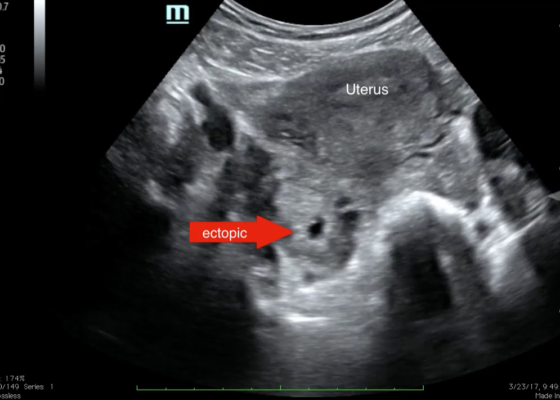

Point-of-care Ultrasound for the Diagnosis of Ectopic Pregnancy
DOI: https://doi.org/10.21980/J8VK7VThe transabdominal pelvic ultrasound shows an empty uterus (annotated) with free fluid and a right sided extrauterine gestational sac representing an ectopic pregnancy (red arrow).
Emergency Medicine Curriculum: Complications of Pregnancy Small Group Module
DOI: https://doi.org/10.21980/J8TS67We aim to teach the presentation and management of pregnancy complications through interactive teaching during small group discussions concerning patient cases. This curriculum utilizes resources chosen by education faculty, study questions, actual experience, and small group discussions in place of a traditional lecture-based format. In doing so, a goal of the curriculum is to encourage self-directed learning, improve understanding and knowledge retention, improve the educational experience of our residents, and allow assessment by the faculty concerning the knowledge base and ability of the residents.

The Casserole Perimortem Caesarean Section Model
DOI: https://doi.org/10.21980/J8FK8HAt the end of this 1-hour activity learners will: 1) describe the indications, contraindications and complications of the PCS, and 2) demonstrate the performance of a PCS.
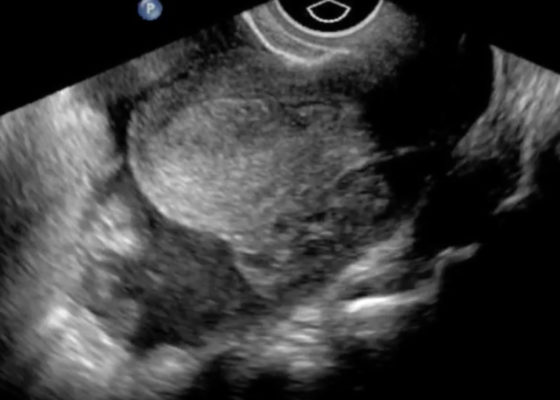
Ruptured Ectopic Pregnancy
DOI: https://doi.org/10.21980/J8SG6TThe patient’s serum beta-hCG was 5,637 mIU/mL. The transvaginal ultrasound showed an empty uterus with free fluid posteriorly in the pelvis and Pouch of Douglas (00:00). A 4.5 cm heterogeneous mass was visible in the left adnexa concerning for an ectopic pregnancy (00:10).