
Posts by JETem
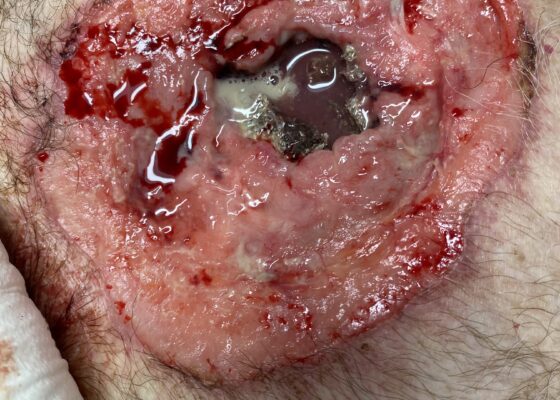

Open Chest Wound with Sternal Fracture in the Emergency Department, a Case Report
DOI: https://doi.org/10.5070/M5.52202The image demonstrates the large chronic-appearing wound of the patient’s anterior chest as well as the visible fractured segments of the patient’s exposed sternum. The sternum is necrotic appearing concerning for a chronic process including osteomyelitis and malignancy. Purulent drainage is visible on the wound consistent with an infectious process.
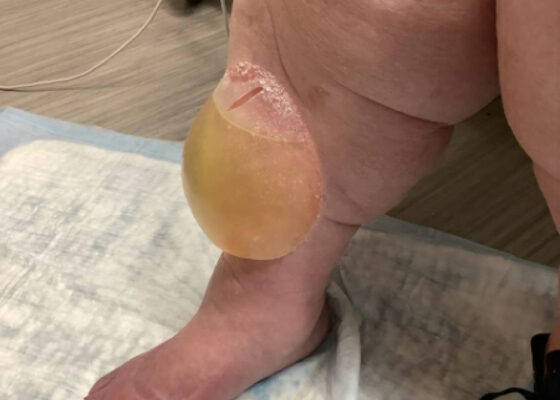
Effects of Volume Overload: A Case Report of an Edema Bulla
DOI: https://doi.org/10.5070/M5.52206This image shows a large edema bulla on the patient's right shin. The bulla is 10 x 10 cm, filled with serous fluid, has a spontaneously occurring defect in the skin of the superior portion of the bulla, and is non-erythematous. The bulla is much larger than the 1-5 cm edema bullae described in the literature. As edema bulla is primarily a clinical diagnosis, taking the full history and physical exam into account is essential to recognize these bullae.
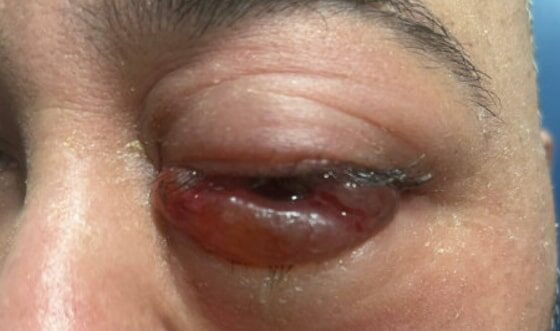
A Case Report of Carotid Cavernous Fistula: A Commonly Missed Diagnosis
DOI: https://doi.org/10.5070/M5.52242The initial physical exam performed by the ED provider revealed severe left eye chemosis, clear drainage, visual acuity of right eye 20/100 and left eye 20/400, and a left eye IOP of 52. There was a deficit of extraocular movement in all directions of gaze and limitation in all visual fields in the left eye. The MRI showed that at the level of the eye, the left cavernous sinus is asymmetrically enlarged compared to the right (red arrow) with an enlarged left inferior petrosal sinus with internal flow void on the pre-contrast MRI images (blue arrow). The orange arrow notes a central filling defect of the left superior ophthalmic vein on the MRA.

Simulation-Based Preparation for the American Board of Emergency Medicine Certifying Exam: A Comprehensive Curriculum for Residents
DOI: https://doi.org/10.21980/J8.53814The goal of this curriculum is to equip residents with the knowledge and skills needed to succeed on the ABEM Certifying Exam. It includes a comprehensive set of case types expected to appear on the Certifying Exam, with a focus on assessing competencies not currently evaluated by the existing written Qualifying Exam and retiring Oral Exam. The curriculum is designed to be delivered to current residents in a single-day exam format to closely replicate the structure and experience of the new Certifying Exam.

Difficult Conversation Case: Missed Testicular Cancer
DOI: https://doi.org/10.21980/J8.52336This difficult conversation case is intended to assess the examinee’s ability to disclose sensitive, unexpected information to a patient regarding a missed diagnosis of testicular cancer. By the end of this session, learners should be able to, 1) demonstrate effective communication, including establishing rapport, acknowledging a prior misdiagnosis, and disclosing a revised diagnosis of cancer, 2) elicit and react to the patient’s emotional and informational needs in an empathetic and professional manner, and 3) convey a patient-centered plan of care, including appropriate next steps and coordination with specialist services.
Difficult Conversation Case: Death Notification
DOI: https://doi.org/10.21980/J8.52354This Observed Structured Clinical Examination (OSCE) is intended to cover the topic of Difficult Conversations. The overarching educational goal of this case is to assess learners’ communication skills, emotional responsiveness, and ability to facilitate a death notification conversation. Participants will be evaluated on their ability to communicate in an empathic, patient-centered manner while leading a difficult discussion. Successful participants will establish rapport, actively listen, disclose sensitive information clearly and compassionately, and respond appropriately to emotional reactions. By the end of the session, learners should be able to: (1) establish rapport with the patient’s family by initiating introductions and creating a supportive environment, (2) assess the family’s baseline understanding of the patient’s condition by using open-ended questions and active listening to elicit their perspective, (3) communicate the patient’s death clearly and compassionately, using concise, non-technical language, (4) demonstrate empathy by responding appropriately to emotional reactions, validating concerns, and addressing questions thoughtfully, and (5) provide closure to the conversation by summarizing key points, offering emotional support, and clarifying the next steps in the patient’s care.
Managing Conflict Case: Admission of a Patient with Decompensated Schizophrenia, Hypertension, and Diabetes
DOI: https://doi.org/10.21980/J8.52341The following objectives, which align with ABEM’s recommended objectives, address the nuances of managing conflict. By the end of the session, learners should be able to: 1) demonstrate familiarity with the ABEM Managing Conflict case format and structure, 2) establish rapport by developing connection and trust with the admitting physicians, 3) demonstrate understanding of the other party's position by verbalizing thoughtful and specific questions about his/her concerns, 4) explain his/her own position clearly and insightfully, 5) acknowledge divergent positions with thoughtfulness and insight, 6) identify interests shared by both the psychiatrist and hospitalist as well as what is in the best interest of the patient, and 7) propose a path forward which accounts for the interests of all parties involved.
Managing Conflict Case: The Difficult Consultant
DOI: https://doi.org/10.21980/J8.53815By the end of the session, the learner should be able to: 1) review format and have become familiar with an ABEM Certifying Exam conflict management communication case, 2) demonstrate the ability to initiate the consultation call, establish rapport, and present a concise, evidence-based summary of the patient’s STEMI findings, 3) recognize concerns raised by the cardiologist and respond with an empathetic acknowledgment (eg, validating workload, uncertainty, or resource constraints) to support a collaborative tone, 4) articulate differing viewpoint by referencing objective clinical data (eg, ST-segment elevations, ongoing chest pain, risk from delays) when conflict is encountered and justify why urgent catheterization lab activation is indicated, and 5) identify shared goals in optimizing patient care (reducing myocardial damage and preventing deterioration) and use these to negotiate a mutually acceptable plan.