
Posts by JETem

Laceration Repair for Emergency Physicians
DOI: https://doi.org/10.21980/J8TP7KBy the end of this educational session, the learner will: 1) understand indications and contraindications for suture repair of lacerations, 2) compare when various types of wound repair are appropriate: such as sutures, staples, tissue adhesive and tissue tape, as well as what size of suture material is appropriate depending on the location of the laceration on the body, 3) list the appropriate types and sizes of suture for various locations and types of lacerations, 4) understand the definitions of the three types of wound closure (primary, secondary and delayed primary) and when they are appropriate, 5) understand the basics of local anesthetic including which anesthetic to use and the maximum dose for each, 6) understand when sutures should be removed, 7) list various suturing techniques and their indications, and 8) improve comfort levels in performing various suturing techniques including: simple interrupted, horizontal mattress, vertical mattress, and corner repair. If desired, instructors can individually assess the learner sutures using the attached complete validated suture checklist to show proficiency in these techniques. Please see the brief wrap-up section at the end of the manuscript.


Management of Wolff-Parkinson-White Tachyarrhythmia Presenting as Syncope with Seizure-like Activity
DOI: https://doi.org/10.21980/J8534PAt the end of this simulation session the learner will: 1) Recognize clinical history suggestive of cardiogenic syncope, 2) recognize clinical evidence of Wolff-Parkinson-White syndrome, 3) promptly and appropriately treat unstable WPW tachyarrhythmia.
Precipitous Birth
DOI: https://doi.org/10.21980/J8192RBy the end of this simulation session, the learner will be able to: 1) Recognize impending delivery, 2) identify abnormal maternal vital signs and potential associated pathologies (eg: hypertension in preeclampsia), 3) discuss the evaluation and management of postpartum bleeding, 4) discuss the principles of neonatal resuscitation, 5) appropriately disposition the patients, and 6) effectively communicate with team members and nursing staff during resuscitation of a critically ill patient.
Pediatric Toxic Shock Syndrome
DOI: https://doi.org/10.21980/J8WK8JBy the end of this simulation session, the learner will be able to: 1) Recognize toxic shock syndrome. 2) Review the importance of a thorough physical exam. 3) Discuss management of toxic shock syndrome, including supportive care and the difference in antibiotic choices for streptococcal and staphylococcal toxic shock syndrome. 4) Appropriately disposition a patient suffering from toxic shock syndrome. 5) Communicate effectively with team members and nursing staff during a resuscitation of a critically ill patient.

Bedside Ultrasound for the Diagnosis of Peritonsillar Abscess
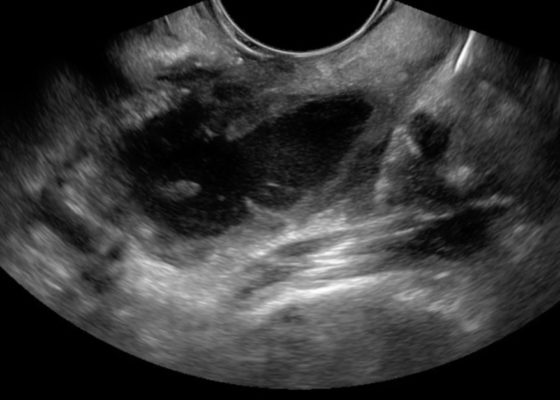
DOI: https://doi.org/10.21980/J8N33NThe first video is an intraoral ultrasound using the high frequency endocavitary probe demonstrating an anechoic fluid collection adjacent to the patient’s enlarged left tonsil. The second video shows real-time ultrasound-guided successful drainage of the PTA.

Bilateral Hip Dislocation in Unrestrained Driver
DOI: https://doi.org/10.21980/J8HD0CThe initial radiograph of the pelvis revealed bilateral hip dislocations. Small bony fragments were noted in the right hip joint, suggestive of an underlying fracture. The sacroiliac joints and the pelvic ring were intact. In the emergency department, bilateral hip reductions were performed using the Captain Morgan technique.1 The post-reduction film showed reduction of the bilateral hip dislocations with extensive comminuted and displaced fractures of the right and left acetabula.
Open Book Pelvic Fracture
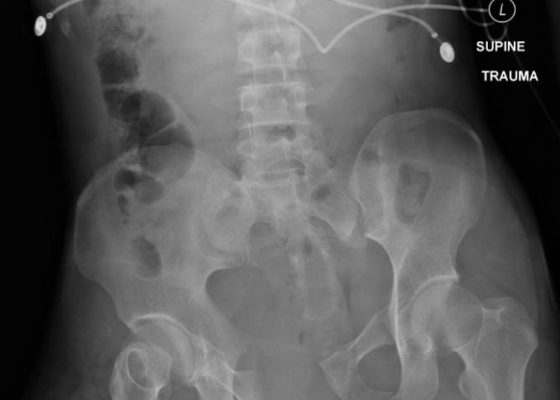
DOI: https://doi.org/10.21980/J8CK7HThe initial radiograph of the pelvis shows an open-book pelvic fracture deformity with pubic symphyseal dislocation, left greater than right sacroiliac diastases, and fractures of the left superior and inferior pubic rami, right inferior pubic ramus, and left acetabular anterior column. The additional inlet and outlet radiographs of the pelvis after application of a pelvic binder also show an open book fracture with significant improvement of the widened pubic symphysis.

Oropharynx Ulceration
DOI: https://doi.org/10.21980/J87W60The photograph demonstrates an area of ulcerative tissue at the left palatine tonsil without surrounding erythema or purulent drainage. The computed tomography (CT) scan shows a large ulceration of the left soft palate and palatine tonsil (red arrow). There is no evidence of skull base osteomyelitis. There is suppurative lymphadenopathy with partial left jugular vein compression due to mass effect (yellow highlight). There is mild nasopharyngeal airway narrowing with architectural distortion (blue arrow), but no other evidence of airway obstruction.