
JETem
  • Home
  • About
    • Aim and Scope
    • Our Team
    • Editorial Board
    • FAQ
  • Issues
    • Current Issue
    • Ahead of Print
    • Past Issues
  • Visual EM
    • Latest Visual EM
    • Search Visual EM
    • Thumbnail Library
  • For Authors
    • Instructions for Authors
    • Submit to JETem
    • Photo Consent
    • Policies
      • Peer Review Policy
      • Copyright Policy
      • Editorial Policy, Ethics and Responsibilities
      • Conflicts of Interest & Informed Consent
      • Open Access Policy
      • Acceptance Fee
  • For Reviewers
    • Instructions for JETem Reviewers
    • Interested in Being a JETem Reviewer?
  • Topic
    • Abdominal/Gastroenterology
    • Administration
    • Board Review
    • Cardiology/Vascular
    • Certifying Exam Cases
      • Clinical Decision-Making
      • Prioritization
      • Communication
      • Procedure & Ultrasound
    • Clinical Informatics, Telehealth and Technology
    • Dermatology
    • EMS
    • Endocrine
    • ENT
    • Faculty Development
    • Genitourinary
    • Geriatrics
    • Hematology/Oncology
    • Infectious Disease
    • Miscellaneous (stats, etc)
    • Neurology
    • Ob/Gyn
    • Ophthalmology
    • Orthopedics
    • Pediatrics
    • Pharmacology
    • Procedures
    • Psychiatry
    • Renal/Electrolytes/Nutrition
    • Respiratory
    • Social Determinants of Health
    • Toxicology
    • Trauma
    • Ultrasound
    • Urology
    • Wellness
    • Wilderness
  • Modality
    • Certifying Exam Practice Cases
      • Clinical Care Cases
      • Communication & Procedural Cases
      • Old School Oral Board Cases
    • Curricula
    • Innovations
    • Lectures
    • Podcasts
    • Simulation
    • Small Group Learning
    • Team Based Learning (TBL)
    • Visual EM
  • Contact Us

Posts by JETem

Creative Commons images

Point-of-care Ultrasound Detection of Endophthalmitis

James Tucker MD, PhD*, Jonathan Patane, MD^ and Shadi Lahham, MD, MS^

DOI: https://doi.org/10.21980/J8G634 Issue 3:1[mrp_rating_result]
The patient’s ultrasound revealed an attached retina and a complex network of hyperechoic, mobile, membranous material in the posterior segment.
OphthalmologyUltrasoundVisual EM
Creative Commons images

Acute Pyelonephritis with Perinephric Stranding on CT

Ronald Goubert* and Jonathan Peña, MD*

DOI: https://doi.org/10.21980/J8BH0VIssue 3:1[mrp_rating_result]
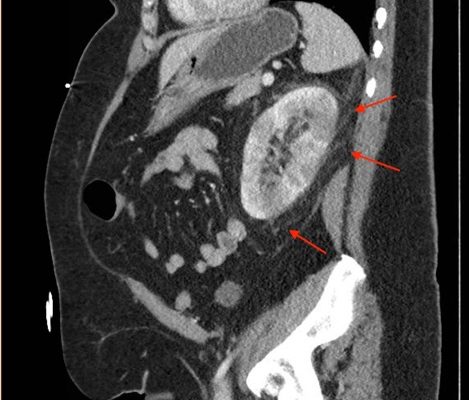
A CT abdomen and pelvis with IV contrast showed neither nephrolithiasis nor diverticulitis, and instead showed heterogeneous enhancement of the left kidney with mild edematous enlargement and striated left nephrogram. Significant perinephric stranding (red arrows) was also noted and was consistent with severe acute pyelonephritis.
Renal/ElectrolytesInfectious DiseaseVisual EM
Creative Commons images

Empyema

Jonathan Patane, MD* and Daniel Ritter, BS^

DOI: https://doi.org/10.21980/J86P9RIssue 3:1[mrp_rating_result]
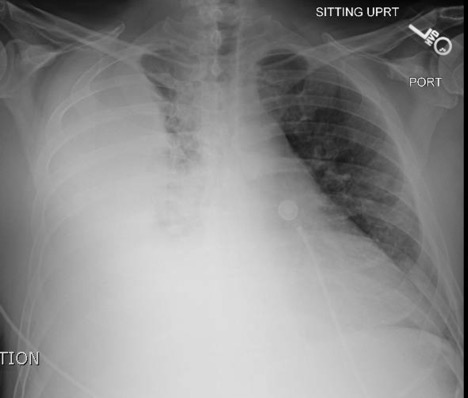
The chest X-ray shows a large fluid collection in the right lung demonstrated by the opacification that blunts the costophrenic angle on the right side. There is also a meniscus present, which is generally indicative of fluid.  Chest computed tomography (CT) demonstrated an infiltrate with a mixture of densities within the same collection, consistent with a loculated effusion and concerning for an empyema.
RespiratoryInfectious DiseaseVisual EM

Novel Emergency Medicine Curriculum Utilizing Self-Directed Learning and the Flipped Classroom Method: Obstetric and Gynecologic Emergencies Small Group Module

Jillian McGrath, MD*, Arwa Mesiwala, MD*, Michael Barrie, MD*, Creagh Boulger, MD, RDMS*, Laura Thompson, MD*, Jennifer Mitzman, MD*, Diane Gorgas, MD*, Geremiha Emerson, MD*, Sorabh Khandelwal, MD*, Alyssa Tyransky^ and Andrew King, MD*

DOI: https://doi.org/10.21980/J8DK9K Issue 2:4[mrp_rating_result]
We aim to teach the presentation and management of obstetric and gynecologic emergencies through the creation of a flipped classroom design. This unique, innovative curriculum utilizes resources chosen by education faculty and resident learners, study questions, real-life experiences, and small group discussions in place of traditional lectures. In doing so, a goal of the curriculum is to encourage self-directed learning, improve understanding and knowledge retention, and improve the educational experience of our residents.
CurriculaOb/GynSmall Group Learning

Novel Emergency Medicine Curriculum Utilizing Self-Directed Learning and the Flipped Classroom Method: Head, Eyes, Ears, Nose and Throat Emergencies Small Group Module

Andrew King, MD*, Paul Crawford *, Christopher San Miguel, MD*, Michael Barrie, MD*, Sandra Spencer, MD^, Alyssa Tyransky* and Nicholas Kman, MD*

DOI: https://doi.org/10.21980/J8PW5N Issue 2:4[mrp_rating_result]
We aim to teach the presentation and management of HEENT emergencies through the creation of a flipped classroom design. This unique, innovative curriculum utilizes resources chosen by education faculty and resident learners, study questions, real-life experiences, and small group discussions in place of traditional lectures. In doing so, a goal of the curriculum is to encourage self-directed learning, improve understanding and knowledge retention, and improve the educational experience of our residents.
CurriculaENTSmall Group Learning

ED I-PASS: A Streamlined Version of the I-PASS Patient Handoff Tool for the Emergency Department

Sarah R. Williams, MD*, Jeffrey Chien, MD* and Ryan Ribeira MD*

DOI: https://doi.org/10.21980/J80G8F Issue 2:4[mrp_rating_result]
The purpose of this presentation is to provide ED providers with a tool that may improve the safety of their patient handoffs. By the end of this presentation, the learner will be able to 1) describe the importance of safe and efficient handoffs, 2) recall each element of the I-PASS mnemonic, and 3) demonstrate an understanding of how it can be feasibly performed in a busy ED setting.
AdministrationLectures

Placenta Previa

Angela Irene Carrick, DO*

DOI: https://doi.org/10.21980/J8J911 Issue 2:4[mrp_rating_result]
By the end of this oral boards case, the learner will be able to: 1. List the potential causes of vaginal bleeding in pregnancy after 20 weeks including placental abruption, placenta previa and vasa previa. 2. Describe the bedside stabilization and evaluation in a pregnant patient with vaginal bleeding after 20 weeks. a) Stabilize the mother (patient) including placing two large bore intravenous (IV) lines, administer an IV fluid bolus, obtaining complete blood count (CBC), coagulation studies, and type & cross matching blood. b) Transvaginal ultrasound to determine the placental location. c) Sterile speculum examination. A digital or speculum pelvic examination should NOT be performed until a transvaginal ultrasound is performed to determine placental location. The resident should understand that performing a digital or speculum exam in a patient with placenta previa or vasa previa can cause or exacerbate hemorrhage. If these two conditions are not present on ultrasound, then a sterile speculum exam may be performed to further examine the bleeding. 3. Contrast the typical presentation of placenta previa with that of placental abruption. a) Placenta Previa usually causes painless vaginal bleeding. Part of the placenta is located near or over the internal cervical orifice. b) Placental Abruption usually causes painful vaginal bleeding. There is premature separation of the placenta from the uterine lining. 4) Describe the appropriate disposition of a patient with a pregnancy over 20 weeks with vaginal bleeding. After initial workup and stabilization these women are usually admitted for fetal monitoring, observation and consultation by the obstetrician (OB/gyn).
Certifying Exam CasesOb/Gyn

Hemodialysis in the Poisoned Patient

Megan Boysen-Osborn, MD, MHPE* and Jeffrey R Suchard, MD, FACMT*

DOI: https://doi.org/10.21980/J88S68 Issue 2:4[mrp_rating_result]
By the end of this cTBL, the learner will: 1) recognize laboratory abnormalities related to toxic alcohol ingestion; 2) calculate an anion gap and osmolal gap; 3) know the characteristics of drugs that are good candidates for HD; 4) discuss the management of patients with toxic alcohol ingestions; 5) discuss the management of patients with salicylate overdose; 6) know the indications for HD in patients with overdoses of antiepileptic drugs; 7) discuss the management of patients with lithium toxicity.
Team Based Learning (TBL)Renal/ElectrolytesToxicology
«‹68›»
Page 68 of 91

JETem is an online, open access, peer-reviewed, journal-repository for EM educators. We are PMC Indexed.

Most Viewed

  • Simple Auricular Hematoma (“Cauliflower Ear”) Task Trainer
  • The Three Breath Method: Teaching Coping Mechanisms for Processing Patient Death
  • Clinical Decision Making: Acute Ischemic Stroke with Large Vessel Occlusion
  • PRIMER: Premedical Introduction to Mentored Emergency Research: Connecting Undergraduate Assistants and Emergency Medicine Residents in a Community Hospital Setting
  • Dangerous Dysrhythmias in the ED: An Interactive EKG Workshop for Emergency Medicine Clerkship Learners

Visit Our Collaborators


Creative Commons Licence
This work is licensed under a Creative Commons Attribution 4.0 International License.

About

Education

Learners should benefit from active learning. JETem accepts submissions of team-based learning, small group learning, simulation, podcasts, lectures, innovations, curricula, question sets, and visualEM.

Scholarship

We believe educators should advance through the scholarship of their educational work. JETem gives educators the opportunity to publish scholarly academic work so that it may be widely distributed, thereby increasing the significance of their results.

Links

  • Home
  • Aim and Scope
  • Current Issue
  • For Reviewers
  • Instructions for Authors
  • Contact Us

Newsletter

Sign up to receive updates from JETem regarding newly published issues and findings.

Copyright Creative Commons Attribution 4.0 International