
JETem
  • Home
  • About
    • Aim and Scope
    • Our Team
    • Editorial Board
    • FAQ
  • Issues
    • Current Issue
    • Ahead of Print
    • Past Issues
  • Visual EM
    • Latest Visual EM
    • Search Visual EM
    • Thumbnail Library
  • For Authors
    • Instructions for Authors
    • Submit to JETem
    • Photo Consent
    • Policies
      • Peer Review Policy
      • Copyright Policy
      • Editorial Policy, Ethics and Responsibilities
      • Conflicts of Interest & Informed Consent
      • Open Access Policy
  • For Reviewers
    • Instructions for JETem Reviewers
    • Interested in Being a JETem Reviewer?
  • Topic
    • Abdominal/Gastroenterology
    • Administration
    • Board Review
    • Cardiology/Vascular
    • Certifying Exam Cases
      • Clinical Decision-Making
      • Prioritization
      • Communication
      • Procedure & Ultrasound
    • Clinical Informatics, Telehealth and Technology
    • Dermatology
    • EMS
    • Endocrine
    • ENT
    • Faculty Development
    • Genitourinary
    • Geriatrics
    • Hematology/Oncology
    • Infectious Disease
    • Miscellaneous (stats, etc)
    • Neurology
    • Ob/Gyn
    • Ophthalmology
    • Orthopedics
    • Pediatrics
    • Pharmacology
    • Procedures
    • Psychiatry
    • Renal/Electrolytes
    • Respiratory
    • Social Determinants of Health
    • Toxicology
    • Trauma
    • Ultrasound
    • Urology
    • Wellness
    • Wilderness
  • Modality
    • Certifying Exam Practice Cases
      • Clinical Care Cases
      • Communication & Procedural Cases
      • Old School Oral Board Cases
    • Curricula
    • Innovations
    • Lectures
    • Podcasts
    • Simulation
    • Small Group Learning
    • Team Based Learning (TBL)
    • Visual EM
  • Contact Us

Visual EM

Creative Commons images

Irreducible Traumatic Posterior Shoulder Dislocation

Blake Collier, DO* and Christopher Trigger, MD*

DOI: https://doi.org/10.21980/J8V884Issue 2:1[mrp_rating_result]
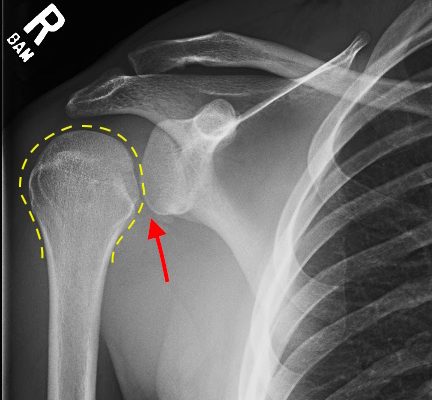
Radiographs demonstrated posterior displacement of the humeral head on the “Y” view (see white arrow) and widening of the glenohumeral joint space on anterior-posterior view (see red arrow). The findings were consistent with posterior dislocation and a Hill-Sachs type deformity. Sedation was performed and reduction was attempted using external rotation, traction counter-traction. An immediate “pop” was felt during the procedure. Post-procedure radiographs revealed a persistent posterior subluxation with interlocking at posterior glenoid. CT revealed posterior dislocation with acute depressed impaction deformity medial to the biceps groove with the humeral head perched on the posterior glenoid, interlocked at reverse Hill-Sachs deformity (see blue arrow).
OrthopedicsVisual EM
Creative Commons images

Pseudogout and Calcium Pyrophosphate Disease

Andrew Williamson, MD*

DOI: https://doi.org/10.21980/J8QG66Issue 2:1[mrp_rating_result]
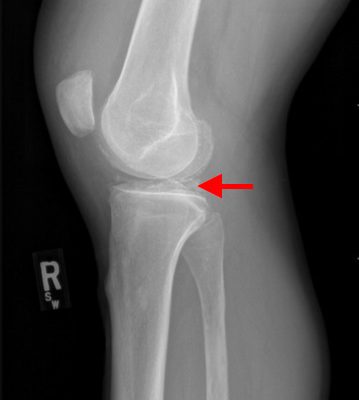
Radiographs of the knee showed multiple radio-dense lines paralleling the articular surface (see red arrows) consistent with calcium pyrophosphate crystal deposition within the joint often seen in calcium pyrophosphate disease (CPPD) also known as pseudogout.
OrthopedicsVisual EM
Creative Commons images

ST Elevation in aVR with Coexistent Multilead ST Depression

Benjamin Cooper, MD*

DOI: https://doi.org/10.21980/J8KS3XIssue 2:1[mrp_rating_result]
The ECG shows ST-segment depressions in precordial leads V3 through V6, and limb leads I, II, and aVL, and 1 mm of ST-segment elevation in aVR. The initial troponin I was elevated at 1.37 ng/mL (upper limit of normal 0.40). Cardiology decided to delay catheterization until the next day when diffuse coronary disease was discovered (including 90% of the left circumflex stenosis, 60% proximal and 75% mid-left anterior descending stenosis, 75% third diagonal branch stenosis, and 90% posterior descending artery stenosis). The following day, the patient went to the operating room for coronary artery bypass grafting (CABG).
Cardiology/VascularVisual EM
Creative Commons images

Ventriculoperitoneal Shunt Migration

Justin P Puller, MD* and Jonathan T Miller, MD*

DOI: https://doi.org/10.21980/J8G019Issue 2:1[mrp_rating_result]
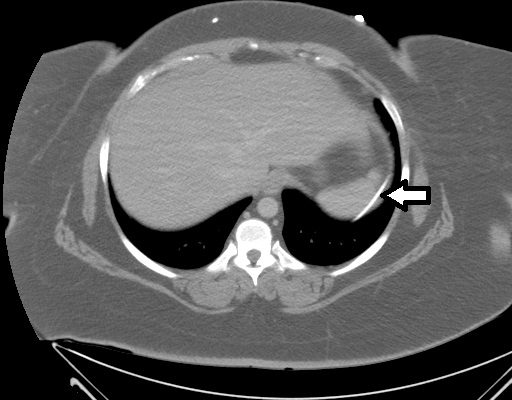
An immediate post-op abdominal x-ray performed after the patient’s VP shunt revision 30 days prior to this ED visit reveals the VP shunt tip in the mid abdomen. A CT of the abdomen performed on the day of the ED visit reveals the VP shunt tip interposed between the spleen and the diaphragm.
Abdominal/GastroenterologyVisual EM
Creative Commons images

K-9 Police Dog Bite

Vy Han, MD* and John R. Marshall, MD*

DOI: https://doi.org/10.21980/J8B88GIssue 2:1[mrp_rating_result]
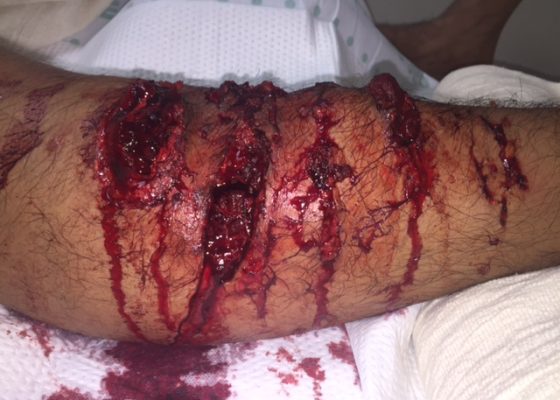
The photograph is of the anterior compartment of the right lower leg demonstrating multiple deep lacerations with exposed and torn muscle. X-ray showed no foreign body.
TraumaVisual EM
Creative Commons images

Lunate Dislocation

Jonathan Peña, MD*

DOI: https://doi.org/10.21980/J86K56Issue 2:1[mrp_rating_result]
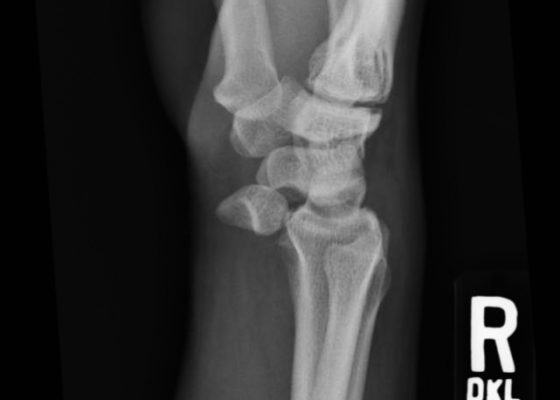
Plain film of the right wrist showed the classic “spilled teacup” consistent with a lunate dislocation. There is a loss of the normal articulation between the distal radius and lunate.
OrthopedicsTraumaVisual EM
Creative Commons images

Bedside Echocardiography for Rapid Diagnosis of Malignant Cardiac Tamponade

Alaina Brinley, MD, PhD*, Maili Alvarado, MD* and J Christian Fox, MD*

DOI: https://doi.org/10.21980/J82S38Issue 2:1[mrp_rating_result]
The video shows a subxiphoid view of the heart with evidence of a large pericardial effusion with tamponade – note the anechoic stripe in the pericardial sac (see red arrow). This video demonstrates paradoxical right ventricular collapse during diastole and right atrial collapse during systole which is indicative of tamponade.1,2 Figure 1 is from the same patient and shows sonographic pulsus paradoxus. This is an apical 4 chamber view of the heart with the sampling gate of the pulsed wave doppler placed over the mitral valve. The Vpeak max and Vpeak min are indicated. If there is more than a 25% difference with inspiration between these 2 values, this is highly suggestive of tamponade.1 In this case, there is a 32.4% difference between the Vpeak max 69.55 cm/s and Vpeak min 46.99 cm/s.
Cardiology/VascularHematology/OncologyUltrasoundVisual EM
Creative Commons images

Takotsubo (Stress) Cardiomyopathy

Justin J Hourmozdi, MD*, Julian P Suszanski, MD* and Jacqueline M Pflaum, MD*^

DOI: https://doi.org/10.21980/J8Z309Issue 2:1[mrp_rating_result]
Bedside echocardiography showed the findings consistent with Takotsubo cardiomyopathy. Echocardiographic images are shown in subxiphoid (A) and apical four chamber (B) views. Note the apical ballooning appearance (asterisk) of the left ventricle (LV).
Cardiology/VascularVisual EM
«‹39›»
Page 39 of 45

JETem is an online, open access, peer-reviewed, journal-repository for EM educators. We are PMC Indexed.

Most Viewed

  • Enhancing Emergency Medicine Resident Education: A Weekly Education Series to Augment Electrocardiogram Education
  • Development and Design of a Pediatric Case-Based Virtual Escape Room on Acute Iron Toxicity
  • Pre-Clinical Case Competition to Assess Confidence in Responding to Select Out-Of-Hospital Medical Emergencies
  • Pediatric Difficult Airway Simulation Day
  • Cards Against Pulmonology

Visit Our Collaborators


Creative Commons Licence
This work is licensed under a Creative Commons Attribution 4.0 International License.

About

Education

Learners should benefit from active learning. JETem accepts submissions of team-based learning, small group learning, simulation, podcasts, lectures, innovations, curricula, question sets, and visualEM.

Scholarship

We believe educators should advance through the scholarship of their educational work. JETem gives educators the opportunity to publish scholarly academic work so that it may be widely distributed, thereby increasing the significance of their results.

Links

  • Home
  • Aim and Scope
  • Current Issue
  • For Reviewers
  • Instructions for Authors
  • Contact Us

Newsletter

Sign up to receive updates from JETem regarding newly published issues and findings.

Copyright Creative Commons Attribution 4.0 International