JETem
  • Home
  • About
    • Aim and Scope
    • Our Team
    • Editorial Board
    • FAQ
  • Issues
    • Current Issue
    • Ahead of Print
    • Past Issues
  • Visual EM
    • Latest Visual EM
    • Search Visual EM
    • Thumbnail Library
  • For Authors
    • Instructions for Authors
    • Submit to JETem
    • Photo Consent
    • Policies
      • Peer Review Policy
      • Copyright Policy
      • Editorial Policy, Ethics and Responsibilities
      • Conflicts of Interest & Informed Consent
      • Open Access Policy
      • Acceptance Fee
  • For Reviewers
    • Instructions for JETem Reviewers
    • Interested in Being a JETem Reviewer?
  • Topic
    • Abdominal/Gastroenterology
    • Administration
    • Board Review
    • Cardiology/Vascular
    • Certifying Exam Cases
      • Clinical Decision-Making
      • Prioritization
      • Communication
      • Procedure & Ultrasound
    • Clinical Informatics, Telehealth and Technology
    • Dermatology
    • EMS
    • Endocrine
    • ENT
    • Faculty Development
    • Genitourinary
    • Geriatrics
    • Hematology/Oncology
    • Infectious Disease
    • Miscellaneous (stats, etc)
    • Neurology
    • Ob/Gyn
    • Ophthalmology
    • Orthopedics
    • Pediatrics
    • Pharmacology
    • Procedures
    • Psychiatry
    • Renal/Electrolytes/Nutrition
    • Respiratory
    • Social Determinants of Health
    • Toxicology
    • Trauma
    • Ultrasound
    • Urology
    • Wellness
    • Wilderness
  • Modality
    • Certifying Exam Practice Cases
      • Clinical Care Cases
      • Communication & Procedural Cases
      • Old School Oral Board Cases
    • Curricula
    • Innovations
    • Lectures
    • Podcasts
    • Simulation
    • Small Group Learning
    • Team Based Learning (TBL)
    • Visual EM
  • Contact Us

Visual EM

Creative Commons images

Henoch-Schönlein Purpura in the Adult

Ivan Virovets, DO* and Danielle Biggs, MD*

DOI: https://doi.org/10.21980/J8QH08 Issue 5:1[mrp_rating_result]
The images show a raised, palpable, purpuric rash on the lower extremities, surrounded by a mild, 1+ non-pitting edema. Several of the lesions are exfoliated with serous discharge. There is no surrounding erythema, fluctuance, or lymphangitis to suggest cellulitis. There was no tenderness to palpation; however, pruritus was exacerbated on palpation.
DermatologyCardiology/VascularVisual EM
Creative Commons images

Digital Nerve Block for the Reduction of a Proximal Phalanx Fracture of the Foot – a Case Report

Emerald Raney, MD*, John Costumbrado, MD, MPH*, Barbara Blasko, MD* and Dev Dhillon, BS^

DOI: https://doi.org/10.21980/J8KS8T Issue 5:1[mrp_rating_result]
Plain film of the right foot showed evidence of an oblique fracture of the body of the proximal 4th phalanx (image 2). No other acute traumatic injuries noted in the rest of the bones and joints of the right foot. After performing a digital block of the toe and reduction, repeat imaging showed evidence of successful reduction with anatomic alignment and redemonstration of the fracture line (image 3).
Visual EMOrthopedics
Creative Commons images

Case Report: Antifreeze Ingestion and Urine Fluorescence

Taras Varshavsky, MD* and Meigra Myers Chin, MD *

DOI: https://doi.org/10.21980/J8G05T Issue 5:1[mrp_rating_result]
The patient’s urine sample (right) was compared to a control (left) using a Wood’s lamp. It revealed light green fluorescence under ultraviolet light, which increased suspicion for ethylene glycol poisoning from antifreeze ingestion.
ToxicologyVisual EM
Creative Commons images

Open Subtalar Dislocation

Devan Pandya, MD* and Joseph Fargusson, MD*

DOI: https://doi.org/10.21980/J87P8PIssue 4:4[mrp_rating_result]
X-ray of the left ankle revealed a complete dislocation of the subtalar joint with medial dislocation of the calcaneus (outlined in orange) relative to the talus (outlined in red) with subcutaneous air noted in the lateral soft tissues (blue arrows in Figure 1). The talonavicular joint has also been disrupted (navicular outlined in blue). There was no evidence of fracture. Post-reduction computed tomography of the left lower extremity confirmed no evidence of associated fracture.
OrthopedicsVisual EM
Creative Commons images

Atypical Presentation of Abdominal Aortic Aneurysm

Michael Rohinton Mirza, MD* and Christopher Bryczkowski, MD*

DOI: https://doi.org/10.21980/J82W6F Issue 4:4 [mrp_rating_result]
Bedside ultrasound revealed an abdominal aortic aneurysm (AAA) with concern for dissection vs thrombus/hematoma due to an area of echogenicity within the lumen of the vessel, since normal blood vessels (including the aorta) have lumens that are uniformly anechoic. An intimal flap concerning for dissection appears as a hyperechoic stripe within the lumen of the vessel on ultrasound, often with a hypoechoic and/or anechoic area appreciated underneath the flap, indicating a separate area of blood flow. If this visualized area is of significant size, color doppler can be used to confirm blood flow on both sides of the flap. Given his bedside ultrasound findings, the patient underwent emergent computed tomography scan and was found to have an enlarged infrarenal abdominal aortic aneurysm, with acute intramural hematoma, extending into bilateral common iliac arteries.
Cardiology/VascularVisual EM
Creative Commons images

Thoracic Aortic Aneurysm Measured by Point of Care Ultrasound Suprasternal Notch View

Hamid Ehsani-Nia, DO* and Christopher Bryczkowski, MD*

DOI: https://doi.org/10.21980/J8Z64V Issue 4:4[mrp_rating_result]
Point-of-care cardiac echocardiogram demonstrated a dilated ascending aorta (illustrated in red) measuring approximately 4 cm in the parasternal long axis (PLAX). A dilated aortic arch (illustrated in green) also measuring approximately 4 cm was appreciated using the suprasternal notch view (SSNV). A follow-up computed tomography angiogram (CTA) was performed, validating bedside ultrasound measurements.
UncategorizedCardiology/VascularVisual EM
Creative Commons images

Incarcerated Ventral Hernia of T-colon Resulting in Colon Perforation and Intraabdominal Abscess

Shu-Chen Han, MD*

DOI: https://doi.org/10.21980/J83W74 Issue 4:4 [mrp_rating_result]
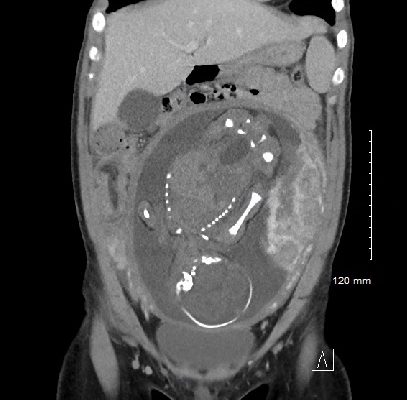
History of present illness: A 75-year-old female with a remote history of rectal cancer presented to the emergency department with acute right upper abdominal pain. The pain had begun suddenly after lunch. On review of systems, the patient had mild nausea. Initial vital signs were within normal limit. She denied fever, chills, or vomiting. The physical examination revealed a distended,
Abdominal/GastroenterologyVisual EM
Creative Commons images

Ultrasonographic Findings of Acute Achilles Tendon Rupture

Charles Craig Rudy, MD*^, John A Thompson, MD* and Rachel R Bengtzen, MD*^

DOI: https://doi.org/10.21980/J8063S Issue 4:4[mrp_rating_result]
The ultrasound video clip shows a longitudinal view of the AT during a dynamic exam. While the patient’s foot is gently passively dorsi/plantar flexed, the video demonstrates first a normal Achilles tendon (from the unaffected extremity) without disruption (highlighted by a yellow bracket on screen left).  Then it shows an abnormal tendon (the patient’s affected side) with disruption of the typical linear tendon fibers (red arrow identifies area of rupture). Dynamic testing shows the movement of the distal stump of the AT is evident adjacent to hypoechoic fluid that is reactive edema or blood from the acute rupture. 
OrthopedicsVisual EM
«‹18›»
Page 18 of 44

JETem is an online, open access, peer-reviewed, journal-repository for EM educators. We are PMC Indexed.

Most Viewed

  • Escape Intern Orientation! — A Capstone and Team Building Activity for New EM Interns
  • Enhancing Relationship-Centered Communication and Feedback in Emergency Medicine Through Applied Improvisation (EM-PROV)
  • Postpartum Complications Modified TBL
  • Midline Catheters: A Novel Curriculum for Emergency Medicine Residents
  • Stopping Fistula Hemorrhage without Bleeding Time and Money – A Low Cost, Low Resource Hemodialysis Fistula Model for Emergency Medicine Residents

Visit Our Collaborators


Creative Commons Licence
This work is licensed under a Creative Commons Attribution 4.0 International License.

About

Education

Learners should benefit from active learning. JETem accepts submissions of team-based learning, small group learning, simulation, podcasts, lectures, innovations, curricula, question sets, and visualEM.

Scholarship

We believe educators should advance through the scholarship of their educational work. JETem gives educators the opportunity to publish scholarly academic work so that it may be widely distributed, thereby increasing the significance of their results.

Links

  • Home
  • Aim and Scope
  • Current Issue
  • For Reviewers
  • Instructions for Authors
  • Contact Us

Newsletter

Sign up to receive updates from JETem regarding newly published issues and findings.

Copyright Creative Commons Attribution 4.0 International