
Administration

An Observation Medicine Curriculum for Emergency Medicine Education
DOI: https://doi.org/10.21980/J87P92The primary goal of this observation medicine curriculum is to train current EM residents in short-term acute care beyond the initial ED visit. This entails caring for patients from the time of their arrival to the OU to the point when a final disposition from the OU is determined, be it inpatient admission or discharge to home.

What do you do if your relief comes to work intoxicated: An Impaired Provider Scenario
DOI: https://doi.org/10.21980/J8DM0HBy the end of this simulation, learners will be able to: 1) Identify potential impairment in the form of alcohol intoxication in a physician colleague; 2) demonstrate the ability to communicate effectively with the colleague and remove them from the patient care environment; 3) discuss the appropriate next steps in identifying long-term wellness resources for the impaired colleague; and 4) demonstrate understanding of the need to continue to provide care for the patients by moving the case forward.
Periodic Refresher Emails for Emergency Department Mass Casualty Incident Plans
DOI: https://doi.org/10.21980/J8C05WThis curriculum is intended to maintain a knowledge base of MCI processes to mitigate degradation of necessary knowledge between hands-on MCI training.

The Continuous Residency Improvement Committee (CRIC) – A Novel Twist for Program Evaluation in an Academic Emergency Medicine Residency Program
DOI: https://doi.org/10.21980/J8SD17The purpose of this innovation was to develop a novel approach to continuous program evaluation and improvement using a multisource feedback design to improve resident satisfaction with the program’s responsiveness to feedback while addressing the ACGME mandate for self-study.

ED I-PASS: A Streamlined Version of the I-PASS Patient Handoff Tool for the Emergency Department
DOI: https://doi.org/10.21980/J80G8FThe purpose of this presentation is to provide ED providers with a tool that may improve the safety of their patient handoffs. By the end of this presentation, the learner will be able to 1) describe the importance of safe and efficient handoffs, 2) recall each element of the I-PASS mnemonic, and 3) demonstrate an understanding of how it can be feasibly performed in a busy ED setting.
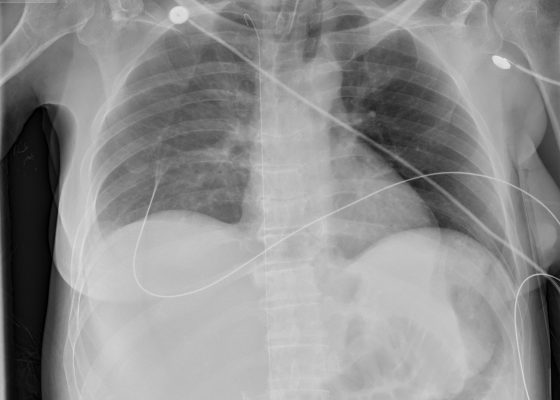

The Lost Guidewire
DOI: https://doi.org/10.21980/J82P4MInitial chest radiograph shows a guidewire in the inferior vena cava (IVC), superior vena cava (SVC), and right IJ veins.
‹2
Page 2 of 2