
Posts by JETem

A Simulation-Based Curriculum for the Development of Leadership and Communication Skills for Emergency Medicine Residents
DOI: https://doi.org/10.21980/J8R33KThis educational intervention was developed to provide physician learners a safe learning environment to practice critical leadership skills, including overcoming team member limitations, navigating power struggles, addressing team morale, and managing disruptive team members.

Implementing the Stop the Bleed Campaign in a University Community
DOI: https://doi.org/10.21980/J84D0ZThe main objective is to implement a system to use available resources of the Stop the Bleed campaign to widely educate members of the university community in the utilization of multiple compression techniques including direct pressure, tourniquet application, and wound packing. Additional course objectives include using the Stop the Bleedsm campaign to teach participants how to fit into the emergency response team as the immediate responder and the identification of life-threatening bleeding.

Priapism Team-based Learning
DOI: https://doi.org/10.21980/J80K9VThe primary goal of this curriculum is to teach EM interns critical thinking; clinical decision making; and presentation, communication, documentation and procedural skills. The secondary goal is to identify interns who might not be performing at the expected level for potential early intervention. In addition, we wanted to ensure that all interns have achieved Level 1 milestones in the patient care, systems-based practices, and interpersonal and communication competencies.
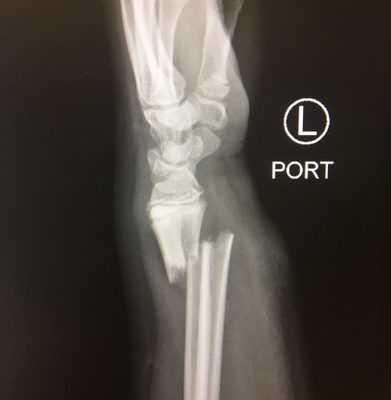

Pediatric Sedation for Forearm Fracture
DOI: https://doi.org/10.21980/J8CS7KAt the end of this simulation, participants will: 1) review options for pain control in pediatric patients, 2) perform a pre-sedation history and physical exam, 3) review the indications and contraindications for pediatric moderate sedation, 4) understand components of consent, and get consent from the patient’s parent, 5) list medication options for moderate sedation in a pediatric patient and review their appropriate doses, indications, contraindications, and side effects, 6) discuss management of moderate sedation complications, and 7) review criteria for discharging a patient after sedation.
Out-of-Hospital Delivery of a Live Newborn Requiring Resuscitation
DOI: https://doi.org/10.21980/J8834MBy the end of this simulation session, the learner will be able to: 1) perform a neonatal assessment, 2) identify which neonates require resuscitation, 3) understand the principles of neonatal resuscitation, 4) describe proper airway management in neonatal resuscitation, 5) discuss underlying etiologies or pathologies that may lead to a neonate to require resuscitation, and 6) communicate effectively with team members and nursing staff during the resuscitation of a critically ill neonate.


Wellens’ Syndrome
DOI: https://doi.org/10.21980/J8FS8KInitial electrocardiogram (ECG) revealed the classic biphasic T waves in V2 and V3 of Wellen’s syndrome (see red outlines). A second EKG demonstrated an evolving deeply inverted T wave (see blue outlines).

Arteriovenous Graft Pseudoaneurysm
DOI: https://doi.org/10.21980/J8B06ZA bedside ultrasound of the mass demonstrated a large compressible hypoechoic structure (see purple outline) above the arteriovenous graft (see red outline). The contents demonstrated movement of fluid within the structure. This was confirmed with Doppler mode, which allowed for visualization of flow communicating between the structure and the underlying vessel, which is diagnostic for a pseudoaneurysm.