
JETem
  • Home
  • About
    • Aim and Scope
    • Our Team
    • Editorial Board
    • FAQ
  • Issues
    • Current Issue
    • Ahead of Print
    • Past Issues
  • Visual EM
    • Latest Visual EM
    • Search Visual EM
    • Thumbnail Library
  • For Authors
    • Instructions for Authors
    • Submit to JETem
    • Photo Consent
    • Policies
      • Peer Review Policy
      • Copyright Policy
      • Editorial Policy, Ethics and Responsibilities
      • Conflicts of Interest & Informed Consent
      • Open Access Policy
      • Acceptance Fee
  • For Reviewers
    • Instructions for JETem Reviewers
    • Interested in Being a JETem Reviewer?
  • Topic
    • Abdominal/Gastroenterology
    • Administration
    • Board Review
    • Cardiology/Vascular
    • Certifying Exam Cases
      • Clinical Decision-Making
      • Prioritization
      • Communication
      • Procedure & Ultrasound
    • Clinical Informatics, Telehealth and Technology
    • Dermatology
    • EMS
    • Endocrine
    • ENT
    • Faculty Development
    • Genitourinary
    • Geriatrics
    • Hematology/Oncology
    • Infectious Disease
    • Miscellaneous (stats, etc)
    • Neurology
    • Ob/Gyn
    • Ophthalmology
    • Orthopedics
    • Pediatrics
    • Pharmacology
    • Procedures
    • Psychiatry
    • Renal/Electrolytes/Nutrition
    • Respiratory
    • Social Determinants of Health
    • Toxicology
    • Trauma
    • Ultrasound
    • Urology
    • Wellness
    • Wilderness
  • Modality
    • Certifying Exam Practice Cases
      • Clinical Care Cases
      • Communication & Procedural Cases
      • Old School Oral Board Cases
    • Curricula
    • Innovations
    • Lectures
    • Podcasts
    • Simulation
    • Small Group Learning
    • Team Based Learning (TBL)
    • Visual EM
  • Contact Us

Posts by JETem

Periodic Refresher Emails for Emergency Department Mass Casualty Incident Plans

Jessie G Nelson, MD*^, Sara Hevesi, MD†, Robert Welborn, MD†, Krista R Carlson, MD, MS**, Benjamin Eide, MPH^^, Merideth Winkler, RN, BSN†, Marissa K Peterson, MS††, Elizabeth Ramey, MS¶

DOI: https://doi.org/10.21980/J8C05WIssue 5:3[mrp_rating_result]
This curriculum is intended to maintain a knowledge base of MCI processes to mitigate degradation of necessary knowledge between hands-on MCI training.
EMSAdministrationCurricula

A Model Curriculum for a Helicopter Emergency Medicine Services (HEMS) Rotation for Resident Physicians

Jordan Imoehl, MD*^, Michael T Steuerwald, MD*^ and Andrew D Cathers, MD*^

DOI: https://doi.org/10.21980/J8GP97 Issue 5:3[mrp_rating_result]
The primary objective of this course is to present a standardized curriculum which allows learners to gain understanding of HEMS systems and retrieval medicine while practicing safety in the aviation environment.
EMSCurricula

Pediatric Seizure Team-Based Learning

Sara Paradise Dimeo, MD*, Gabriel Sudario, MD^, Supriya Sharma, MD†, Lilly Bellman, MD†, Anjalee Gallion, MD**, Katherine Andreeff, MD^^ and Megan Boysen-Osborn, MD, MHPE^

DOI: https://doi.org/10.21980/J8MD22Issue 5:3[mrp_rating_result]
 By the end of this TBL session, learners should be able to: 1) Define features of simple versus complex febrile seizure, 2) Discuss which patients with seizure may require further diagnostic workup, 3) Summarize a discharge discussion for a patient with simple febrile seizures 4) Identify a differential diagnosis for pediatric patients presenting with seizure, 5) Define features of status epilepticus, 6) Review an algorithm for the pharmacologic management of status epilepticus, 7) Indicate medication dosing and routes of various benzodiazepine treatments, 8) Obtain a thorough history in an infant patient with seizures to recognize hyponatremia due to improperly prepared formula, 9) Choose the appropriate treatment for a patient with a hyponatremic seizure, 10) Describe the anatomy of a ventriculoperitoneal (VP) shunt, 11) Relate a differential diagnosis of VP shunt malfunction, 12) Compare and contrast the neuroimaging options for a patient with a VP shunt
PediatricsNeurologyTeam Based Learning (TBL)

Build Your Own Eye: A Method for Teaching Ocular Anatomy and Pathophysiology

Alaina Brinley Rajagopal, MD, PhD*, Mark Joseph Slader, BS* and Megan Boysen Osborn, MD, MHPE*

DOI: https://doi.org/10.21980/J8GS8W Issue 5:3[mrp_rating_result]
By the end of this session the participant will be able to: 1) Describe basic anatomy of the eye, 2) Build a basic model of the eye, 3) Identify which diseases are associated with which parts of the eye, 4) Identify the pathophysiology behind diseases of the eye, 5) Name correct treatment for each disease.
OphthalmologyTeam Based Learning (TBL)
Creative Commons images

Severe Hyperkalemia

Daniel Johnson, DO* and Dan Wiener, MD*

DOI: https://doi.org/10.21980/J8KH1D Issue 5:3[mrp_rating_result]
The initial ECG obtained upon arrival shows what is commonly referred to as a sine wave pattern. This patient does have a biventricular pacemaker which would ordinarily create a wide QRS complex mimicking an intraventricular conduction delay. However, the QRS complex here is exceptionally wide, in excess of 400 milliseconds (normal: less than 120 milliseconds). As the QRS widens, alongside other deflections present on the ECG, it morphologically mimics a mathematical sine wave.
Cardiology/VascularVisual EM
Creative Commons images

Is an X-ray a Useful Test for Esophageal Food Boluses? A Case Report

Meryl M Abrams, MD*, Jennifer L White, MD* and Jeffrey Gardecki, MD*

DOI: https://doi.org/10.21980/J8Q639 Issue 5:3[mrp_rating_result]
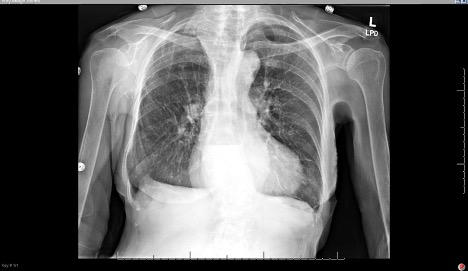
The plain film radiograph of the chest demonstrated a fluid level (yellow arrow) in the distal esophagus with dilation of the esophagus proximal to that point (blue line). Neither of these findings were present on the previous visit.
Abdominal/GastroenterologyVisual EM
Creative Commons images

Case Report: Talar Neck Fracture

Wilson Frasca, MD* and Nhan Do, MD*

DOI: https://doi.org/10.21980/J8FP75 Issue 5:3[mrp_rating_result]
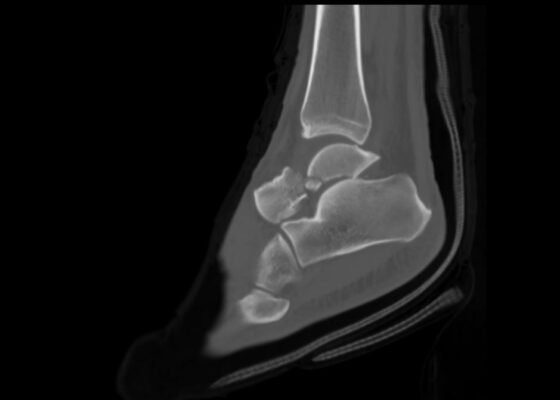
ABSTRACT: This report demonstrates a case of a severe talar neck fracture. Although rare, talar neck fractures have a high potential for morbidity. Typically caused by a high energy injury, this patient’s mechanism of injury was relatively minor, and presentation was not immediately concerning for such a severe fracture. Initial x-rays provided a gross demonstration of the fracture, but a
OrthopedicsVisual EM
Creative Commons images

Case Report of Spontaneous Thyroid Hemorrhage Following LMA Insertion

Gregory Podolej, MD* and Gary Bhagat, MD*

DOI: https://doi.org/10.21980/J8XP8W Issue 5:3[mrp_rating_result]
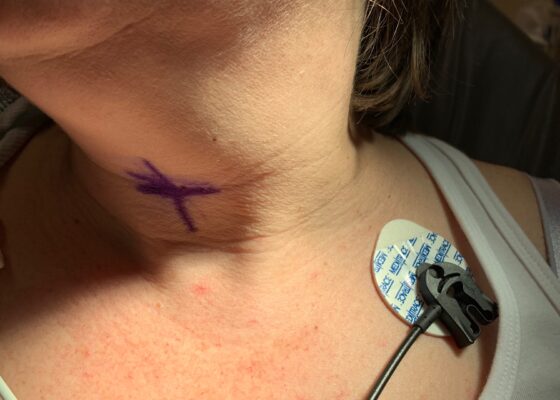
Two photographs of patients neck, both showcasing no obvious erythema, bruising, or swelling which is noteworthy because there is potential for airway compromise but there was nothing visible to indicate that on exam. CTA of neck showing thyroid nodule and potential thyroid hemorrhage (outlined in orange) on the left without evidence of airway compromise at the time of CT scan. Official read by attending radiologist states there is a “heterogeneous left thyroid nodule measuring 3 cm. Findings are suggestive of multinodular goiter with possible acute hemorrhage. Adjacent tract of soft tissue stranding in the anterior left neck with mild adjacent fascial thickening. This could represent small amount of hemorrhage or could be inflammatory.”
EndocrineVisual EM
«‹40›»
Page 40 of 91

JETem is an online, open access, peer-reviewed, journal-repository for EM educators. We are PMC Indexed.

Most Viewed

  • Simple Auricular Hematoma (“Cauliflower Ear”) Task Trainer
  • The Three Breath Method: Teaching Coping Mechanisms for Processing Patient Death
  • Clinical Decision Making: Acute Ischemic Stroke with Large Vessel Occlusion
  • PRIMER: Premedical Introduction to Mentored Emergency Research: Connecting Undergraduate Assistants and Emergency Medicine Residents in a Community Hospital Setting
  • Dangerous Dysrhythmias in the ED: An Interactive EKG Workshop for Emergency Medicine Clerkship Learners

Visit Our Collaborators


Creative Commons Licence
This work is licensed under a Creative Commons Attribution 4.0 International License.

About

Education

Learners should benefit from active learning. JETem accepts submissions of team-based learning, small group learning, simulation, podcasts, lectures, innovations, curricula, question sets, and visualEM.

Scholarship

We believe educators should advance through the scholarship of their educational work. JETem gives educators the opportunity to publish scholarly academic work so that it may be widely distributed, thereby increasing the significance of their results.

Links

  • Home
  • Aim and Scope
  • Current Issue
  • For Reviewers
  • Instructions for Authors
  • Contact Us

Newsletter

Sign up to receive updates from JETem regarding newly published issues and findings.

Copyright Creative Commons Attribution 4.0 International