
JETem
  • Home
  • About
    • Aim and Scope
    • Our Team
    • Editorial Board
    • FAQ
  • Issues
    • Current Issue
    • Ahead of Print
    • Past Issues
  • Visual EM
    • Latest Visual EM
    • Search Visual EM
    • Thumbnail Library
  • For Authors
    • Instructions for Authors
    • Submit to JETem
    • Photo Consent
    • Policies
      • Peer Review Policy
      • Copyright Policy
      • Editorial Policy, Ethics and Responsibilities
      • Conflicts of Interest & Informed Consent
      • Open Access Policy
      • Acceptance Fee
  • For Reviewers
    • Instructions for JETem Reviewers
    • Interested in Being a JETem Reviewer?
  • Topic
    • Abdominal/Gastroenterology
    • Administration
    • Board Review
    • Cardiology/Vascular
    • Certifying Exam Cases
      • Clinical Decision-Making
      • Prioritization
      • Communication
      • Procedure & Ultrasound
    • Clinical Informatics, Telehealth and Technology
    • Dermatology
    • EMS
    • Endocrine
    • ENT
    • Faculty Development
    • Genitourinary
    • Geriatrics
    • Hematology/Oncology
    • Infectious Disease
    • Miscellaneous (stats, etc)
    • Neurology
    • Ob/Gyn
    • Ophthalmology
    • Orthopedics
    • Pediatrics
    • Pharmacology
    • Procedures
    • Psychiatry
    • Renal/Electrolytes/Nutrition
    • Respiratory
    • Social Determinants of Health
    • Toxicology
    • Trauma
    • Ultrasound
    • Urology
    • Wellness
    • Wilderness
  • Modality
    • Certifying Exam Practice Cases
      • Clinical Care Cases
      • Communication & Procedural Cases
      • Old School Oral Board Cases
    • Curricula
    • Innovations
    • Lectures
    • Podcasts
    • Simulation
    • Small Group Learning
    • Team Based Learning (TBL)
    • Visual EM
  • Contact Us

Posts by JETem

Agitated Psychiatric Patient

Brooke M Pabst, MD*, Cynthia Leung, MD, PhD*, Jennifer A Frey, PhD* and Jennifer Yee, DO*

DOI: https://doi.org/10.21980/J85352 Issue 5:4[mrp_rating_result]
At the conclusion of the simulation session, learners will be able to: 1) Obtain a relevant focused history and physical examination on the agitated psychiatric patient. 2) Develop a differential for the agitated psychiatric patient, including primary psychiatric conditions and other organic pathologies. 3) Discuss the management of the agitated psychiatric patient, including the different options available for chemical sedation. 4) Prioritize safety of self and staff when caring for an agitated psychiatric patient.
PsychiatrySimulation

Cardiac Tamponade

Alan Chu MD*  and Jennifer Yee, DO*

DOI: https://doi.org/10.21980/J81D1D Issue 5:4[mrp_rating_result]
By the end of this simulation session, the learner will be able to:  (1) describe a diagnostic differential for dizziness (2) describe the pathophysiology of cardiac tamponade (3) describe the acute management of cardiac tamponade, including fluid bolus and pericardiocentesis (4) describe the electrocardiogram (ECG) findings of pericardial effusion (5) describe the ultrasound findings of cardiac tamponade (6) describe the indications for emergent bedside pericardiocentesis versus medical stabilization and delayed pericardiocentesis for cardiac tamponade (7) describe the procedural steps for pericardiocentesis, and (8) describe your state’s laws regarding disclosure for sentinel events.
Cardiology/VascularSimulation

Owning the Trauma Bay: Teaching Trauma Resuscitation to Emergency Medicine Residents and Nurses through In-situ Simulation

Andrew Bellino, MD*, Alexandra June Gordon, MD^, Al’ai Alvarez, MD*  and Kimberly Schertzer, MD*

DOI: https://doi.org/10.21980/J8WK9X Issue 5:4[mrp_rating_result]
ABSTRACT: Audience: The following two cases were designed to address learning objectives specific to interns, junior residents, and senior residents in emergency medicine, as well as trauma-certified emergency nurses.  Introduction: Traumatic and unintentional injuries account for 5.8 million deaths across the globe each year, with a high proportion of those deaths occurring within the initial hour from the time of
SimulationTrauma

Simulated Mass Casualty Incident Triage Exercise for Training Medical Personnel

Alaina Brinley Rajagopal, MD, PhD*, Nathan Jasperse, BS* and Megan Boysen Osborn, MD, MHPE* 

DOI: https://doi.org/10.21980/J82H1R Issue 5:4[mrp_rating_result]
By the end of this exercise, learners should be able to (1) recite the basic START patient categories (2) discuss the physical exam signs associated with each START category, (3) assign roles to medical providers in a mass casualty scenario, (4) accurately categorize patients into triage categories: green, yellow, red, and black, and (5) manage limited resources when demand exceeds availability.
EMSSmall Group LearningTrauma

Thyroid Storm

Kathryn Ritter, MD* and Carmen Wolfe, MD*

DOI: https://doi.org/10.21980/J8RW71 Issue 5:4[mrp_rating_result]
At the end of this practice oral boards case, the learner will: 1) assess a patient with altered mental status in an oral boards format; 2) review appropriate laboratory testing and diagnostic imaging; 3) identify signs and symptoms of thyroid storm and 4) review appropriate pharmacologic therapies with the proper sequence and timing.
EndocrineCertifying Exam Cases
Creative Commons images

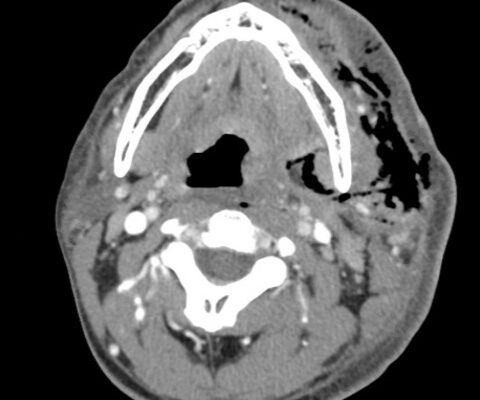
Necrotizing Fasciitis and Mediastinitis after Wisdom Tooth Extraction: A Case Report

Jennifer Edwards, MD*, Ryan Fisher, MD* and Amrita Vempati, MD*

DOI: https://doi.org/10.21980/J8XW7KIssue 5:4[mrp_rating_result]
Computer tomography (CT) imaging of soft tissues of the neck and of the chest/abdomen/pelvis revealed extensive swelling and subcutaneous air (see red arrows) on the left side of the face and neck extending to the left shoulder, as well as parapharyngeal/retropharyngeal spaces and posterior/superior mediastinum.
Infectious DiseaseVisual EM
Creative Commons images

Adult Clavicular Fracture Case Report

Jessica L Sea, PhD*, Nadia Zuabi, MD* and Alisa Wray, MD, MAEd*

DOI: https://doi.org/10.21980/J8FM0TIssue 5:4[mrp_rating_result]
The patient's chest and clavicular radiographs showed a comminuted displaced acute fracture of the right mid-clavicle (green, blue, yellow). The clavicular fracture was also visible on the chest computed tomography (CT). The remainder of his trauma workup was negative for acute findings.
OrthopedicsTraumaVisual EM
DRUJ Elbow Xray, Lateral. Unannotated. JETem 2020

Case Report of Distal Radioulnar Joint and Posterior Elbow Dislocation

Danielle Matonis, MD*, Katelyn Wittel, BS* and Alisa Wray, MD, MAEd*

DOI: https://doi.org/10.21980/J89S6K Issue 5:4[mrp_rating_result]
Radiographs of the left elbow and wrist were obtained. Left elbow radiographs showed simple posterolateral dislocation of the olecranon (red) without fracture of the olecranon (red) or trochlea (blue). Left wrist lateral radiographs demonstrated DRUJ dislocation with dorsal displacement of the distal ulna (green) without fracture or widening of the radioulnar joint (purple). Post-reduction radiographs demonstrated appropriate alignment of the elbow with the trochlea seated in the olecranon and improved alignment of the DRUJ.
OrthopedicsTraumaVisual EM
«‹38›»
Page 38 of 91

JETem is an online, open access, peer-reviewed, journal-repository for EM educators. We are PMC Indexed.

Most Viewed

  • Simple Auricular Hematoma (“Cauliflower Ear”) Task Trainer
  • The Three Breath Method: Teaching Coping Mechanisms for Processing Patient Death
  • Clinical Decision Making: Acute Ischemic Stroke with Large Vessel Occlusion
  • PRIMER: Premedical Introduction to Mentored Emergency Research: Connecting Undergraduate Assistants and Emergency Medicine Residents in a Community Hospital Setting
  • Dangerous Dysrhythmias in the ED: An Interactive EKG Workshop for Emergency Medicine Clerkship Learners

Visit Our Collaborators


Creative Commons Licence
This work is licensed under a Creative Commons Attribution 4.0 International License.

About

Education

Learners should benefit from active learning. JETem accepts submissions of team-based learning, small group learning, simulation, podcasts, lectures, innovations, curricula, question sets, and visualEM.

Scholarship

We believe educators should advance through the scholarship of their educational work. JETem gives educators the opportunity to publish scholarly academic work so that it may be widely distributed, thereby increasing the significance of their results.

Links

  • Home
  • Aim and Scope
  • Current Issue
  • For Reviewers
  • Instructions for Authors
  • Contact Us

Newsletter

Sign up to receive updates from JETem regarding newly published issues and findings.

Copyright Creative Commons Attribution 4.0 International