
Issue 10:3

A Longitudinal, Practical Curriculum for Faculty Development as New Coaches in Graduate Medical Education
DOI: https://doi.org/10.21980/J88M08The aim of this curriculum is to provide a longitudinal, practical, and interactive coach training curriculum for faculty with no prior coaching experience.

Cognitive Errors and Debiasing
DOI: https://doi.org/10.21980/J84W96By the end of this lecture, learners should be able to, 1) Define dual process theory, 2) identify common cognitive biases, 3) recognize high-risk situations for cognitive errors, and 3) discuss debiasing strategies and integrate one strategy into your workflow.

Critical Care Transport: Blunt Polytrauma in Pregnancy
DOI: https://doi.org/10.21980/J81366At the completion of this simulation participants will be able to 1) perform primary and secondary trauma surveys, 2) assess the neurovascular status of a tibia/fibula fracture, 3) appreciate anatomic and physiologic differences in pregnancy, 4) appropriately order analgesia and imaging, 5) recognize and treat hemorrhagic shock, 6) perform an extended focused assessment with sonography in trauma exam (eFAST) in undifferentiated hemorrhage, 7) identify a displaced pelvic fracture and properly apply a pelvic binder, and 8) obtain and interpret fetal heart rate using ultrasound.
Beta-Blocker Toxicity
DOI: https://doi.org/10.21980/J8WD3XBy the end of the session, learners will be able to: 1) manage a patient with hypotension, and bradycardia while maintaining a broad differential, 2) evaluate the causes of hypotension by utilizing ultrasound, 3) review when to initiate vasopressors and first-line agents for beta-blocker toxicity, 4) discuss treatment algorithm for BB toxicity including high-dose insulin and, 5) discuss the risk factors for suicide

A Comprehensive and Modality Diverse Cervical Spine and Back Musculoskeletal Physical Exam Curriculum for Medical Students
DOI: https://doi.org/10.21980/J8RQ0NBy the end of this session, students will be able to: 1) demonstrate how to properly perform a cervical spine and back physical exam, 2) understand the reasoning behind cervical spine and back PE maneuvers, 3) identify the proper technique and equipment to use for the cervical spine and back PE, 4) understand normal and abnormal findings in the cervical spine and back PE, 5) accurately record and report exam findings for the cervical spine and back PE.
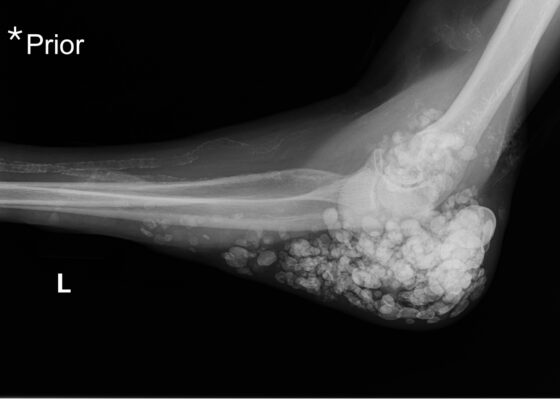

Metastatic Calcinosis Cutis in the Emergency Department: A Case Report
DOI: https://doi.org/10.21980/J87Q00X-ray imaging was obtained of the left elbow and showed soft tissue calcium deposits. Radiology stated, “massive periarticular calcinosis of renal failure obscures fine osseous detail. Several of the largest calcifications have decompressed since the prior exam and may contribute to the drainage observed clinically. Superimposed infection is not excluded.” X-rays with an asterisk are the comparison images from two months previous to the visit. Areas of decompression are highlighted in blue demonstrating that some of the larger calcified nodules are no longer present.
1›
Page 1 of 2