
Visual EM


Supracondylar Fracture
DOI: https://doi.org/10.21980/J8492PHistory of present illness: A 15-year-old male presented to the emergency department with right elbow pain after falling off a skateboard. The patient denied a decrease in strength or sensation but did endorse paresthesias to his hand. On exam, the patient had an obvious deformity of his right elbow with tenderness to palpation and decreased range of motion at the
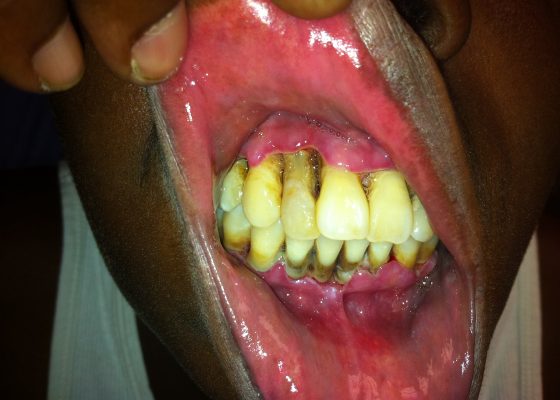
Acute Necrotizing Ulcerative Gingivitis (ANUG)
DOI: https://doi.org/10.21980/J8S88HPhysical examination revealed inflamed gingiva, ulceration, and soft tissue necrosis (Image 1) along with mandibular lymphadenopathy (not shown). Given her symptoms, poor oral care, and her immunocompromised state, she was given a diagnosis of Acute Necrotizing Ulcerative Gingivitis (ANUG) or Vincent’s Angina.

Acute Aortic Dissection Presenting Exclusively as Lower Extremity Paresthesias
DOI: https://doi.org/10.21980/J8NK57Chest x-ray and CT angiogram was performed to evaluate his thoracic and abdominal vasculature. Chest x-ray did not show any significant widening of the mediastinum. The CT angiogram demonstrated an intimal tear along the aortic arch separating a true and false aortic lumen, consistent with an acute aortic dissection. The true lumen (highlighted in blue in images 1-5) can be identified by continuity with an undissected part of the aorta. While the false lumen (highlighted in red in images 1-5) can be identified by its crescent shape and larger cross-sectional area.

Galeazzi Fracture
DOI: https://doi.org/10.21980/J8HS39The X-ray showed an acute comminuted fracture of the distal diaphysis of the radius with disruption of the distal radioulnar joint, consistent with a Galeazzi fracture. The patient was then splinted and taken for operative reduction and internal fixation the following day.
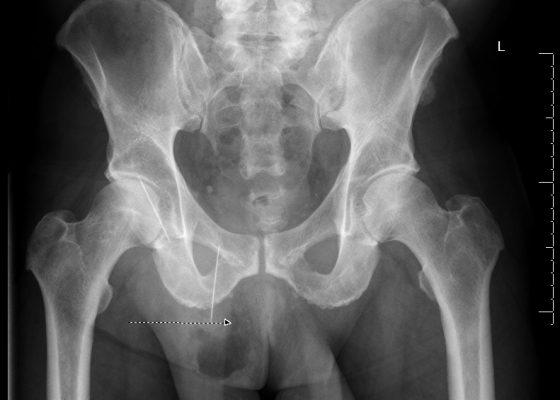
Bowel Perforation complicating an incarcerated inguinal hernia
DOI: https://doi.org/10.21980/J8D30BThe AP and lateral pelvis x-rays revealed two sewing needles, 60 mm in length, within the soft tissue over the anterior right lower hemipelvis. In addition, the AP view showed emphysema involving the right hemiscrotum (arrow), concerning for perforated bowel.

Infectious Mononucleosis: Pharyngitis and Morbilliform Rash
DOI: https://doi.org/10.21980/J88C7HHer physical exam was significant for bilateral tonsillar exudates, cervical lymphadenopathy, and a morbilliform rash that included the palms (Figure 1-4). Laboratory testing was significant for white blood cell (WBC) count of 16.5 thous/mcl with an elevation in absolute lymphocytes of > 10 thous/mcl. The monospot and EBV (Epstein-Barr virus) panel were positive.
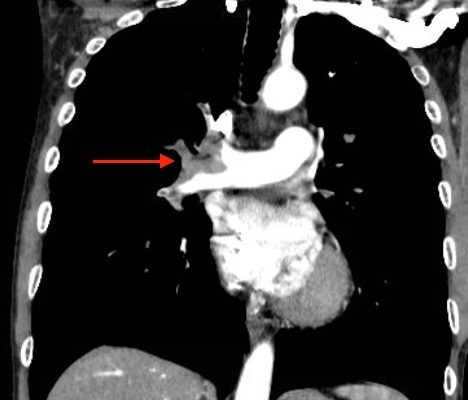
Acute, massive pulmonary embolism with right heart strain and hypoxia requiring emergent tissue plasminogen activator (TPA) infusion
DOI: https://doi.org/10.21980/J84K5KCT angiogram showed multiple large acute pulmonary emboli, most significantly in the distal right main pulmonary artery (image 1 and 2). Additional pulmonary emboli were noted in the bilateral lobar, segmental, and subsegmental levels of all lobes. There was a peripheral, wedge-shaped consolidation surrounded by groundglass changes in the posterolateral basal right lower lobe that was consistent with a small lung infarction (image 3).
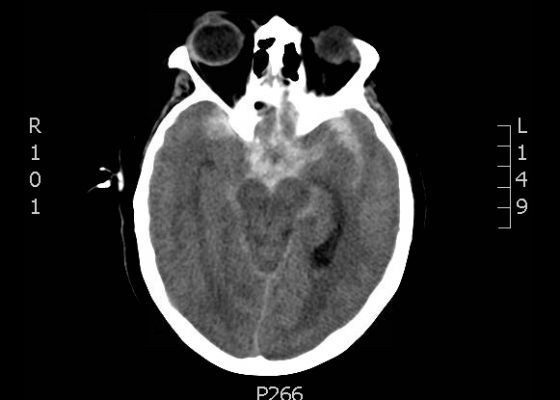
Presentation of Significant Subarachnoid Hemorrhage without Loss of Consciousness
DOI: https://doi.org/10.21980/J80W29A non-contrast head CT demonstrated extensive subarachnoid hemorrhage occupying both cerebral convexities, the anterior interhemispheric fissure, the sylvian fissures, and the basal cisterns. Later CTA would show an 8 mm by 7 mm by 8mm MCA aneurysm near the M1/M2 junction and two pericallosal artery aneurysms, 7 by 6 mm and 8 by 5 mm respectively.