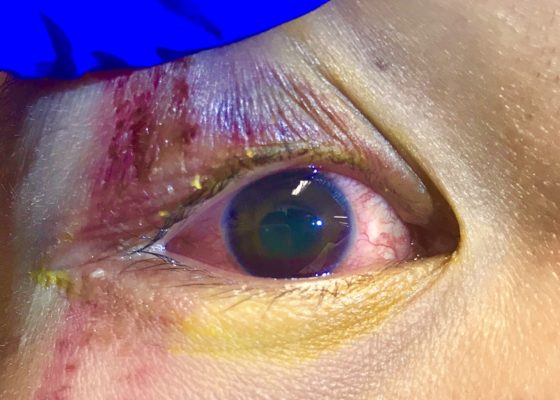
Ophthalmology


Point-of-care Ultrasound Detection of Endophthalmitis
DOI: https://doi.org/10.21980/J8G634The patient’s ultrasound revealed an attached retina and a complex network of hyperechoic, mobile, membranous material in the posterior segment.

Corneal Sparing Conjunctival Abrasion
DOI: https://doi.org/10.21980/J8KG93Physical exam was significant for multiple broken teeth, multiple minor abrasions on the face, and fine shards of shattered glass on his face and hair. His right eye had conjunctival injection, with no signs of subconjunctival hemorrhage or ocular penetration. Vision, extraocular movement, and pupillary exam were grossly intact. Fluorescein staining with slit lamp exam with cobalt blue filter examination of the right eye revealed superficial bulbar conjunctival uptake of fluorescein dye staining an area of the conjunctiva inferior to the limbus 5 mm vertical by 2 mm horizontal (estimation by photo provided). No foreign bodies were visualized in the inferior fornix. These findings were consistent with superficial conjunctival abrasion. The exam noted sparing of the corneal epithelium.

Globe Rupture
DOI: https://doi.org/10.21980/J8N91ZThe patient’s computed tomography (CT) head demonstrated a deformed left globe, concerning for ruptured globe. The patient had hyperdense material in the posterior segment (see green arrow), consistent with vitreous hemorrhage. CT findings that are consistent with globe rupture may include a collapsed globe, intraocular air, or foreign bodies.

The Halloween Lateral Canthotomy Model
DOI: https://doi.org/10.21980/J8GW2NThe purpose of the model is to teach residents and students how to perform lateral canthotomy and to achieve competency in their skills.
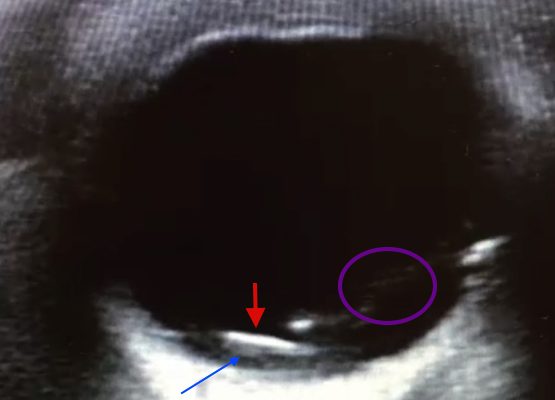
Intraocular Foreign Body: Ultrasound and CT Findings
DOI: https://doi.org/10.21980/J8JS3MPoint of care ultrasound revealed a mobile, radiolucent hyperechoic structure (see red arrow) with reverberation within the posterior chamber (see blue arrow), likely a metallic foreign body. Linear areas of mobile hyperechoic material revealed possible vitreous hemorrhage (see purple circular area). Orbital non-contrast CT confirmed a 3 mm metallic focus within the dependent portion of the left globe, lodged in the posterior sclera, with some vitreous hemorrhage but no evidence of globe rupture. Ophthalmology was consulted and the patient was taken to surgery later that night.

The Acute Red Eye
DOI: https://doi.org/10.21980/J8BC74By the end of this educational session, the learner will: 1) list 10 major causes for an acute red eye; 2) describe historical features that help distinguish between benign and serious causes of the acute red eye; 3) describe physical examination features that help distinguish between benign and serious causes of the acute red eye; and 4) use historical and physical examination features to distinguish between the 10 different causes of the acute red eye.