
Posts by JETem
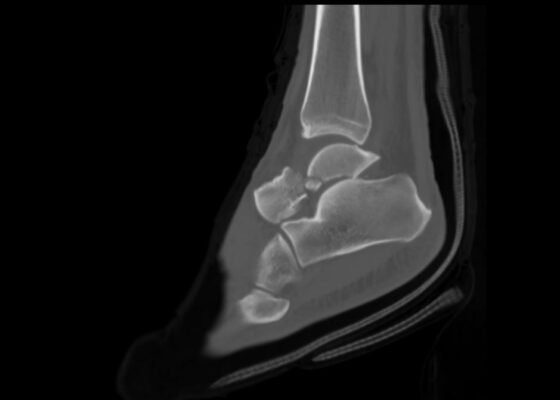

Case Report: Talar Neck Fracture
DOI: https://doi.org/10.21980/J8FP75ABSTRACT: This report demonstrates a case of a severe talar neck fracture. Although rare, talar neck fractures have a high potential for morbidity. Typically caused by a high energy injury, this patient’s mechanism of injury was relatively minor, and presentation was not immediately concerning for such a severe fracture. Initial x-rays provided a gross demonstration of the fracture, but a
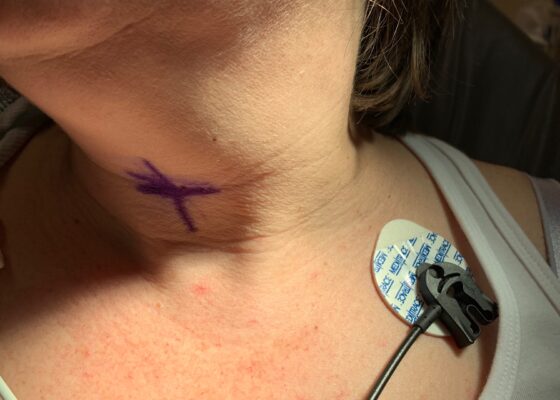
Case Report of Spontaneous Thyroid Hemorrhage Following LMA Insertion
DOI: https://doi.org/10.21980/J8XP8WTwo photographs of patients neck, both showcasing no obvious erythema, bruising, or swelling which is noteworthy because there is potential for airway compromise but there was nothing visible to indicate that on exam.
CTA of neck showing thyroid nodule and potential thyroid hemorrhage (outlined in orange) on the left without evidence of airway compromise at the time of CT scan. Official read by attending radiologist states there is a “heterogeneous left thyroid nodule measuring 3 cm. Findings are suggestive of multinodular goiter with possible acute hemorrhage. Adjacent tract of soft tissue stranding in the anterior left neck with mild adjacent fascial thickening. This could represent small amount of hemorrhage or could be inflammatory.”

Caught on CT! The Case of the Hemodynamically Stable Ruptured Abdominal Aortic Aneurysm
DOI: https://doi.org/10.21980/J8B07BThe associated images demonstrate the transverse, sagittal, and coronal views of a 6.8 cm infrarenal ruptured AAA continuous with a 4 cm right common iliac aneurysm (transverse, sagittal and coronal). Active hemorrhage was seen contained within the aortic wall, and retroperitoneal bleeding can be appreciated with asymmetric enlargement of the left psoas muscle (coronal - red arrow).1 Plaque and calcifications with a residual opacified true lumen is also present (transverse – red star, sagittal – red arrow). Known as the tangential calcium sign, this is a common radiologic finding of AAAs.2
Post-Coital Sudden Cardiac Arrest Due to Non-Traumatic Subarachnoid Hemorrhage—A Case Report
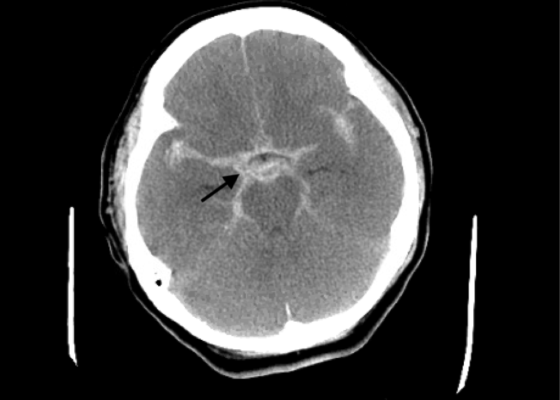
DOI: https://doi.org/10.21980/J8663NThe electrocardiogram demonstrated sinus tachycardia with ST segment elevation in lead aVR (black arrows) and diffuse ST depressions concerning for possible ST elevation myocardial infarction (STEMI). Given the events reported and the patient’s neurologic exam without sedation, non-contrast CT of the head was ordered; imaging showed evidence of a large subarachnoid hemorrhage, mostly at the level of the Circle of Willis (black arrow) concerning for an aneurysmal bleed as well as mild generalized white matter density suggestive of cerebral edema.

A Case Report of Epidural Hematoma After Traumatic Brain Injury
DOI: https://doi.org/10.21980/J8R059Non-contrast CT head demonstrated a right sided EDH (red arrow) with overlying scalp hematoma, left-sided subdural hematoma (blue arrow), and bilateral subarachnoid hemorrhages. No skull fractures were noted.

A Case Report on Miliary Tuberculosis in Acute Immune Reconstitution Inflammatory Syndrome
DOI: https://doi.org/10.21980/J81H02A portable single-view radiograph of the chest was obtained upon the patient’s arrival to the ED resuscitation bay that showed diffuse reticulonodular airspace opacities (red arrows) seen throughout the bilateral lungs, concerning for disseminated pulmonary tuberculosis. Subsequently, a computed tomography (CT) angiography of the chest was obtained which again demonstrates this diffuse reticulonodular airspace opacity pattern (red arrows).

Family Game Show-style Didactic for Teaching Nervous System Disorders during Emergency Medicine Training
DOI: https://doi.org/10.21980/J8D357By the end of this didactic exercise the learner will: 1) name 13 important neurologic conditions related to emergency medicine: TPA (tissue plasminogen activator) contraindications/TPA eligibility, optic neuritis, botulism, giant cell (temporal) arteritis, viral encephalitis, neurocysticercosis, rabies, myasthenia gravis, neurosyphilis, status epilepticus, Bell’s palsy, dementia vs. delirium, acute inflammatory demyelinating polyneuropathy (Guillain-Barré); 2) recognize five pattern words associated with each neurologic condition; 3) understand exam findings, diagnostic tests, and/or treatments for 13 important neurologic conditions.
A Just-in-Time Video Primer on Pneumothorax Pathophysiology and Early Management
DOI: https://doi.org/10.21980/J8891JBy the end of this module, participants should be able to: 1) review the normal physiology of the pleural space; 2) discuss the pathophysiology of pneumothorax; 3) describe the clinical presentation of pneumothorax; 4) identify pneumothorax on a chest radiograph; and 5) review treatment options for pneumothorax.