A Multimodal Approach to Lateral Canthotomy and Cantholysis Training for Emergency Medicine Trainees: A Simulation Training Package
Correspondence should be addressed to Haris Shoaib, MSc, PhD at hshoaib786@gmail.com
DOI: https://doi.org/10.5070/M5.52351
ABSTRACT:
Audience: This simulation is intended for emergency medicine residents.
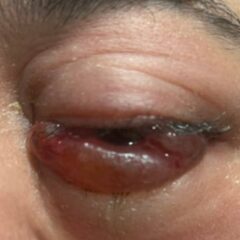
Background: Lateral canthotomy and cantholysis (LCC) is a sight-saving procedure for orbital compartment syndrome (OCS).1 Due to the rarity of OCS, emergency-medicine trainees often have limited exposure and low procedural confidence. In a questionnaire we found that trainees have low confidence levels in performing the procedure attributed to the low incidence of OCS and the scarcity of training opportunities. Existing literature describes LCC task trainers with creation of simulation models, but few provide a reproducible multimodal package adaptable for multiple training centres.2,3 Our innovation combines presentation, instructional video, gamified quiz, and hands-on practicer with low fidelity models. Unlike previous studies referencing the use of pre-made or cadaveric-based models, this design offers detailed guidance on model assembly using commonly available and low-cost materials.2,3 We designed and tested a multimodal training approach to optimize trainee confidence and competence in recognizing OSC and performing the LCC procedure. This aligns with recent calls in medical education for innovative, cost-effective simulation that maintains clear guidance and instructions while overcoming financial and/or logistical barriers.4,5
Educational Objectives: By the end of this session, learners should be able to: 1) recognize the clinical features of OCS, 2) describe the indications and steps of performing LCC, 3) perform a lateral canthotomy and cantholysis procedure on a low-fidelity model, and 4) demonstrate improved confidence in recognizing and managing OCS.
Educational Methods: The training uses a multimodal structure involving the following resources: 1) Instructor-led presentation on OCS and LCC with a step-by-step guide (Appendix A), 2) gamified quiz (Appendix B), 3) a procedural demonstration video, 4) a procedural handout containing a step-by-step guide (Appendix C), 5) a low-fidelity model of the orbit constructed from inexpensive materials, and 6) hands-on procedural practice with trainer feedback.
Research Methods: Trainees’ confidence and perceived competence in performing the procedure were assessed using a 10-point Likert scale before and after the training, in addition to collection of qualitative feedback via free-text comments. Trainees also rated all educational components of the course using a 10-point Likert scale. Statistical significance was calculated using paired t-tests.
Results: A total of thirty-four emergency medicine trainees participated in this multi-national training simulation package across three centers within the UK, completing pre- and post-intervention feedback. We observed a significant improvement in participants’ self-assessed confidence levels when comparing theoretical knowledge (5.0 ± 2.5 to 8.7 ± 1.7; p < 0.0001) and procedural competence (4.1 ± 2.8 to 8.9 ± 1.5; p < 0.0001). All educational components of the training package were rated highly, with mean scores ranging between 8.7 and 10 (measured on a 10-point Likert scale). All trainees involved supported the idea of annual delivery of the training package to emergency medicine trainees. Qualitative feedback further supported the value of practical simulation.
Discussion: Given the severe clinical consequences of OCS, there is a need for diagnostic and procedural competence. This training package demonstrated significant improvement in trainees’ confidence and competence for a rare but critical emergency department procedure. The low-fidelity model and simulation package is reproducible, cost-effective, and scalable across training centres.
Topics: Simulation, emergency medicine, orbital compartment syndrome, lateral canthotomy, cantholysis, procedural skills, low-fidelity model.