
JETem
  • Home
  • About
    • Aim and Scope
    • Our Team
    • Editorial Board
    • FAQ
  • Issues
    • Current Issue
    • Ahead of Print
    • Past Issues
  • Visual EM
    • Latest Visual EM
    • Search Visual EM
    • Thumbnail Library
  • For Authors
    • Instructions for Authors
    • Submit to JETem
    • Photo Consent
    • Policies
      • Peer Review Policy
      • Copyright Policy
      • Editorial Policy, Ethics and Responsibilities
      • Conflicts of Interest & Informed Consent
      • Open Access Policy
      • Acceptance Fee
  • For Reviewers
    • Instructions for JETem Reviewers
    • Interested in Being a JETem Reviewer?
  • Topic
    • Abdominal/Gastroenterology
    • Administration
    • Board Review
    • Cardiology/Vascular
    • Certifying Exam Cases
      • Clinical Decision-Making
      • Prioritization
      • Communication
      • Procedure & Ultrasound
    • Clinical Informatics, Telehealth and Technology
    • Dermatology
    • EMS
    • Endocrine
    • ENT
    • Faculty Development
    • Genitourinary
    • Geriatrics
    • Hematology/Oncology
    • Infectious Disease
    • Miscellaneous (stats, etc)
    • Neurology
    • Ob/Gyn
    • Ophthalmology
    • Orthopedics
    • Pediatrics
    • Pharmacology
    • Procedures
    • Psychiatry
    • Renal/Electrolytes/Nutrition
    • Respiratory
    • Social Determinants of Health
    • Toxicology
    • Trauma
    • Ultrasound
    • Urology
    • Wellness
    • Wilderness
  • Modality
    • Certifying Exam Practice Cases
      • Clinical Care Cases
      • Communication & Procedural Cases
      • Old School Oral Board Cases
    • Curricula
    • Innovations
    • Lectures
    • Podcasts
    • Simulation
    • Small Group Learning
    • Team Based Learning (TBL)
    • Visual EM
  • Contact Us

Trauma

Creative Commons images

Pneumomediastinum After Cervical Stab Wound

Chad Correa, BS* and Emily Ma, MD^

DOI: https://doi.org/10.21980/J87P79 Issue 3:1[mrp_rating_result]
Anteroposterior (AP) chest X-ray showed subcutaneous emphysema of the neck, surrounding the trachea (red arrows), right side greater than left, and a streak of gas adjacent to the aortic arch (white arrow). Computed tomography angiogram (CTA) of the neck showed air outside of the trachea, positive for pneumomediastinum (blue arrows). 
TraumaRespiratoryVisual EM

Laceration Repair for Emergency Physicians

Alisa Wray, MD* and Shannon Toohey, MD, MAEd*

DOI: https://doi.org/10.21980/J8TP7K Issue 2:4[mrp_rating_result]
By the end of this educational session, the learner will: 1) understand indications and contraindications for suture repair of lacerations, 2) compare when various types of wound repair are appropriate: such as sutures, staples, tissue adhesive and tissue tape, as well as what size of suture material is appropriate depending on the location of the laceration on the body, 3) list the appropriate types and sizes of suture for various locations and types of lacerations, 4) understand the definitions of the three types of wound closure (primary, secondary and delayed primary) and when they are appropriate, 5) understand the basics of local anesthetic including which anesthetic to use and the maximum dose for each, 6) understand when sutures should be removed, 7) list various suturing techniques and their indications, and 8) improve comfort levels in performing various suturing techniques including: simple interrupted, horizontal mattress, vertical mattress, and corner repair. If desired, instructors can individually assess the learner sutures using the attached complete validated suture checklist to show proficiency in these techniques. Please see the brief wrap-up section at the end of the manuscript.
ProceduresTeam Based Learning (TBL)Trauma
Creative Commons images

Open Book Pelvic Fracture

Samer Assaf, MD* and Ghadi Ghanem*

DOI: https://doi.org/10.21980/J8CK7H Issue 2:3[mrp_rating_result]
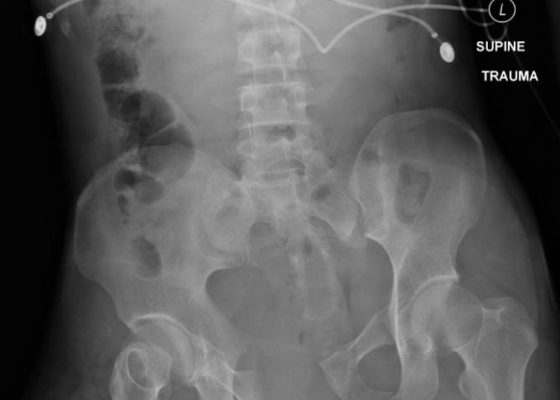
The initial radiograph of the pelvis shows an open-book pelvic fracture deformity with pubic symphyseal dislocation, left greater than right sacroiliac diastases, and fractures of the left superior and inferior pubic rami, right inferior pubic ramus, and left acetabular anterior column. The additional inlet and outlet radiographs of the pelvis after application of a pelvic binder also show an open book fracture with significant improvement of the widened pubic symphysis.
OrthopedicsTraumaVisual EM
Creative Commons images

Realistic Chest Tube Simulator Using Pork Belly with Skin

Donald Patrick Mebust, MD* and Jonathan Kei, MD*

DOI: https://doi.org/10.21980/J8R03J Issue 2:3[mrp_rating_result]
By the end of this instructional session learners will be able to: 1) discuss the indications, contraindications, and complications associated with chest tube thoracostomy, 2) competently perform chest tube insertion on a simulator, and 3) properly secure chest tube.
ProceduresInnovationsRespiratoryTrauma
Creative Commons images

Open Pneumothorax

Bart Paull, MD*, Zachary Jarou, MD* and David Richards, MD*

DOI: https://doi.org/10.21980/J88036 Issue 2:3[mrp_rating_result]
A large chest wound was clinically obvious. A chest radiograph performed after intubation showed subcutaneous emphysema, an anterior rib fracture, and a right-sided pneumothorax. He was then taken to the operating room for further management.
TraumaRespiratoryVisual EM
Creative Commons images

K-9 Police Dog Bite

Vy Han, MD* and John R. Marshall, MD*

DOI: https://doi.org/10.21980/J8B88GIssue 2:1[mrp_rating_result]
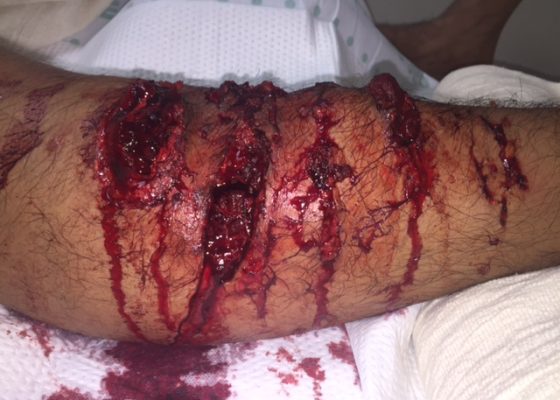
The photograph is of the anterior compartment of the right lower leg demonstrating multiple deep lacerations with exposed and torn muscle. X-ray showed no foreign body.
TraumaVisual EM
Creative Commons images

Lunate Dislocation

Jonathan Peña, MD*

DOI: https://doi.org/10.21980/J86K56Issue 2:1[mrp_rating_result]
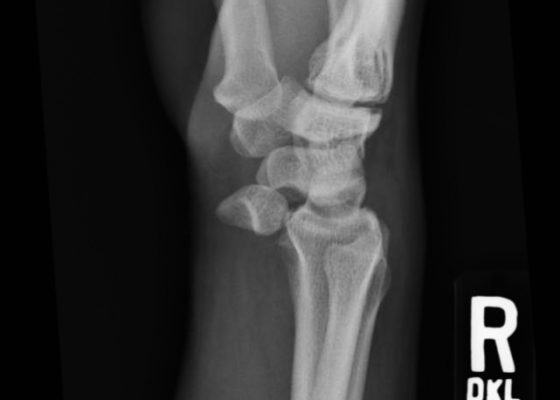
Plain film of the right wrist showed the classic “spilled teacup” consistent with a lunate dislocation. There is a loss of the normal articulation between the distal radius and lunate.
OrthopedicsTraumaVisual EM
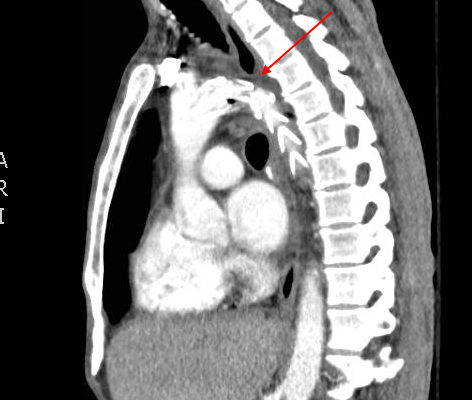
Traumatic Aortic Injury. Sag CT 1, Annotated. JETem 2016

Traumatic Aortic Injury

Brianna Miner*, Megan Boysen Osborn, MD, MHPE* and Shannon Toohey, MD, MA*

DOI: https://doi.org/10.21980/J85P4JIssue 1:2[mrp_rating_result]
The initial chest x-ray showed an abnormal superior mediastinal contour (blue line), suggestive of a possible aortic injury. The CT angiogram showed extensive circumferential irregularity and outpouching of the distal aortic arch (red arrows) compatible with aortic transection. In addition, there was a circumferential intramural hematoma, which extended through the descending aorta to the proximal infrarenal abdominal aorta (green arrow). There was also an extensive surrounding mediastinal hematoma extending around the descending aorta and supraaortic branches (purple arrows).
TraumaCardiology/VascularVisual EM
«‹5›
Page 5 of 6

JETem is an online, open access, peer-reviewed, journal-repository for EM educators. We are PMC Indexed.

Most Viewed

  • Simple Auricular Hematoma (“Cauliflower Ear”) Task Trainer
  • The Three Breath Method: Teaching Coping Mechanisms for Processing Patient Death
  • Clinical Decision Making: Acute Ischemic Stroke with Large Vessel Occlusion
  • PRIMER: Premedical Introduction to Mentored Emergency Research: Connecting Undergraduate Assistants and Emergency Medicine Residents in a Community Hospital Setting
  • Dangerous Dysrhythmias in the ED: An Interactive EKG Workshop for Emergency Medicine Clerkship Learners

Visit Our Collaborators


Creative Commons Licence
This work is licensed under a Creative Commons Attribution 4.0 International License.

About

Education

Learners should benefit from active learning. JETem accepts submissions of team-based learning, small group learning, simulation, podcasts, lectures, innovations, curricula, question sets, and visualEM.

Scholarship

We believe educators should advance through the scholarship of their educational work. JETem gives educators the opportunity to publish scholarly academic work so that it may be widely distributed, thereby increasing the significance of their results.

Links

  • Home
  • Aim and Scope
  • Current Issue
  • For Reviewers
  • Instructions for Authors
  • Contact Us

Newsletter

Sign up to receive updates from JETem regarding newly published issues and findings.

Copyright Creative Commons Attribution 4.0 International