
Posts by JETem
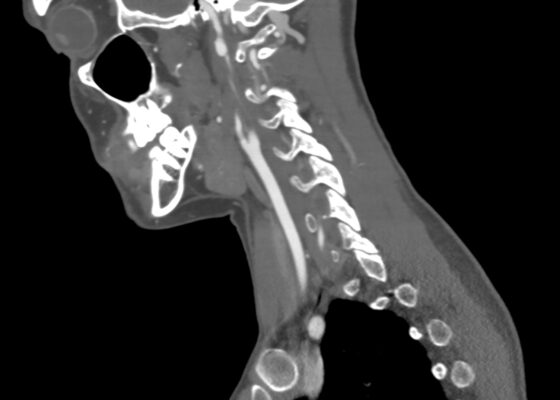

Blunt Cerebrovascular Injury: A Visual Case Report with Computed Tomography Angiography Findings Revealing Carotid and Vertebral Artery Dissection
DOI: https://doi.org/10.5070/M5.52229Computed tomography angiography of the neck showed worsening right ICA dissection with increased size of the pseudoaneurysm to 9 mm and worsening stenosis to greater than 70%. Computed tomography angiography of the neck also showed a new dissection of the V2 segment of the right vertebral artery with a 3 mm pseudoaneurysm and greater than 50% stenosis.
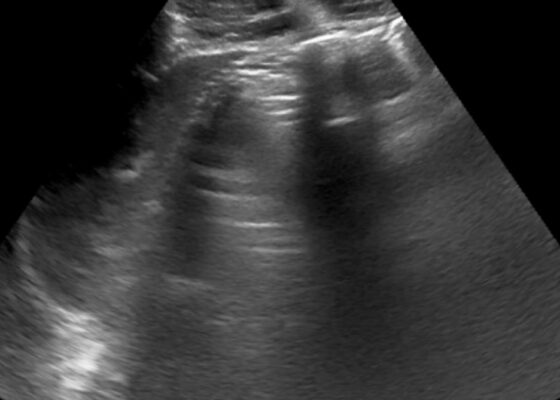
A-Lines below the Diaphragm – A Case Report of Occult Pneumoperitoneum
DOI: https://doi.org/10.5070/M5.52389The RUQ POCUS focusing over the left liver lobe shows multiple enhanced peritoneal stripe signs (red arrows) and several reverberation artifacts (yellow arrows). The second RUQ POCUS of the right lobe of the liver and the gallbladder shows reverberation artifacts (yellow arrow) and ring-down artifacts (blue arrow). The chest X-ray shows free air under the right diaphragm (orange arrow), which indicates pneumoperitoneum. The CT abdomen and pelvis show pneumoperitoneum near the porta hepatis (green arrow).
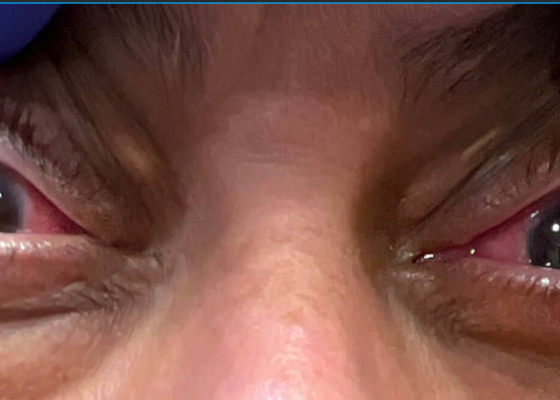
A Case Report of Granulomatosis with Polyangiitis Presenting with Chronic Conjunctivitis
DOI: https://doi.org/10.5070/M5.52284Notable bilateral proptosis with conjunctival injection and limbic sparing (clear conjunctiva surrounding the margin of the cornea, shown by the arrow in the image of the eyes) was present.
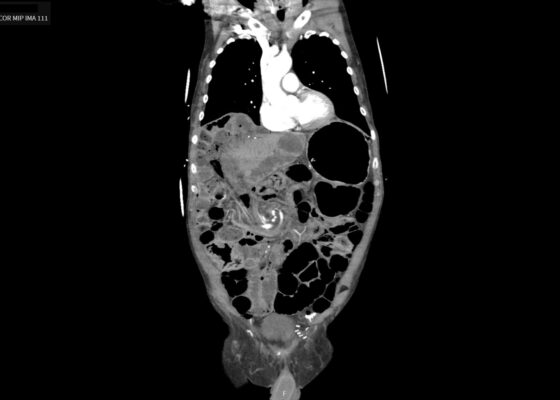
Caught in the Whirl: A Case Report of Midgut Volvulus in an Elderly Patient
DOI: https://doi.org/10.5070/M5.52361An upright chest x-ray demonstrated air underneath the diaphragm bilaterally (yellow arrows), enhancing the diaphragmatic contour. A computed tomography angiography (CTA) abdomen and pelvis showed scattered pneumoperitoneum (red arrow), dilated segments of small bowel (orange arrow), and clockwise swirling of the mesentery (blue arrow), concerning for mesenteric volvulus with possible bowel perforation.

Escape Intern Orientation! — A Capstone and Team Building Activity for New EM Interns
DOI: https://doi.org/10.5070/M5.52158By the end of this small group exercise, learners will be able to: 1) identify first, second, and third-degree heart block on a 12-lead ECG; 2) recognize STEMI pattern on a 12-lead ECG; 3) categorize appropriate images that make up an EFAST exam for a trauma patient; 4) recall the proper management of a tension pneumothorax; 5) identify an organized approach to emergency department rapid-sequence intubation (RSI); 6) recognize acute otitis media (AOM); 7) locate the appropriate antibiotic and pediatric dose to treat acute otitis media via the Harriet Lane Handbook; 8) demonstrate how to apply evidence-based guidelines to a clinical case of neonatal pediatric fever; 9) recall common clinical findings of basilar skull fracture; 10) identify important concepts in the management of stroke syndromes; 11) recognize vital sign abnormalities that could indicate sepsis; and 12) review important concepts related to the management of septic patients.
Enhancing Relationship-Centered Communication and Feedback in Emergency Medicine Through Applied Improvisation (EM-PROV)
DOI: https://doi.org/10.5070/M5.52345By the end of this session, learners will be able to improve relationship-centered communication (RCC): 1) define “yes, and” and its role in RCC, and 2) demonstrate active listening and responsiveness using improvisational techniques such as “yes, and,” gift-giving, establishing scene, and callbacks. They will also be able to improve learner feedback: 1) define “yes, and” and its role in learner feedback, 2) review three evidence-based feedback models through a “yes, and” lens, and 3) practice improv techniques and deliver structured feedback in real-time peer scenarios using improvisational techniques such as “yes, and,” gift-giving, establishing scenes, and callbacks.

Postpartum Complications Modified TBL
DOI: https://doi.org/10.5070/M5.52264By the end of this session learners will be able to: 1) identify the timeline in which postpartum complications typically occur, 2) discuss the specific differential diagnoses common in the postpartum period, 3) recognize risk factors for endometritis and mastitis, 4) recognize the presentation of postpartum cardiomyopathy and pituitary infarction, 5) formulate a treatment plan for postpartum endometritis including appropriate antibiotics and disposition, 6) formulate a treatment plan for mastitis including appropriate antibiotics and disposition, 7) formulate an appropriate assessment plan for pituitary infarction with appropriate disposition, and 8) formulate an appropriate treatment plan and disposition for postpartum cardiomyopathy.

Midline Catheters: A Novel Curriculum for Emergency Medicine Residents
DOI: https://doi.org/10.5070/M5.52243The purpose of this curriculum is to teach emergency medicine residents how to place and utilize midline catheters.